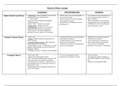
Theories of Motor Learning
Assumptions Clinical Implications Limitations
Adams Closed Loop Theory - Closed Loop - Sensory feedback is used for the - Perform same exact mvmt repeatedly to - Can’t explain accurate performance of
ongoing production of skilled mvmt one accurate end point open loop mvmts made in absence of
- Slow mvmts - Increase practice Increase learning sensory feedback
- Relies on sensory feedback (Sherrington) - Errors produced during - May be impossible to store separate
- Blocked Practice learningincrease strength of incorrect perceptual trace for every single mvmt
- Errors = Bad! Needs to be accurate! perceptual trace - Variability of mvmt may improve
- Memory trace - initiation of mvmt motor performance of task
- Perceptual trace - built up over a period of
practice & is the reference of correctness.
- Improvements = Increased capability of
performer to use the reference in closed loop
Schmidt’s Schema Theory - Open Loop - Optimal learning task practiced under - Differences b/w children & adults w/
- Schema - Abstract memory representation for many different conditions variable forms of practice.
events RULE - Positive benefits for error production - Lack of specificity of interaction w/
- Generalized Motor Program - Rules that allow (learn from own mistakes) other systems during motor learning.
for the generation of novel mvmts - Schema has rules for all stored elements, - Can’t account for immediate
- Rapid, ballistic mvmts = recall memory w/ motor not just correct elements acquisition of new types of coordination.
programs and parameters to carry out mvmt w/o
peripheral feedback
- Variability of practice Improve motor learning
Ecological Theory - Karl Newel, 1991 - Pt. learns to distinguish relevant - Very new theory
- Systems & Ecological MC theories perceptual cues important to action. - Not applied to specific examples of
- ML = increases coordination b/w perception and motor skill acquisition in any systematic
action thru task & environmental constraints. way.
- Perceptual-motor workspace - identifies mvmts - Stages of Learning Motor Skills
and perceptual cues (reg. cond.) most relevant to
performance of task
- Optimal task-relevant mapping of perception &
action NO Rules!
Assumptions Clinical Implications Limitations
Adams Closed Loop Theory - Closed Loop - Sensory feedback is used for the - Perform same exact mvmt repeatedly to - Can’t explain accurate performance of
ongoing production of skilled mvmt one accurate end point open loop mvmts made in absence of
- Slow mvmts - Increase practice Increase learning sensory feedback
- Relies on sensory feedback (Sherrington) - Errors produced during - May be impossible to store separate
- Blocked Practice learningincrease strength of incorrect perceptual trace for every single mvmt
- Errors = Bad! Needs to be accurate! perceptual trace - Variability of mvmt may improve
- Memory trace - initiation of mvmt motor performance of task
- Perceptual trace - built up over a period of
practice & is the reference of correctness.
- Improvements = Increased capability of
performer to use the reference in closed loop
Schmidt’s Schema Theory - Open Loop - Optimal learning task practiced under - Differences b/w children & adults w/
- Schema - Abstract memory representation for many different conditions variable forms of practice.
events RULE - Positive benefits for error production - Lack of specificity of interaction w/
- Generalized Motor Program - Rules that allow (learn from own mistakes) other systems during motor learning.
for the generation of novel mvmts - Schema has rules for all stored elements, - Can’t account for immediate
- Rapid, ballistic mvmts = recall memory w/ motor not just correct elements acquisition of new types of coordination.
programs and parameters to carry out mvmt w/o
peripheral feedback
- Variability of practice Improve motor learning
Ecological Theory - Karl Newel, 1991 - Pt. learns to distinguish relevant - Very new theory
- Systems & Ecological MC theories perceptual cues important to action. - Not applied to specific examples of
- ML = increases coordination b/w perception and motor skill acquisition in any systematic
action thru task & environmental constraints. way.
- Perceptual-motor workspace - identifies mvmts - Stages of Learning Motor Skills
and perceptual cues (reg. cond.) most relevant to
performance of task
- Optimal task-relevant mapping of perception &
action NO Rules!