Lecture Notes
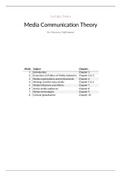
Media Communication Theory
By Ninarosa Juffermans
Week Subject Chapters
1. Introduction Chapter 1
2. Economics & Politics of Media Industries Chapter 2 & 3
3. Media organisations and professionals Chapter 4
4. Ideology and the mass media Chapter 5 & 6
5. Media influences and effects Chapter 7
6. Active media audiences Chapter 8
7. Media technologies Chapter 9
8. Cultural globalisation Chapter 10
, Lecture 1: introduction
12 t h of September 2018
Course Introduction ................................................................................................................................................ 1
Basic Theory: Sociology of Media ........................................................................................................................ 1
Media and Communication Theories .............................................................................................................. 1
Exercises ................................................................................................................................................................ 2
Structure & Agency (theoretical concepts).................................................................................................... 2
A Short History of the Media ................................................................................................................................ 3
Course Introduction
• Lecture slides aren’t a summary but you can print it before the class to make notes next to it
• Bring the “Media & Society” book to the tutorials
• Exam is based on 5th edition although it’s a bit outdated already
• Little pencil à exam material
• Example à illustrates development, concepts, and theories. You don’t need to know it, just
try to understand the theory
• The focus of the exam is on theories and concepts. Covers general trends + theories in the
book
Basic Theory: Sociology of Media
Media and Communication Theories
Why do we need/study media and communication theories?
1. We have a fascination with media
2. It’s just fun to understand the media industry as we use media very often
3. There are many popular assumptions about media effects: the things we read in the
newspaper or head in a debate. It’s people discussing the effects of media
4. Media are a dominant social institution in society. They have a very central place. They
affect politics and family life. So it’s always useful to understand how media work and how
journalists operate
5. Mass media are a powerful socialising agent
• Theory à systematic explanation … observations … relate to a particular aspect of life
o Makes sense of the reality out there, helps us to understand things and find patterns
o Concepts are key terms in a theory
o Helps us to understand the effect on (parts of our) life
• Socialisation à the process whereby we learn and internalise the values, beliefs, and norms
of our culture and, in doing, develop a sense of self
o We all grew up and were socialised by family and friends. But media are also a
powerful socialising agent. They’re a glue that held societies together; we discuss
things in media together and give us the feeling we share something
o Internalising à you hear something and you make it your own. It becomes part of
how you see reality and society
,Why a sociological perspective?
• We relate media in a wider context
• Social > political > economic > technical (factors)
• Social construction of reality à the process of shaping reality through socail interaction.
While reality exists, we must negotiate the meaning of that reality
o How do we discuss or look at things? Media play an important role in that
o Why do we associate certain things with being male or female?
• A focus on social relationships between institutions/ within institutions/ between
institutions and…
Exercises
Exercise 1: organise a debate on a current affairs programme on the public service broadcaster
• Features:
o Q&A with the audience
o Let them prepare some questions beforehand
o Q&A on Twitter
o Nice fingerfood
• Stage à white and light
• Invited à congressmen, people from the government. So they can see what the candidates
actually have to offer
• Presented by à Twan Huys because he won’t be pushed in the corner. He’s good at asking
questions but won’t be taken over
Other ideas:
• Kind of a game setting with a mixed audience and preselected questions. There will be a
timer so you can see who talks for how long. A fact checker is present
Exercise 2: tell your colleagues how to spot talent
• Must be able to perform all kinds of music – even acapella
• Have a strong personality: do well with change & adapt well. Make sure to not get wild
• Have a background in voluntary work to prove they care about others
Other ideas:
• Look at Soundcloud (amount of views)
In those exercises, are we autonomous or do we follow a structure? We need to follow a certain
structure that sets limits to the decisions.
Structure & Agency (theoretical concepts)
• Agency à intentional and undetermined human action
o Independent action
o Choices based on decisions, actions, and creativity
o Where individualism comes in
• Structure à any recurring pattern of social behaviour
o Constraints
o Influenced choices that are not autonomous
o E.g. patterns, taken for granted way of doing things
• They always work together (happen at the same time) but one can be stronger than another
• Some media types have more room for agency: make it easier for people to give their own
opinion. E.g. in YouTube there’s a lot of agency as people can upload and comment
, Studying the production + contents + influencers + reception of mass media:
1. There’s a tension between structure and agency
2. Structure is partially shaped by agency: people can have agency (make their own creative
decisions) but also make their own structures
3. One can be more shaping than the other: in some occasions there’s more agency, in others
there’s more structures
• A tug of war à sometimes it goes to the agency side and sometimes to the structure.
Spectrum between structural constraints and human agency. 4 ways of influence:
production, contents, reception, contemporary developments
A Short History of the Media
• Movie: the fifth estate. Introduction is a summary of the development of the media, from
ancient techniques to now.
1. Invention of print: often, printing is seen as the beginning of the media. All of a sudden it
became possible to replicate documents which is why it was an important development. It
allowed to challenge existing structures in society as it allowed to reach a large audience
2. Newspaper: late 18th century. It’s a disposable object that appears daily but it’s also more
commercial. Moreover, it caters for a new class of people: people in cities (urban audience).
Goes together with industrialisation and the rise of capitalism. There was more money to
spend. Started to challenge the established power relations in society. It was a part of a
movement towards new movements like freedom of speech
3. Mass communication + mass media: early 20th century. Related to the wider social context
of urbanisation; shows the sociological perspective
a. Large scale: reaching a huge audience
b. One-way flow of content: receiver can’t talk back
c. A known sender and anonymous audience: you know who’s producing but the
audience is just a mass that doesn’t talk back
4. Cinema and film: at the end of 19th century. Used for propaganda (distribute political
messages) and entertainment purposes. Partly a response to the invention of leisure: free
time after work, like doing things in the city. The cinema was one of those things
5. Broadcasting: radio, television. It’s a domestic medium; you’re not going out anymore, you
just watch tv at home. Broadcasting combined different + existing technologies
6. Digitisation: converting a digital signal which brings possibilities. No longer an anonymous
audience: possibilities to talk back. More interaction, a two way flow. Technologies
combine: connecting to the internet using your tv. But media types rarely disappear: people
still listen to vinyl records
Media Communication Theory
By Ninarosa Juffermans
Week Subject Chapters
1. Introduction Chapter 1
2. Economics & Politics of Media Industries Chapter 2 & 3
3. Media organisations and professionals Chapter 4
4. Ideology and the mass media Chapter 5 & 6
5. Media influences and effects Chapter 7
6. Active media audiences Chapter 8
7. Media technologies Chapter 9
8. Cultural globalisation Chapter 10
, Lecture 1: introduction
12 t h of September 2018
Course Introduction ................................................................................................................................................ 1
Basic Theory: Sociology of Media ........................................................................................................................ 1
Media and Communication Theories .............................................................................................................. 1
Exercises ................................................................................................................................................................ 2
Structure & Agency (theoretical concepts).................................................................................................... 2
A Short History of the Media ................................................................................................................................ 3
Course Introduction
• Lecture slides aren’t a summary but you can print it before the class to make notes next to it
• Bring the “Media & Society” book to the tutorials
• Exam is based on 5th edition although it’s a bit outdated already
• Little pencil à exam material
• Example à illustrates development, concepts, and theories. You don’t need to know it, just
try to understand the theory
• The focus of the exam is on theories and concepts. Covers general trends + theories in the
book
Basic Theory: Sociology of Media
Media and Communication Theories
Why do we need/study media and communication theories?
1. We have a fascination with media
2. It’s just fun to understand the media industry as we use media very often
3. There are many popular assumptions about media effects: the things we read in the
newspaper or head in a debate. It’s people discussing the effects of media
4. Media are a dominant social institution in society. They have a very central place. They
affect politics and family life. So it’s always useful to understand how media work and how
journalists operate
5. Mass media are a powerful socialising agent
• Theory à systematic explanation … observations … relate to a particular aspect of life
o Makes sense of the reality out there, helps us to understand things and find patterns
o Concepts are key terms in a theory
o Helps us to understand the effect on (parts of our) life
• Socialisation à the process whereby we learn and internalise the values, beliefs, and norms
of our culture and, in doing, develop a sense of self
o We all grew up and were socialised by family and friends. But media are also a
powerful socialising agent. They’re a glue that held societies together; we discuss
things in media together and give us the feeling we share something
o Internalising à you hear something and you make it your own. It becomes part of
how you see reality and society
,Why a sociological perspective?
• We relate media in a wider context
• Social > political > economic > technical (factors)
• Social construction of reality à the process of shaping reality through socail interaction.
While reality exists, we must negotiate the meaning of that reality
o How do we discuss or look at things? Media play an important role in that
o Why do we associate certain things with being male or female?
• A focus on social relationships between institutions/ within institutions/ between
institutions and…
Exercises
Exercise 1: organise a debate on a current affairs programme on the public service broadcaster
• Features:
o Q&A with the audience
o Let them prepare some questions beforehand
o Q&A on Twitter
o Nice fingerfood
• Stage à white and light
• Invited à congressmen, people from the government. So they can see what the candidates
actually have to offer
• Presented by à Twan Huys because he won’t be pushed in the corner. He’s good at asking
questions but won’t be taken over
Other ideas:
• Kind of a game setting with a mixed audience and preselected questions. There will be a
timer so you can see who talks for how long. A fact checker is present
Exercise 2: tell your colleagues how to spot talent
• Must be able to perform all kinds of music – even acapella
• Have a strong personality: do well with change & adapt well. Make sure to not get wild
• Have a background in voluntary work to prove they care about others
Other ideas:
• Look at Soundcloud (amount of views)
In those exercises, are we autonomous or do we follow a structure? We need to follow a certain
structure that sets limits to the decisions.
Structure & Agency (theoretical concepts)
• Agency à intentional and undetermined human action
o Independent action
o Choices based on decisions, actions, and creativity
o Where individualism comes in
• Structure à any recurring pattern of social behaviour
o Constraints
o Influenced choices that are not autonomous
o E.g. patterns, taken for granted way of doing things
• They always work together (happen at the same time) but one can be stronger than another
• Some media types have more room for agency: make it easier for people to give their own
opinion. E.g. in YouTube there’s a lot of agency as people can upload and comment
, Studying the production + contents + influencers + reception of mass media:
1. There’s a tension between structure and agency
2. Structure is partially shaped by agency: people can have agency (make their own creative
decisions) but also make their own structures
3. One can be more shaping than the other: in some occasions there’s more agency, in others
there’s more structures
• A tug of war à sometimes it goes to the agency side and sometimes to the structure.
Spectrum between structural constraints and human agency. 4 ways of influence:
production, contents, reception, contemporary developments
A Short History of the Media
• Movie: the fifth estate. Introduction is a summary of the development of the media, from
ancient techniques to now.
1. Invention of print: often, printing is seen as the beginning of the media. All of a sudden it
became possible to replicate documents which is why it was an important development. It
allowed to challenge existing structures in society as it allowed to reach a large audience
2. Newspaper: late 18th century. It’s a disposable object that appears daily but it’s also more
commercial. Moreover, it caters for a new class of people: people in cities (urban audience).
Goes together with industrialisation and the rise of capitalism. There was more money to
spend. Started to challenge the established power relations in society. It was a part of a
movement towards new movements like freedom of speech
3. Mass communication + mass media: early 20th century. Related to the wider social context
of urbanisation; shows the sociological perspective
a. Large scale: reaching a huge audience
b. One-way flow of content: receiver can’t talk back
c. A known sender and anonymous audience: you know who’s producing but the
audience is just a mass that doesn’t talk back
4. Cinema and film: at the end of 19th century. Used for propaganda (distribute political
messages) and entertainment purposes. Partly a response to the invention of leisure: free
time after work, like doing things in the city. The cinema was one of those things
5. Broadcasting: radio, television. It’s a domestic medium; you’re not going out anymore, you
just watch tv at home. Broadcasting combined different + existing technologies
6. Digitisation: converting a digital signal which brings possibilities. No longer an anonymous
audience: possibilities to talk back. More interaction, a two way flow. Technologies
combine: connecting to the internet using your tv. But media types rarely disappear: people
still listen to vinyl records