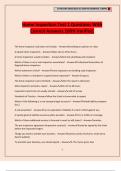
1 BIO 210 CHAPTER 11 EXAM | QUESTIONS & ANSWERS (VERIFIED) | LATEST UPDATE | GRADED A+ The nervous system is? Correct Answer: The master controlling and communicating system of the body The three functions of the nervous system are? Correct Answer: 1. Sensory input 2. Integratio n 3. Motor output The sensory input Corre ct Answer: gathers information by the internal and external sensory receptors The integration function Correct Answer: processes and interprets the sensory input The motor output function Correct Answer: activates the effector organs (muscles and glads) and produces the appropriate response 2 The central nervous system is composed of? Correct Answer: The brain and spinal cord of the dorsal body cavity The peripheral nervous system is composed of? Correct Answer: Spinal and cranial nerves The peripheral nervous system has two functional divisions known as? Correct Answer: Sensory and motor divisions Sensory is also known as Correct Answer: Afferent Division Motor is also known as Correct Answer: Efferent division The somatic nervous system Correct Answer: conducts impulses from the Central Nervous System to Skeletal muscle Autonomic Nervous System Correct Answer: consists of visceral motor nerve fibers, and regulates smooth and cardiac muscles, and glands
Examen
BIO 210 CHAPTER 11 EXAM | QUESTIONS & ANSWERS (VERIFIED) | LATEST UPDATE | GRADED A+
Note
Vendu
-
Pages
12
Grade
A+
Publié le
04-03-2024
Écrit en
2023/2024
1 BIO 210 CHAPTER 11 EXAM | QUESTIONS & ANSWERS (VERIFIED) | LATEST UPDATE | GRADED A+ The nervous system is? Correct Answer: The master controlling and communicating system of the body The three functions of the nervous system are? Correct Answer: 1. Sensory input 2. Integration 3. Motor output The sensory input Correct Answer: gathers information by the internal and external sensory receptors The integration function Correct Answer: processes and interprets the sensory input The motor output function Correct Answer: activates the effector organs (muscles and glads) and produces the appropriate response 2 The central nervous system is composed of? Correct Answer: The brain and spinal cord of the dorsal body cavity The peripheral nervous system is composed of? Correct Answer: Spinal and cranial nerves The peripheral nervous system has two functional divisions known as? Correct Answer: Sensory and motor divisions Sensory is also known as Correct Answer: Afferent Division Motor is also known as Correct Answer: Efferent division The somatic nervous system Correct Answer: conducts impulses from the Central Nervous System to Skeletal muscle Autonomic Nervous System Correct Answer: consists of visceral motor nerve fibers, and regulates smooth and cardiac muscles, and glands 3 In the autonomic nervous system there are two functional subdivisions. What are they? Correct Answer: Sympathetic and Parasympathetic subdivisions Neuroglia cells Correct Answer: small cells that surround and wrap delicate neurons Neurons or nerve cells are Correct Answer: excitable cells that transmit electrical signals Four main neuroglia that support the Central Nervous System neurons are? Correct Answer: Astrocytes, Microglial cells, ependymal cells, and oligodendrocytes Astrocytes are? Correct Answer: most abundant and versatile glial cells Astrocytes Correct Answer: Support and brace neurons Microglial cells are Correct Answer: small, ovoid cells with thorny processes that touch and monitor neurons Ependymal Cells 4 Correct Answer: Range in shape from squamous to columnar and line central cavities of the brain and spinal column Oligodendrocytes are Correct Answer: branched cells that insulate myelin sheaths in thicker nerve fibers Satellite cells Correct Answer: Surround neuron cell bodies in PNS Schwann cells Correct Answer: surround all Peripheral nerve fibers and form myelin sheaths in thicker nerve fibers Neurons are Correct Answer: structural and functional units of the nervous system In the neuron process tracts are? Correct Answer: Bundles of neuron processes in CNS In the neuron process nerves are? Correct Answer: Bundles of neurons in PNS The two types of neuron processes are? 5 Correct Answer: Dendrites and axon Anterograde Correct Answer: away from the cell body Retrograde Correct Answer: toward cell body The ruction of myelin is to Correct Answer: protect and electrically insulate axons Myelination in the PNS is Correct Answer: formed by Schwann cells that wrap the axon in a jelly roll fashion Myelin sheaths in the PNS are Correct Answer: formed by processes of oligodendrocytes NOT WHOLE CELLS Each cell can wrap up to ______axons at onces Correct Answer: 60 In myelin sheaths in the CNS the _________ matter is regions of the brain and spinal cord with dense myelinated fibers Correct Answer: White 6 In myelin sheaths in the CNS the _________ matter is neuron cell bodies and nonmyelinated fibers Correct Answer: Gray The structural classification of neurons is Correct Answer: 1. Multipolar 2. Bipolar 3. Unipolar The functional classification of Neurons are? Correct Answer: 1. Sensory 2. Motor 3. Interneurons 99% of Body's neurons are________? Correct Answer: Interneurons All neurons have a ___________membrane potential Correct Answer: Resting The resting membrane potential depends on? Correct Answer: Differences in ion concentration and permeability 7 Voltage Correct Answer: Measure of potential energy generated by separated charge Current Correct Answer: Flow of electrical charges between two points Resistance Correct Answer: Hindrance to charge flow An insulator has a _________ electrical resistance Correct Answer: High A conductor has a ________ electrical resistance Correct Answer: Low Depolarization Correct Answer: decreases in membrane potential Hyper-polarization Correct Answer: increase in membrane potential Generating an action potential are 8 Correct Answer: 1. All gated sodium and potassium channels are closed(Resting stage) 2. Depolarization (sodium channels open) 3. Re-polarization (sodium channels inactivate and potassium gates open 4. Hyperpolarization (Some potassium stay open and sodium channels reset The all-or-none phenomenon is Correct Answer: An Action potential either happens completely or not at all propagation Correct Answer: allows Action potential to be transmitted from origin down entire axon length toward terminals Two types of refractory periods Correct Answer: absolute refractory period and relative refractory period Absolute refactoring period Correct Answer: Time from opening of sodium channels until resetting of the channels relative refractory period Correct Answer: follows the absolute refractory period; depends on the action potential as if it needs to occur again Continuous Conduction 9 Correct Answer: Slow conduction that occurs in nonmyelinated axons Saltatory conduction Correct Answer: occurs only in myelinated axons and is 30 times faster Group A fibers Correct Answer: are the largest in diameter Group B fibers Correct Answer: medium or intermediate diameter Group C fibers Correct Answer: Smallest in diameter Neurons are functionally connected by? Correct Answer: synapses Graded potentials are? Correct Answer: Brief, short distance signals Chemical synapses Correct Answer: most common type that release and receive chemical neurotransmitters 10 Six steps for information transfer across chemical synapses Correct Answer: 1. Action potential arrives at axon terminal 2. Volted-gated calcium channels open and enters 3. Calcium entry causes synaptic vesicles to release neurotransmitters 4. Neurotransmitter diffuses across the synaptic cleft and binds to receptors 5. Binding of neurotransmitter opens ion channels, creating graded potentials 6. Neurotransmitter effects are terminated Excitatory Postsynaptic potential Correct Answer: Sodium influx greater than potassium efflux resulting in local graded potential depolarization inhibitory postsynaptic potential Correct Answer: allows entrance and exit of ions that cause hyper- polarization Temporal summation Correct Answer: One or more presynaptic neurons transmit impulses in rapid-fire order Spatial summation Correct Answer: Postsynaptic neuron is stimulated by large number of terminals simultaneously 11 Synaptic potentiation Correct Answer: Repeated use of synapse increases ability of presynaptic cell to excite postsynaptic neuron Neurotransmitters Correct Answer: chemical messengers that cross the synaptic gaps between neurons Acetylcholine Correct Answer: Synthesized from acetic acid and choline by enzyme choline Catecholamines Correct Answer: Dopamine, norepinephrine and epinephrine Endocannabinoids Correct Answer: act at same receptors as THC (active ingredient in marijunana) Circuits Correct Answer: Patterns of synaptic connections in neuron pools Four types of circuits Correct Answer: Diverging, Converging, reverberating, and Parallel after-distcharge Neuron pool 12 Correct Answer: function groups of neurons
Montrer plus
Lire moins
Établissement
BIO 210
Cours
BIO 210
Oups ! Impossible de charger votre document. Réessayez ou contactez le support.
École, étude et sujet
- Établissement
- BIO 210
- Cours
- BIO 210
Infos sur le Document
- Publié le
- 4 mars 2024
- Nombre de pages
- 12
- Écrit en
- 2023/2024
- Type
- Examen
- Contient
- Questions et réponses
Sujets
-
bio 210 chapter 11 exam questions answers ve
Aperçu du contenu
€9,77
Accéder à l'intégralité du document:
Garantie de satisfaction à 100%
Disponible immédiatement après paiement
En ligne et en PDF
Tu n'es attaché à rien
Faites connaissance avec le vendeur

Les scores de réputation sont basés sur le nombre de documents qu'un vendeur a vendus contre paiement ainsi que sur les avis qu'il a reçu pour ces documents. Il y a trois niveaux: Bronze, Argent et Or. Plus la réputation est bonne, plus vous pouvez faire confiance sur la qualité du travail des vendeurs.
Graders
Document également disponible en groupe

Package deal
BIO 210 EXAM PACKAGE | QUESTIONS & ANSWERS (VERIFIED) | LATEST UPDATE | GRADED A
22
2024
€ 245,67
Plus d'infos