COMMUNICABLE DISEASES – A
GLOBAL PERSPECTIVE
CHAPTER 1
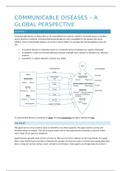
Communicable disease: an illness that can be transmited rom a person, animal or inanimate source to another
person directly or indirectly. Immunocompromised people are more susceptble or the disease, like young
children. Some communicable diseases can result in chronic illness, or example the human papilloma virus and
HIV.
An endemic disease is constantly present in a moderate amount o people (e.g. malaria, chlamydia)
An epidemic is when an excessive/abnormal amount o people have a disease or in ecton (e.g. infuenza,
measles)
A pandemic is a global spread o a disease (e.g. ebola)
A communicable disease is caused by an agent. Through transmission the agent reaches the host.
THE AGENT
The agent can be a virus, bacteria, prion or helminth or any other organism. The agent needs to survive and
there ore needs to multply. This can be sexual, where cells o two organisms are combined, or asexual, where
exact copies o one agent are produced.
Agents that are parasitc need a host to survive, or they can not survive without one or long periods. I an agent
finds a host and the host is not able to eliminate the parasite, the host turns into a reservoir and reproducton takes
place. A reservoir can be a human, insect, animals or environment. Some agents can change shape to survive in
,hostle conditons (persistence), or example bacteria that can orm spores. Agents can also wait with being
in ectve i conditons are suboptmal, this is called latency.
I enough agents are produced to cause illness, the severity depends on the virulence and toxicity o the organism.
The in ectveness depends on the in ectve dose; the number o agents needed to survive the barriers o the
immune de ense and cause disease.
TRANSMISSION
The transmission o the agent can ollow various routes:
- Direct: person to person, by skin, eco-oral, through droplets (respiratory in ectons)
- Human reservoir with intermediate host: adults live in humans, but the ofspring goes through
developmental stages in other organisms
- Animal as intermediate host or reservoir: zoonosis
- Vectors: insects carrying the disease rom one host to another
- Plants: vegetable material that is consumed by a human
Most dangerous are carriers; people that are carrying the agent and are in ectve but do not show symptoms (yet).
This can be because o a long incubaton period, asymptomatc carrying or stll being in ectve but being recovered
o the disease. Being a carrier can be chronic or temporary. Subclinical transmission is passing on an in ecton to
others who do not get symptoms. I a susceptble person enters this community, he will get sick and cause an
outbreak.
THE HOST
How susceptble a person is depends on various actors: genetcs, age, sex (pregnancy) and the immune system. I a
host met an in ecton be ore, he or she can become immune to the in ecton. The resistance to diseases can be
lowered by poor nutriton, stress, multple in ectons or other actors.
THE ENVIRONMENT
The environment covers the social as well as the physical environment. Social environment covers educaton level
and financial status. The physical environment ocuses on where a host lives. Overcrowding ofren leads to a greater
prevalence o communicable diseases. Living in a warm and water-rich area also increases chances o getng a
communicable disease.
Climate, temperature, topography ( orest/desert/…), rain all, wind, seasonality climate change?!
CHAPTER 2
To measure in ectons various actors have to be taken into account: in ectous people, susceptble hosts, density o
the populaton, climate and various other actors. To object y the orce o in ecton the ollowing ormula can be
used: number of infectouu individualu × tranumiuuion rate. To calculate the number o newly in ected individuals:
force of infecton x number of uuuceptble houtu in populaton.
Common-source epidemic uses the overall atack rate: number o individuals afected during an epidemic/number
o susceptble exposed to the risk
In a new in ecton, everyone is at risk because there is no (assumed) immunity.
, EPIDEMIOLOGY
Epidemic: something is an epidemic when the epidemic threshold is crossed = the amount o new cases o an
in ecton to become epidemic. Common used measures are the incidence, mortality or prevalence.
An epidemic (or every communicable disease) is characterized by:
- A latent period: the tme between in ecton and in ectveness
- An incubaton period: the tme between in ecton and symptoms
- Disease: the symptomatc period
- Period o communicability: the in ectous period, this can be be ore, during and/or afrer the disease
An epidemic curve is a diagram showing the number o cases over tme. Factors infuencing the distributon o cases
are the in ectng dose, portal o entry, latent period and more. An epidemic can be common-source or propagated-
source. Common-source epidemics are caused by exposure to a place or product, and can be divided in point-
source (resultng rom one exposure) and extended (various repeated exposures). A propagated-source epidemic
spreads rom host to host.
Investgaton on an outbreak o a disease covers the hosts, the place where the hosts are and the tme (number o
cases within a period). First o all a case definiton needs to be set so the workers know what they are looking or.
GLOBAL PERSPECTIVE
CHAPTER 1
Communicable disease: an illness that can be transmited rom a person, animal or inanimate source to another
person directly or indirectly. Immunocompromised people are more susceptble or the disease, like young
children. Some communicable diseases can result in chronic illness, or example the human papilloma virus and
HIV.
An endemic disease is constantly present in a moderate amount o people (e.g. malaria, chlamydia)
An epidemic is when an excessive/abnormal amount o people have a disease or in ecton (e.g. infuenza,
measles)
A pandemic is a global spread o a disease (e.g. ebola)
A communicable disease is caused by an agent. Through transmission the agent reaches the host.
THE AGENT
The agent can be a virus, bacteria, prion or helminth or any other organism. The agent needs to survive and
there ore needs to multply. This can be sexual, where cells o two organisms are combined, or asexual, where
exact copies o one agent are produced.
Agents that are parasitc need a host to survive, or they can not survive without one or long periods. I an agent
finds a host and the host is not able to eliminate the parasite, the host turns into a reservoir and reproducton takes
place. A reservoir can be a human, insect, animals or environment. Some agents can change shape to survive in
,hostle conditons (persistence), or example bacteria that can orm spores. Agents can also wait with being
in ectve i conditons are suboptmal, this is called latency.
I enough agents are produced to cause illness, the severity depends on the virulence and toxicity o the organism.
The in ectveness depends on the in ectve dose; the number o agents needed to survive the barriers o the
immune de ense and cause disease.
TRANSMISSION
The transmission o the agent can ollow various routes:
- Direct: person to person, by skin, eco-oral, through droplets (respiratory in ectons)
- Human reservoir with intermediate host: adults live in humans, but the ofspring goes through
developmental stages in other organisms
- Animal as intermediate host or reservoir: zoonosis
- Vectors: insects carrying the disease rom one host to another
- Plants: vegetable material that is consumed by a human
Most dangerous are carriers; people that are carrying the agent and are in ectve but do not show symptoms (yet).
This can be because o a long incubaton period, asymptomatc carrying or stll being in ectve but being recovered
o the disease. Being a carrier can be chronic or temporary. Subclinical transmission is passing on an in ecton to
others who do not get symptoms. I a susceptble person enters this community, he will get sick and cause an
outbreak.
THE HOST
How susceptble a person is depends on various actors: genetcs, age, sex (pregnancy) and the immune system. I a
host met an in ecton be ore, he or she can become immune to the in ecton. The resistance to diseases can be
lowered by poor nutriton, stress, multple in ectons or other actors.
THE ENVIRONMENT
The environment covers the social as well as the physical environment. Social environment covers educaton level
and financial status. The physical environment ocuses on where a host lives. Overcrowding ofren leads to a greater
prevalence o communicable diseases. Living in a warm and water-rich area also increases chances o getng a
communicable disease.
Climate, temperature, topography ( orest/desert/…), rain all, wind, seasonality climate change?!
CHAPTER 2
To measure in ectons various actors have to be taken into account: in ectous people, susceptble hosts, density o
the populaton, climate and various other actors. To object y the orce o in ecton the ollowing ormula can be
used: number of infectouu individualu × tranumiuuion rate. To calculate the number o newly in ected individuals:
force of infecton x number of uuuceptble houtu in populaton.
Common-source epidemic uses the overall atack rate: number o individuals afected during an epidemic/number
o susceptble exposed to the risk
In a new in ecton, everyone is at risk because there is no (assumed) immunity.
, EPIDEMIOLOGY
Epidemic: something is an epidemic when the epidemic threshold is crossed = the amount o new cases o an
in ecton to become epidemic. Common used measures are the incidence, mortality or prevalence.
An epidemic (or every communicable disease) is characterized by:
- A latent period: the tme between in ecton and in ectveness
- An incubaton period: the tme between in ecton and symptoms
- Disease: the symptomatc period
- Period o communicability: the in ectous period, this can be be ore, during and/or afrer the disease
An epidemic curve is a diagram showing the number o cases over tme. Factors infuencing the distributon o cases
are the in ectng dose, portal o entry, latent period and more. An epidemic can be common-source or propagated-
source. Common-source epidemics are caused by exposure to a place or product, and can be divided in point-
source (resultng rom one exposure) and extended (various repeated exposures). A propagated-source epidemic
spreads rom host to host.
Investgaton on an outbreak o a disease covers the hosts, the place where the hosts are and the tme (number o
cases within a period). First o all a case definiton needs to be set so the workers know what they are looking or.