Consumer Psychology
Book chapters, Articles and Ted Talks
Week 1: Introduction
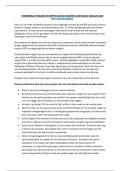
Textbook Chapter 1 – A historical context for understanding consumption
Consumer behavior: individuals and groups involved in all aspects of the consumption process.
This means understanding how individuals or groups acquire, use and dispose of products,
services, ideas or experiences.
L1: the study of individuals, groups, or organizations and the processes they use to select,
secure, use, and dispose or products, services, experiences, or ideas to satisfy their needs and
wants.
- Sumptuary laws: An interesting aspect of early consumption. Laws that attempt to
regulate expenditure, especially with a view to restraining excess in food, dress, equipage,
etc.
- Exchange value: Represent what the value of a good is to the consumer and therefore
what it could be exchanged for, usually its price.
- Use value: the satisfaction we get from a good or service, which is usually thought of as
being determined by a set of attributes that define its quality. The value of a good to
consumer in terms of the usefulness it provides.
- The sign or symbolic value: the symbolic meaning consumers attach to goods to construct
and participate in the social world; in doing so they consume the idea of the good to signal
identity in social relationships.
- Fetishism of commodities: the disguising or masking of commodities whereby the
appearance of goods hides the story of those who made them and how they made them.
- Consumption function: maps the relationship between disposable income and level of
wages. It showed that the rich saved proportionately more of their income and therefore
consumed relatively less than the remainder of the population.
- Conspicuous consumption: the use of goods to gain social recognition
Rachel Bowlby said that with the rise of the supermarket, shopping became recognized as
something people did in an open-ended, leisure fashion, rather than simply about meeting
functional needs. But Going shopping can be a leisure activity, as well as a functional activity.
Pop-up stores offer surprise and novelty for consumers, they give producers a low-cost, low-
risk way to bring their products and brands to consumers and are particularly popular at times
of recession. They are popular for consumers because of their limited life span, which
encourage a sense of urgency among customers.
The main ideas from Freud are that people are driven by irrational and unconscious motives,
and that emotions play an important role in influencing cognition (or thinking). Accessing
these hidden desires and motives is important for marketers, but requires subtle approaches
to researching consumers, using indirect and projective questioning techniques – direct
questions don’t provide great insights into hidden motives.
,Ralph Nadar and Namoi Klein are prominent consumer rights activists. Consumer activists
campaign to ensure that producers and retailers recognize their responsibility to the
consumer in producing goods that are safe, fair, and of the value promised. Consumers need
protection from corporations, and ensure that legislation is in place to ensure
protection of consumers’ interests and safety. Part of this movement’s concern relates to
ensuring fairness in marketplace dealings.
Calculating (Materialistic, Individualistic): rational, mainstream, efficient, and effective. ‘keep
up with the Joneses’, concerned with convenience
Traditional (Materialistic, Collectivistic): conformist, cost-conscious, self-disciplined, fearful of
new things, community-oriented
Unique (Non-materialistic, individualistic): fun and impulsive, seeks variety, seeks status,
distinction, and new things
Responsible (Non-materialistic, collectivistic): captured by involvement, altruistic, ‘keep down
with the Joneses’, informed, environmentally aware.
The postmodern consumer crosses many types and is difficult to tell when he/she will be one
or the other. They do not seek a unified theme but want to explore different and separate
identities to match the fragmenting markets and the proliferation of products available to
them.
,Positivist approach: the objectivity of science and the consumer as a rational decision-maker,
goal is to understand consumers in terms of theories that have been tested and which can
explain external reality.
Interpretivist perspective: stresses the subjective meaning of the consumer’s individual
experience and the idea that any behavior is subject to multiple interpretations rather than
one single explanation. Driven by a need to develop a deep understanding of people’s lives and
behaviors, reality is socially constructed and the researcher is an active participant rather than
an objective bystander.
Aronson, E, Wilson, T., & Brewer, M. (1998). Experimentation in Social
Psychology. The Handbook of Social Psychology 1:99-142. (note: this book
chapter needs to be picked up at the Marketing secretaries’ office)
Four stages of laboratory
1. Setting the stage of the experiment.
2. Constructing the IV.
3. Constructing the DV.
4. Planning follow op.
Setting realistic
1. Mundane realism = settings occurs in real world.
2. Experimental realism = involving, forced to take it seriously.
3. Psychological realism = psychological processes occur in every day live.
Problem oriented à phenomenon
Process oriented à mediating process
Trade-off between validity (control) and realism:
1. Internal validity = confidence with which we can draw cause and effect concussions
from our research results.
2. External validity= refers to the robustness of phenomenon à generalizability.
3. Construct validity = correct identification to the nature of the IV & DV and relation
between them.
Iyengar, S. & Lepper, M. (2000). When Choice is Demotivating: Can One Desire
Too Much of a Good Thing? Journal of Personality and Social Psychology, 79
(6), 995-1006.
Abstract
Current psychological theory and research affirm the positive affective and motivational
consequences of having personal choice. These findings have led to the popular notion that
the more choice, the better—that the human ability to manage, and the human desire for,
, choice is unlimited. Findings from 3 experimental studies starkly challenge this implicit
assumption that having more choices is necessarily more intrinsically motivating than having
fewer. These experiments, which were conducted in both field and laboratory settings, show
that people are more likely to purchase gourmet jams or chocolates or to undertake optional
class essay assignments when offered a limited array of 6 choices rather than a more extensive
array of 24 or 30 choices. Moreover, participants actually reported greater subsequent
satisfaction with their selections and wrote better essays when their original set of options
had been limited.
Finding: larger assortments lead to fewer sales.
Alternative explanation:
- Large assortments may produce crowding à less buying.
- Despite rotating manipulations across time slots differences in customer base rather than
of assortment size may account for the effect.
Study 1: Tasting booth 6 or 24 samples jam.
Result à having more rather than few choices is more desirable and intrinsically motivating,
seeing extensive array of options is appealing, but reduces motivation to purchase. 6 limited
bought more than 24.
Study 2: Opportunity to write an essay for extra credits. 6 or 30 essay topics.
Result à 6 topics performed better à perform better in limited choice context (Choice
overload).
Study 3: Participants chose from a limited or extensive array of chocolates.
Result à people reported enjoying the process of choosing a chocolate more from a display
of 30 than of 6. But the participants proved more dissatisfied and regretful of the choice they
made. They were also less likely to take chocolate rather than money as compensation for
participation.
TED Barry Schwartz (2006) -
http://www.ted.com/talks/barry_schwartz_on_the_paradox_of_choice.html
The Paradox Of Choice shows you how today’s vast amount of choice makes you frustrated,
less likely to choose, more likely to mess up, and less happy overall, before giving you concrete
strategies and tips to ease the burden of decision-making.
Negative effect of choice: paralyzes rather than liberation (the more choice à the more
freedom à the more welfare).
• Difficult to choose with so many options à less satisfied with the result
compared to fewer options.
Why?
1. Imagined alternatives: different choice would have been better.
2. Opportunity cost: imagine features of alternatives that you reject à less satisfied with
the alternative you have chosen à reflection.
3. Escalation of expectations: the more options the higher expectations à less
satisfaction.
4. Self-blame: experiences that are disappointing à higher standards à blame their self.
Book chapters, Articles and Ted Talks
Week 1: Introduction
Textbook Chapter 1 – A historical context for understanding consumption
Consumer behavior: individuals and groups involved in all aspects of the consumption process.
This means understanding how individuals or groups acquire, use and dispose of products,
services, ideas or experiences.
L1: the study of individuals, groups, or organizations and the processes they use to select,
secure, use, and dispose or products, services, experiences, or ideas to satisfy their needs and
wants.
- Sumptuary laws: An interesting aspect of early consumption. Laws that attempt to
regulate expenditure, especially with a view to restraining excess in food, dress, equipage,
etc.
- Exchange value: Represent what the value of a good is to the consumer and therefore
what it could be exchanged for, usually its price.
- Use value: the satisfaction we get from a good or service, which is usually thought of as
being determined by a set of attributes that define its quality. The value of a good to
consumer in terms of the usefulness it provides.
- The sign or symbolic value: the symbolic meaning consumers attach to goods to construct
and participate in the social world; in doing so they consume the idea of the good to signal
identity in social relationships.
- Fetishism of commodities: the disguising or masking of commodities whereby the
appearance of goods hides the story of those who made them and how they made them.
- Consumption function: maps the relationship between disposable income and level of
wages. It showed that the rich saved proportionately more of their income and therefore
consumed relatively less than the remainder of the population.
- Conspicuous consumption: the use of goods to gain social recognition
Rachel Bowlby said that with the rise of the supermarket, shopping became recognized as
something people did in an open-ended, leisure fashion, rather than simply about meeting
functional needs. But Going shopping can be a leisure activity, as well as a functional activity.
Pop-up stores offer surprise and novelty for consumers, they give producers a low-cost, low-
risk way to bring their products and brands to consumers and are particularly popular at times
of recession. They are popular for consumers because of their limited life span, which
encourage a sense of urgency among customers.
The main ideas from Freud are that people are driven by irrational and unconscious motives,
and that emotions play an important role in influencing cognition (or thinking). Accessing
these hidden desires and motives is important for marketers, but requires subtle approaches
to researching consumers, using indirect and projective questioning techniques – direct
questions don’t provide great insights into hidden motives.
,Ralph Nadar and Namoi Klein are prominent consumer rights activists. Consumer activists
campaign to ensure that producers and retailers recognize their responsibility to the
consumer in producing goods that are safe, fair, and of the value promised. Consumers need
protection from corporations, and ensure that legislation is in place to ensure
protection of consumers’ interests and safety. Part of this movement’s concern relates to
ensuring fairness in marketplace dealings.
Calculating (Materialistic, Individualistic): rational, mainstream, efficient, and effective. ‘keep
up with the Joneses’, concerned with convenience
Traditional (Materialistic, Collectivistic): conformist, cost-conscious, self-disciplined, fearful of
new things, community-oriented
Unique (Non-materialistic, individualistic): fun and impulsive, seeks variety, seeks status,
distinction, and new things
Responsible (Non-materialistic, collectivistic): captured by involvement, altruistic, ‘keep down
with the Joneses’, informed, environmentally aware.
The postmodern consumer crosses many types and is difficult to tell when he/she will be one
or the other. They do not seek a unified theme but want to explore different and separate
identities to match the fragmenting markets and the proliferation of products available to
them.
,Positivist approach: the objectivity of science and the consumer as a rational decision-maker,
goal is to understand consumers in terms of theories that have been tested and which can
explain external reality.
Interpretivist perspective: stresses the subjective meaning of the consumer’s individual
experience and the idea that any behavior is subject to multiple interpretations rather than
one single explanation. Driven by a need to develop a deep understanding of people’s lives and
behaviors, reality is socially constructed and the researcher is an active participant rather than
an objective bystander.
Aronson, E, Wilson, T., & Brewer, M. (1998). Experimentation in Social
Psychology. The Handbook of Social Psychology 1:99-142. (note: this book
chapter needs to be picked up at the Marketing secretaries’ office)
Four stages of laboratory
1. Setting the stage of the experiment.
2. Constructing the IV.
3. Constructing the DV.
4. Planning follow op.
Setting realistic
1. Mundane realism = settings occurs in real world.
2. Experimental realism = involving, forced to take it seriously.
3. Psychological realism = psychological processes occur in every day live.
Problem oriented à phenomenon
Process oriented à mediating process
Trade-off between validity (control) and realism:
1. Internal validity = confidence with which we can draw cause and effect concussions
from our research results.
2. External validity= refers to the robustness of phenomenon à generalizability.
3. Construct validity = correct identification to the nature of the IV & DV and relation
between them.
Iyengar, S. & Lepper, M. (2000). When Choice is Demotivating: Can One Desire
Too Much of a Good Thing? Journal of Personality and Social Psychology, 79
(6), 995-1006.
Abstract
Current psychological theory and research affirm the positive affective and motivational
consequences of having personal choice. These findings have led to the popular notion that
the more choice, the better—that the human ability to manage, and the human desire for,
, choice is unlimited. Findings from 3 experimental studies starkly challenge this implicit
assumption that having more choices is necessarily more intrinsically motivating than having
fewer. These experiments, which were conducted in both field and laboratory settings, show
that people are more likely to purchase gourmet jams or chocolates or to undertake optional
class essay assignments when offered a limited array of 6 choices rather than a more extensive
array of 24 or 30 choices. Moreover, participants actually reported greater subsequent
satisfaction with their selections and wrote better essays when their original set of options
had been limited.
Finding: larger assortments lead to fewer sales.
Alternative explanation:
- Large assortments may produce crowding à less buying.
- Despite rotating manipulations across time slots differences in customer base rather than
of assortment size may account for the effect.
Study 1: Tasting booth 6 or 24 samples jam.
Result à having more rather than few choices is more desirable and intrinsically motivating,
seeing extensive array of options is appealing, but reduces motivation to purchase. 6 limited
bought more than 24.
Study 2: Opportunity to write an essay for extra credits. 6 or 30 essay topics.
Result à 6 topics performed better à perform better in limited choice context (Choice
overload).
Study 3: Participants chose from a limited or extensive array of chocolates.
Result à people reported enjoying the process of choosing a chocolate more from a display
of 30 than of 6. But the participants proved more dissatisfied and regretful of the choice they
made. They were also less likely to take chocolate rather than money as compensation for
participation.
TED Barry Schwartz (2006) -
http://www.ted.com/talks/barry_schwartz_on_the_paradox_of_choice.html
The Paradox Of Choice shows you how today’s vast amount of choice makes you frustrated,
less likely to choose, more likely to mess up, and less happy overall, before giving you concrete
strategies and tips to ease the burden of decision-making.
Negative effect of choice: paralyzes rather than liberation (the more choice à the more
freedom à the more welfare).
• Difficult to choose with so many options à less satisfied with the result
compared to fewer options.
Why?
1. Imagined alternatives: different choice would have been better.
2. Opportunity cost: imagine features of alternatives that you reject à less satisfied with
the alternative you have chosen à reflection.
3. Escalation of expectations: the more options the higher expectations à less
satisfaction.
4. Self-blame: experiences that are disappointing à higher standards à blame their self.