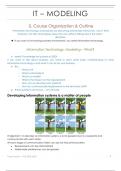
IT – MODELING
0. Course Organization & Outline
“Information technology and business are becoming inextricably interwoven. I don’t think
anybody can talk meaningfully about the one without talking about the other.”
Bill Gates
If you want a functioning business environment, you need information technology.
Information Technology: Modeling – What?
Need IT knowledge for business in 2023!
If you want to talk about business, you need to have some basic understanding of what
Information Technology is and what it can do for your business.
But…
– What is IT?
– What is information?
– What is a model?
– What is the impact on the organization?
– How can we develop such systems?
– How do I communicate requirements to the technical staff?
These questions and more… we will study.
Developing information systems is a matter of people
IT alignment : to develop an information system, a lot of people have to cooperate and
communicate with each other.
At each stage of communication there can also be miscommunication
Requirements can be mistranslated
Stakeholder preferences can be ignored
Fadia Farhat | VUB 2023-2024 1
, Development processes are getting much more bigger and involve much more
stakeholders than before
Maintaining IT systems is not straightforward
Even when you have developed an information systems, things can go wrong because
those systems need maintenance.
Maintaining IT systems is not straightforward.
o Example : Facebook-Instagram-Whatsapp stopped working for several hours.
When your business are digital and depend on those applications or system you have built,
costs can be huge!
Course contents
IT Modeling introduces a range of concepts, methods and approaches that are being
employed by business analysts in the industry.
Business analysts operate on the interface between the business and the IT department in
order to analyse and describe requirements with regards to:
– the design,
– functionalities,
– development,
– and implementation
of business information systems.
Business analysts are becoming more and more the architects of “organizations”, designing
the processes and procedures and as such determining how an organization operates and
in fact is exactly organized.
o They facilitate the organization to change how its doing business,
o To make the operations more efficient,
o By adopting technology.
Topics that will be covered:
o Chapter 1: Information systems development WHAT
using the Systems Development Lifecycle (SDLC) HOW
o Chapter 2: Process modeling (BPMN) WHAT
using Business Process Modeling Notation (BPMN) HOW
o Chapter 3: Data modeling (Unified Modeling Language) WHAT
using the Entity Relationship (ER) model HOW
HOW : methodology
Specific Learning outcomes
At the end of this course, students should be able:
o To generally discuss the development of an information system using the SDLC, and
the use of process and data modeling
o To discuss and illustrate the various uses of process models within organizations and
be able to apply a process modeling technique (BPMN) to describe and analyse
businesss processes;
Fadia Farhat | VUB 2023-2024 2
, o To apply a conceptual data modeling technique (ER modeling), to capture and
analyse the basic information requirements for an enterprise domain, and
understand its broad use within an organization;
Practical uses outside of Information System Development
Basel IV reporting -> what financial service providers need to report to the ECB to
determine their required capital reserves.
o Risk & capital reserves in financial industry
o Tools used:
Process modeling
Data modeling
At your job:
o Insight into business/IT interface
o Business process management
o Working with relational databases
For your thesis
Broader use : business/IT alignment
You are operating in the intersection between business and IT.
Business usually determines the direction : macro-perspective, strategy, where you want to
go.
IT technology : a selection of tools that can help you achieve your goals as outlined by
business.
To alignment between those pieces of technology that exists with what you want to
achieve is vital and also very complex
IT Modeling in curriculum (HIR)
Business Informatics (HIR & TEW Ba1)
User perspective: “How do IS work and what is their use for business”
IT Modeling (HIR Ba3 & MIB)
Business analyst & project mgr. perspective: “How are IS being developed within orgs.”
Information Systems Strategy and Management (HIR Ma1 & MMSC)
Management perspective: “How to manage IS and use as part of business strategy”
Decision Analytics (HIR & MMSC) – optional course
Expert perspective: “Specific expert IS for decision support”
Fundamentals of Data Science (HIR Ma1) – optional course
Expert perspective: ‘on ML implementation, ethics, and management’
Link IT modeling & IT Economics
Micro versus macro perspective towards the use of information technology by
organizations.
o Micro perspective : how to we develop a single information system in a context of a
business
o Macro perspective : IT economics -> how do IT systems affects the economy in
general
Fadia Farhat | VUB 2023-2024 3
, Cfr. lectures IT Economics
Exam
Written exam (closed book) on 100% of total during exam session
January:
• 65% IT Modeling: theory & exercises
• 35% IT Economics
“Only if the student obtains at least 35% (i.e., at least 7/20) on every part individually,
namely IT Modeling and IT Economics (together "Written Exam"). If not, the lowest partial
grade denotes 100% of the total.”
No partial exemptions
Exam is in English but you are allowed to answer in Dutch
Course material
• Canvas
– Slides
– Class recordings (Panopto)
– Exercises
– Reader: articles, papers, additional background material, etc. (optional to deepen your
understanding)
• Additional reading:
– M. Fowler, Martin, UML Distilled: A Brief Guide to the Standard Object Modeling
Language, Addison Wesley
• ISBN: 0-321-19368-7
Chapter 3 data modeling
– B. Silver, BPMN Method and Style: A levels-based methodology for BPM process
modeling and improvement using BPMN 2.0, Cody-Cassidy Press
• ISBN 0-982-36810-0
Process Modeling
– Ken Lunn, Software development with UML, Palgrave Macmillan
• ISBN 0-333-98595-8
Chapter 1
Course software
BPMN.IO
PowerBI
Contact
PL5.4.29
Fadia Farhat | VUB 2023-2024 4
0. Course Organization & Outline
“Information technology and business are becoming inextricably interwoven. I don’t think
anybody can talk meaningfully about the one without talking about the other.”
Bill Gates
If you want a functioning business environment, you need information technology.
Information Technology: Modeling – What?
Need IT knowledge for business in 2023!
If you want to talk about business, you need to have some basic understanding of what
Information Technology is and what it can do for your business.
But…
– What is IT?
– What is information?
– What is a model?
– What is the impact on the organization?
– How can we develop such systems?
– How do I communicate requirements to the technical staff?
These questions and more… we will study.
Developing information systems is a matter of people
IT alignment : to develop an information system, a lot of people have to cooperate and
communicate with each other.
At each stage of communication there can also be miscommunication
Requirements can be mistranslated
Stakeholder preferences can be ignored
Fadia Farhat | VUB 2023-2024 1
, Development processes are getting much more bigger and involve much more
stakeholders than before
Maintaining IT systems is not straightforward
Even when you have developed an information systems, things can go wrong because
those systems need maintenance.
Maintaining IT systems is not straightforward.
o Example : Facebook-Instagram-Whatsapp stopped working for several hours.
When your business are digital and depend on those applications or system you have built,
costs can be huge!
Course contents
IT Modeling introduces a range of concepts, methods and approaches that are being
employed by business analysts in the industry.
Business analysts operate on the interface between the business and the IT department in
order to analyse and describe requirements with regards to:
– the design,
– functionalities,
– development,
– and implementation
of business information systems.
Business analysts are becoming more and more the architects of “organizations”, designing
the processes and procedures and as such determining how an organization operates and
in fact is exactly organized.
o They facilitate the organization to change how its doing business,
o To make the operations more efficient,
o By adopting technology.
Topics that will be covered:
o Chapter 1: Information systems development WHAT
using the Systems Development Lifecycle (SDLC) HOW
o Chapter 2: Process modeling (BPMN) WHAT
using Business Process Modeling Notation (BPMN) HOW
o Chapter 3: Data modeling (Unified Modeling Language) WHAT
using the Entity Relationship (ER) model HOW
HOW : methodology
Specific Learning outcomes
At the end of this course, students should be able:
o To generally discuss the development of an information system using the SDLC, and
the use of process and data modeling
o To discuss and illustrate the various uses of process models within organizations and
be able to apply a process modeling technique (BPMN) to describe and analyse
businesss processes;
Fadia Farhat | VUB 2023-2024 2
, o To apply a conceptual data modeling technique (ER modeling), to capture and
analyse the basic information requirements for an enterprise domain, and
understand its broad use within an organization;
Practical uses outside of Information System Development
Basel IV reporting -> what financial service providers need to report to the ECB to
determine their required capital reserves.
o Risk & capital reserves in financial industry
o Tools used:
Process modeling
Data modeling
At your job:
o Insight into business/IT interface
o Business process management
o Working with relational databases
For your thesis
Broader use : business/IT alignment
You are operating in the intersection between business and IT.
Business usually determines the direction : macro-perspective, strategy, where you want to
go.
IT technology : a selection of tools that can help you achieve your goals as outlined by
business.
To alignment between those pieces of technology that exists with what you want to
achieve is vital and also very complex
IT Modeling in curriculum (HIR)
Business Informatics (HIR & TEW Ba1)
User perspective: “How do IS work and what is their use for business”
IT Modeling (HIR Ba3 & MIB)
Business analyst & project mgr. perspective: “How are IS being developed within orgs.”
Information Systems Strategy and Management (HIR Ma1 & MMSC)
Management perspective: “How to manage IS and use as part of business strategy”
Decision Analytics (HIR & MMSC) – optional course
Expert perspective: “Specific expert IS for decision support”
Fundamentals of Data Science (HIR Ma1) – optional course
Expert perspective: ‘on ML implementation, ethics, and management’
Link IT modeling & IT Economics
Micro versus macro perspective towards the use of information technology by
organizations.
o Micro perspective : how to we develop a single information system in a context of a
business
o Macro perspective : IT economics -> how do IT systems affects the economy in
general
Fadia Farhat | VUB 2023-2024 3
, Cfr. lectures IT Economics
Exam
Written exam (closed book) on 100% of total during exam session
January:
• 65% IT Modeling: theory & exercises
• 35% IT Economics
“Only if the student obtains at least 35% (i.e., at least 7/20) on every part individually,
namely IT Modeling and IT Economics (together "Written Exam"). If not, the lowest partial
grade denotes 100% of the total.”
No partial exemptions
Exam is in English but you are allowed to answer in Dutch
Course material
• Canvas
– Slides
– Class recordings (Panopto)
– Exercises
– Reader: articles, papers, additional background material, etc. (optional to deepen your
understanding)
• Additional reading:
– M. Fowler, Martin, UML Distilled: A Brief Guide to the Standard Object Modeling
Language, Addison Wesley
• ISBN: 0-321-19368-7
Chapter 3 data modeling
– B. Silver, BPMN Method and Style: A levels-based methodology for BPM process
modeling and improvement using BPMN 2.0, Cody-Cassidy Press
• ISBN 0-982-36810-0
Process Modeling
– Ken Lunn, Software development with UML, Palgrave Macmillan
• ISBN 0-333-98595-8
Chapter 1
Course software
BPMN.IO
PowerBI
Contact
PL5.4.29
Fadia Farhat | VUB 2023-2024 4