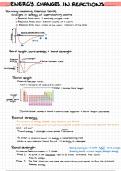
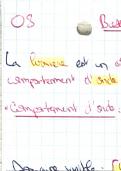
ENERGY CHANGES IN REACTIONS
chemical bonds
Forming breaking +
Changes in
energy ofapproaching atoms
1. Repulsive forces btwn 2
positively-charged nuclei
2. Repulsive forces btwn electron clouds of 2 atoms
3. Attractive forces btwn nucleus of one atom + electrons of the other
↑
At
distance between atomic nuclei
>
.
E
-8-
.
N
· · 0- 7 0
-
.
⑧
Bond
length, bond energy - bond
strength
Entertiarange
in
distance between nuclei
Bond
length
Distance between nuclei
half=
indication of radius of an atom
-
smaller-smaller bond length
bigger
bond
greater a
length
Doubleltriple bond
covalent atoms
=
closer
together-band length decreases
Bond energy
The of
amount released when the bond formed
energy was
The of
amount
energy that will have to be supplied to break the bond and separate the atoms
Unit: k]. mol-'
↑ ~bond
bond
energy stronger-more stable - compound
To break a chemical bond -o
energy is absorbed/required
When new chemical bond forms released
energy is
->
a
Bond strength Boiling/melting pt-> IMF bond
strength
All chemical reactions happen in 2 phases: Breaking bonds - bond
length, strength, energy
Phase 1:All bonds in the reactants need to be broken to produce 'free atoms
Requires energy
Phase 2:The 'free' atoms can now make new combinations and bonds to form the products
Releases energy
chemical bonds
Forming breaking +
Changes in
energy ofapproaching atoms
1. Repulsive forces btwn 2
positively-charged nuclei
2. Repulsive forces btwn electron clouds of 2 atoms
3. Attractive forces btwn nucleus of one atom + electrons of the other
↑
At
distance between atomic nuclei
>
.
E
-8-
.
N
· · 0- 7 0
-
.
⑧
Bond
length, bond energy - bond
strength
Entertiarange
in
distance between nuclei
Bond
length
Distance between nuclei
half=
indication of radius of an atom
-
smaller-smaller bond length
bigger
bond
greater a
length
Doubleltriple bond
covalent atoms
=
closer
together-band length decreases
Bond energy
The of
amount released when the bond formed
energy was
The of
amount
energy that will have to be supplied to break the bond and separate the atoms
Unit: k]. mol-'
↑ ~bond
bond
energy stronger-more stable - compound
To break a chemical bond -o
energy is absorbed/required
When new chemical bond forms released
energy is
->
a
Bond strength Boiling/melting pt-> IMF bond
strength
All chemical reactions happen in 2 phases: Breaking bonds - bond
length, strength, energy
Phase 1:All bonds in the reactants need to be broken to produce 'free atoms
Requires energy
Phase 2:The 'free' atoms can now make new combinations and bonds to form the products
Releases energy