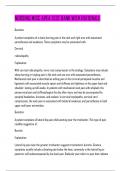
NURSING MISC APEA TEST BANK WITH RATIONALE
NURSING MISC APEA TEST BANK WITH RATIONALE Question: A patient complains of a sharp burning pain in the neck and right arm with associated paresthesias and weakness. These symptoms may be associated with: Cervical radiculopathy Explanation: With cervical radiculopathy, nerve root compression is the etiology. Symptoms may include sharp burning or tingling pain in the neck and one arm with associated paresthesias. Mechanical neck pain is described as aching pain in the cervical paraspinal muscles and ligaments with associated muscle spasm and stiffness and tightness in the upper back and shoulder, lasting up to6 weeks. Inpatients with mechanical neckpain with whiplash, the paracervical pain and stiffnessbegins the day after injury and may be accompanied by occipital headaches, dizziness, and malaise. In cervical myelopathy, cervical cord compression, the neck pain is associated with bilateral weakness and paresthesias in both upper and lower extremities. Question: A patient complains of lateral hip pain while pointing near the trochanter. This type of pain couldbe suggestive of: Bursitis Explanation: Lateral hip pain near the greater trochanter suggests trochanteric bursitis. Sciatica symptoms usually includeashooting pain below theknee, commonly inthe lateral leg or posterior calf andaccompanied by low back pain. Radicular pain refers to pain that radiates along the dermatome of a nerve due to inflammation or irritation of a nerve root, as with sciatica pain. Polyarticular arthritis refers to arthritis involving several joints. Question: The muscle of the scapulohumeral group that crosses the glenohumeral joint posteriorly andinserts on thegreater tubercle is known as the: infraspinatus muscle Explanation: One of the muscles of the scapulohumeral group that crosses the glenohumeral joint posteriorly and inserts on the greater tubercle is the infraspinatus muscle. The other one is the teres minor muscle. The pectoralis major muscle is situated on theanterior chest. The musclethat runs abovethe glenohumeral joint and inserts on the greater tubercle is known as the supraspinatus. The subscapularis muscle originates on the anterior surface of the scapula and crosses the joint anteriorly and inserts on the lesser tubercle. Question: A tool for assessing risk factors for osteoporotic fractures is the: FRAX Explanation: The FRAX calculator generates fracture risk based on age, body mass index, parental fracture history, use of glucocorticoids, presence of rheumatoid arthritis or secondary osteoporosis, and tobacco and alcohol use. It has been validated for black, Hispanic, and Asian women in the USA and has calculators that are country and continent specific. Duel energy x-ray absorptiometry, DEXA, is theoptimal standard for measuring bonedensity. BRAC1 is agene thatcan mutate andincrease the risk of breast cancer. HAARM is the melanoma risk model. Question: Anserinebursitis arises from: excessive running. Correct excessive kneeling. Ia Explanation: Anserine bursitis arises from excessive running, valgus knee deformity, fibromyalgias, and osteoarthritis. Prepatellar bursitis (“housemaid’s knee”) arises from excessive kneeling. A popliteal or “baker’s” cyst arises from distention of thegastrocnemius semimembranous bursafrom underlying arthritis or trauma. Question: When examining the knee, which of the following symptoms could be indicative of a positiveAdduction (Varus) Stress Test? Paininthelateral jointExplanation: The Adduction (or Varus) Stress Test is a maneuver that evaluates the function of the lateral collateral ligament. To perform this test, the knee is held in 30 degrees of flexion. With one handon the medial side of the knee and one hand on the ankle, an adduction force is gently applied. Ifpain is noted in the lateral joint line, this could be indicative of a lateral collateral ligament tear. When tenderness extends more to the proximal or distal joint line, the collateral ligament may bethe cause of pain instead of the meniscus. Question: When assessing the knee, the examiner instructs the patient tostraighten his knee. This motionwould assess knee: Extension Explanation: Having the patient straighten his leg assesses extension of the knee. The examiner instructs the patient to bend his knee. This maneuver assesses knee flexion. Internal rotation of the knee couldbe elicited by having the patient swing his lower leg toward the midline while sitting. Instructingthe patient to swing his leg away from his midline while sitting assesses external rotation of the knee. Question: When performing an examination of a tender left finger on an adult, the surrounding tissuereveals warmth, edema, and redness. This finding could besuggestive of: gouty arthritis Explanation: Redness, warmth, and edema over a tender joint suggest septic or gouty arthritis infection, orpossibly rheumatoid arthritis. Question: An exampleof a fibrous joint would bethe: Skull Explanation: The skull is an example of the fibrous joint. Examples of synovial joints include the shoulder, knee,hip, wrist,distal radioulnar, elbow,andcarpals.Vertebralbodies of thespineand the pubicsymphysis of the pelvis are examples of cartilaginous joints. Question: Topalpate the medial meniscus, slightly internally rotatethe tibiaand palpate the medial soft tissue along the: upper edge of the tibial plateauExplanation: To palpate the medial meniscus, slightly internally rotate the tibia and palpate the medial soft tissue along the upper edge of the tibial plateau. The lateral meniscus is palpated on the lateral joint linebyplacing thepatient's kneeinslight flexion. Topalpatethe tibiofemoral joint, face thepatient's knee and place the thumbs in the soft-tissue depressions on either side of the patellar tendon. Question: The muscle of the scapulohumeral group that originates on the anterior surface of the scapulaand crosses the joint anteriorly and inserts on the lesser tubercle is the: Answer: A. Infraspinatus muscle B. Teres minor muscle C. Subscapularis muscle (correct) D. Supraspinatus muscle Question: Inspectionof the hip begins with careful observation of apatient's gait. A patient's foot moves forward without bearing weight. This is known as the: Swing phase of gaitExplanation: Inspection of the hip begins with careful observation of a patient's gait. There are 2 phases of gait: stanceand swing. The swing phaseoccurs when the foot moves forward and does notbearweight. The stance phase occurs when the foot is on the ground bearing weight. Question: The axioscapular group of muscles:Pulls the shoulder backward
École, étude et sujet
- Établissement
- NURSING MISC APEA
- Cours
- NURSING MISC APEA
Infos sur le Document
- Publié le
- 2 février 2024
- Nombre de pages
- 105
- Écrit en
- 2023/2024
- Type
- Examen
- Contient
- Questions et réponses
Sujets
-
nursing misc apea
-
nursing misc apea test bank with rationale

Document également disponible en groupe