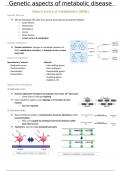
Genetic aspects of metabolic disease
Inborn errors of metabolism (IEMs)
Geneti c Disease
30% of individuals will suffer from genetic based disease during their lifetime
o Cystic fibrosis
o Thalessemia
o Huntingtons
o Cancer
o Heart disease
o In born errors of metabolism
Geneti c mutati ons
Genetic mutations- changes in nucleotide sequence of
DNA- substitution, insertion, or deletion of one or more
base pairs
Causes of mutati on
Spontaneous/ natural Induced
- Replication errors - Intercalating agents
- Tautomerisation - Base analogous
- Deamination - Deaminating agents
- Depurination - Alkylating agents
- Oxidising agents
- Radiation, UV
Spontaneous Mutati ons
1) Replication errors
Normal replication introduces wrong base once every 1010 base pairs
o Good chance it will get repaired
Some repetitive regions cause slippage and insertion of more
repeats
o Can’t be repaired
2) Tautomeric shifts
Bases of DNA are subject to spontaneous structure alterations called
tautomerisation
o They care capable to existing in two forms between which
they interconvert
Tautomers- can form non-standard base pairs
, 3) Deamination
Loss of Amino group
4) Depurination (A or G)
Cleavage of base- sugar bond
Causes of Induced mutati on
Mutagens- external agents that can cause mutation
o Chemical
o Physical
Mutati ons
Chemical 1- Intercalating agents
Insert themselves between bases
o E.g. ethidium bromide
Chemical 2- Base analogues
E.g. Bromouracil (T analogue)
o Incorporated into DNA
o More pore to tautomeric shifts
Chemical 3- Alkylating agents
Add alkyl groups to nucleobases
o e.g. Nitrosamines
Methylbromide (former grain fumigant)
Chemical 4- Deaminating agents
Remove amino groups
o E.g. Nitrous acid (HNO2)
Nitrosamines
Nitrite, Nitrate
o Far quicker than spontaneous deamination
Chemical 5- Oxidising agents
E.g. superoxide ion (O2-), H2O2
Cause of most mutations
Many possible nucleotide alterations
Physical- Radiation, X rays, UV
Break bonds and create free radicals
Bases chemically altered, linked or detached
Leading source of mutation
Number of mutations proportional to radiation dose
Inborn errors of metabolism (IEMs)
Geneti c Disease
30% of individuals will suffer from genetic based disease during their lifetime
o Cystic fibrosis
o Thalessemia
o Huntingtons
o Cancer
o Heart disease
o In born errors of metabolism
Geneti c mutati ons
Genetic mutations- changes in nucleotide sequence of
DNA- substitution, insertion, or deletion of one or more
base pairs
Causes of mutati on
Spontaneous/ natural Induced
- Replication errors - Intercalating agents
- Tautomerisation - Base analogous
- Deamination - Deaminating agents
- Depurination - Alkylating agents
- Oxidising agents
- Radiation, UV
Spontaneous Mutati ons
1) Replication errors
Normal replication introduces wrong base once every 1010 base pairs
o Good chance it will get repaired
Some repetitive regions cause slippage and insertion of more
repeats
o Can’t be repaired
2) Tautomeric shifts
Bases of DNA are subject to spontaneous structure alterations called
tautomerisation
o They care capable to existing in two forms between which
they interconvert
Tautomers- can form non-standard base pairs
, 3) Deamination
Loss of Amino group
4) Depurination (A or G)
Cleavage of base- sugar bond
Causes of Induced mutati on
Mutagens- external agents that can cause mutation
o Chemical
o Physical
Mutati ons
Chemical 1- Intercalating agents
Insert themselves between bases
o E.g. ethidium bromide
Chemical 2- Base analogues
E.g. Bromouracil (T analogue)
o Incorporated into DNA
o More pore to tautomeric shifts
Chemical 3- Alkylating agents
Add alkyl groups to nucleobases
o e.g. Nitrosamines
Methylbromide (former grain fumigant)
Chemical 4- Deaminating agents
Remove amino groups
o E.g. Nitrous acid (HNO2)
Nitrosamines
Nitrite, Nitrate
o Far quicker than spontaneous deamination
Chemical 5- Oxidising agents
E.g. superoxide ion (O2-), H2O2
Cause of most mutations
Many possible nucleotide alterations
Physical- Radiation, X rays, UV
Break bonds and create free radicals
Bases chemically altered, linked or detached
Leading source of mutation
Number of mutations proportional to radiation dose