ATI MED SURGE PROCTORED EXAM 2019 FORM B
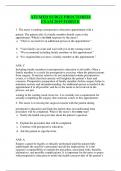
ATI MED SURGE PROCTORED EXAM 2019 FORM B 1. The nurse is making a preoperative education appointment with a patient. The patient asks if a family member should come to the appointment. Which is the best response by the nurse? a. “There is no need for an additional person at the appointment.” b. “Your family can come and wait with you in the waiting room.” c. “We recommend including family members at this appointment.” d. “It is required that you have a family member at this appointment.” ANS: C Including family members in perioperative education is advisable. Often a family member is a coach for postoperative exercises when the patient returns from surgery. If anxious relatives do not understand routine postoperative events, it is likely that their anxiety will heighten the patient’s fears and concerns. Preoperative preparation of family members before surgery helps to minimize anxiety and misunderstanding. An additional person is needed at the appointment if at all possible, and he or she needs to be involved in the process, not just waiting in the waiting room; however, it is certainly not a requirement for actually completing the surgery that someone comes to this appointment. 2. The nurse is reviewing the surgical consent with the patient during preoperative education and finds the patient does not understand what procedure will be completed. What is the nurse’s best next step? a. Notify the health care provider about the patient’s question. b. Explain the procedure that will be completed. c. Continue with preoperative education. d. Ask the patient to sign the form. ANS: A Surgery cannot be legally or ethically performed until the patient fully understands the need for a procedure and all the implications. It is the surgeon’s responsibility to explain the procedure, associated risks, benefits, alternatives, and possible complications. It is important for the nurse to pause with preoperative education to notify the health care provider of the patient’s questions. It is not within the nurse’s scope to explain the procedure. The nurse can certainly reinforce what the health care provider has explained, but the information needs to come from the health care provider. It is not prudent to ask a patient to sign a form for a procedure that he/she does not understand. 3. During preoperative assessment for a 7:30 AM (0730) surgery, the nurse finds the patient drank a cup of coffee this morning. The nurse reports this information to the anesthesia provider. Which action does the nurse anticipate next? a. A delay in or cancellation of surgery b. Questions regarding components of the coffee c. Additional questions about why the patient had coffee Instructions to determine what education was provided in the d. preoperative visit ANS: A The recommendations before nonemergent procedures requiring general and regional anesthesia or sedation/ analgesia include fasting from intake of clear liquids for 2 or more hours. A delay in or cancellation of surgery will be in order for this case. Questions regarding components of the coffee, asking why, and evaluating the preoperative education may all be items to be addressed, especially from a performance improvement perspective, but at this time in caring for this patient, a delay or cancellation is in order to prevent aspiration. 4. The nurse has administered a preoperative medication to the patient going to surgery. Which action will the nurse take next? a. Notify the operating suite that the medication has been given. b. Instruct the patient to call for help to go to the restroom. c. Waste any unused medication according to policy. d. Ask the patient to sign the consent for surgery. ANS: B Once a preoperative medication has been administered, instruct the patient to call for help when getting out of bed to prevent falls. For patient safety, explain the purpose of a preoperative medication and its effects. Notifying the operating suite that the medication has been given may be part of a facilities procedure but is not the best next step. It is important to have the patient sign consents before the patient has received medication that may make him/her drowsy. Wasting unused medication according to policy is important but is not the best next step. 5. The nurse has completed a preoperative assessment for a patient going to surgery and gathers assessment data. Which will be the most important next step for the nurse to take? a. Notify the operating suite that the patient has a latex allergy. b. Document that the patient had a bath at home this morning. c. Administer the ordered preoperative intravenous antibiotic. d. Ask the nursing assistive personnel to obtain vital signs. ANS: A The most important step is notifying the operating suite of the patient’s latex allergy. Many products that contain latex are used in the operating suite and the postanesthesia care unit (PACU). When preparing for a patient with this allergy, special considerations are required from preparation of the room to the types of tubes, gloves, drapes, and instruments utilized. Obtaining vital signs, documenting, and administering medications are all part of the process and should be done—with the latex allergy in mind. However, making sure that the patient has a safe environment is the first step.
École, étude et sujet
- Établissement
- ATI MED SURGE PROCTORE EXA 2019 FORM B
- Cours
- ATI MED SURGE PROCTORE EXA 2019 FORM B
Infos sur le Document
- Publié le
- 16 janvier 2024
- Nombre de pages
- 26
- Écrit en
- 2023/2024
- Type
- Examen
- Contient
- Questions et réponses
Sujets
-
ati med surge proctored exa
-
ati med surge proctored exam 2019 form b

Document également disponible en groupe