W1.1
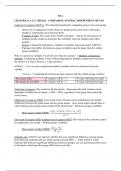
CHAPTER 12.1-12.7 (FIELD) – COMPARING SEVERAL INDEPENDENT MEANS
Analysis of variance/ANOVA: The inferential method for comparing means of several groups
- Allows for a comparison of more than two groups at the same time to determine
whether a relationship exists between them
- F statistic/F-ratio: The result of the ANOVA formula – Allows for the analysis of
multiple groups of data to determine the variability between samples and within
samples
- Factors: Categorical explanatory variables in multiple regression and in ANOVA
- If groups truly differ, the between-group variability must be larger than the within-
group variability!
Why we cannot use multiple T-tests for more than two groups → Multiple comparisons
problem: Conducting multiple T-tests without adjusting for multiple comparisons increases
the chance of a Type I Error (i.e. a false positive)
ANOVA → Two or more categorical predictor variables and one continuous outcome
variable
- Variance = Comparing the between-groups variance with the within-groups variance
The means differ F-statistic will be > 1 P-value will likely be small
The means do not differ F-statistic will be < 1 P-value will likely be large
Total sum of squares: One model for all data points – Represents the total variation in the
dependent variable from its mean (= SSM + SSE), regardless of the group from which the
scores come
Model sum of squares (SSM): How much of the variation can be explained by the model –
Difference between the grand mean and the group means – How much improvement there is
when looking at the group means instead of the grand mean = Between-groups variability
n [ ( x 1−x ) + ( x 2−x ) +⋯ ( xq −x ) ]
2 2 2
- Mean square model (MSM):
g−1
Error sum of squares (SSE)/residual sum of squares (RSS): How much of the variation cannot
be explained by the model = Within-groups variability
2
∑ ( x ig −x g )
- Mean square residual (MSR):
N−g
Omnibus test: ANOVA can indicate whether there are significant difference among groups,
but it does not explicitly tell you which specific groups differ → If the ANOVA result
indicates that there are significant differences between groups, one can perform post-hoc tests
to determine which specific groups differ from each other
, ANOVA significance test:
1. Assumptions:
1. Applicable in cases of a categorical explanatory variable and a quantitative
response variable – The explanatory variable should have at least 3 groups
2. The population distribution of the response variable for the g groups are
approximately normal → Shapiro-Wilk test
3. Homogeneity of variances → Levene’s test
↓
Variations of the traditional F-statistic designed to address situations where the
assumption of homogeneity of variance is violated:
- Brown-Forsythe F
- Welch’s F
4. Independent random samples
2. Hypotheses:
- H 0 : μ1=μ2=…=μ g
- H 1 : at least two of the population means are different
3. Test statistic:
↓
MSM SSM / ⅆ f (amount of groups−1) signal
F= = =
MSE SSE / ⅆ f (total sample ¿of groups) noise
↓
MSM = [ 1
n ( x −x )2 + ( x 2−x )2 +⋯ ( xq −x )2 ]
g−1
2
∑ ( x ig −x g )
MSE =
N−g
4. P-value: 1-F.DIST(F-score; ⅆ f 1; ⅆ f 2; TRUE)
↓
Degrees of freedom:
- ⅆf 1 = g – 1
- ⅆ f 2 = N – g → N = total number of subjects
5. Conclusion: The smaller the P-value, the more unusual the sample data is, the stronger
the evidence against H 0, and the stronger the evidence in favour of H 1
Source df SS MS F P
Model ⅆf 1 M S model × ⅆ f 1 Within-groups MS model P-value
estimate MS error
Error ⅆf 2 MS error × ⅆ f 2 Between-groups
estimate
Total ⅆf 1 + ⅆf 2 Between-groups
SS + Within-
groups SS
, Dummy variable: A categorical value that takes a binary value (0 or 1) to indicate the absence
or presence of some categorical effect that may be expected to shift the outcome – Allow us to
include categorical variables into analyses, which would otherwise be difficult to include due
to their non-numeric nature
Following up a significant F-statistic by looking at model parameters, which provide
information about specific differences between means:
- Dummy coding: The simplest form of contrast coding in which one group is
designated as the reference category (typically mentioned first), and other groups are
compared to this reference (E.g.: if you have three groups (A, B and C), one might
code them as A = 0, B = 1 and C = 0, which allows one to test whether group B differs
from the reference group (i.e. group A)
- Issues with two dummy variables:
- Performing two t-tests inflates the familywise error rate
- The dummy variables might not make all the comparisons that we
want to make
- Planned contrasts: A specific type of contrast coding where one predefines the
comparisons one wants to test before conducting the analysis – Allows one to test a
limited number of comparisons that are meaningful for the research questions (E.g.: in
a study with three groups (A, B and C), one might be interested in comparing A to B
and A to C while ignoring the comparison between B and C)
- Three rules for contrast coding using planned contrasts:
1. If you have a control group, this is usually because you want to
compare it against any other groups.
2. Each contrast must compare only two ‘chunks’ of variation
3. Once a group has been singled out in a contrast it can’t be used in
another contrast – Once a piece of variance has been split from a larger
piece, it cannot be attached to any other pieces of variance, it can only
be subdivided into smaller pieces
- Five rules for assigning values to dummy variables to obtain contrasts:
1. Choose sensible contrasts
2. Groups coded with positive weights will be compared against groups
coded with negative weights – It does not matter which way round this
is done
3. If the weights for a given contrast are added up, the result should be
zero
4. If a group is not involved in a contrast, automatically assign it a weight
of zero, which will eliminate it from the contrast
5. For a given contrast, the weights assigned to the group(s) in one chunk
of variation should be equal to the number of groups in the opposite
chunk of variation
- Post hoc analysis: A statistical analysis specified after a study has been concluded and
the data collected
CHAPTER 12.1-12.7 (FIELD) – COMPARING SEVERAL INDEPENDENT MEANS
Analysis of variance/ANOVA: The inferential method for comparing means of several groups
- Allows for a comparison of more than two groups at the same time to determine
whether a relationship exists between them
- F statistic/F-ratio: The result of the ANOVA formula – Allows for the analysis of
multiple groups of data to determine the variability between samples and within
samples
- Factors: Categorical explanatory variables in multiple regression and in ANOVA
- If groups truly differ, the between-group variability must be larger than the within-
group variability!
Why we cannot use multiple T-tests for more than two groups → Multiple comparisons
problem: Conducting multiple T-tests without adjusting for multiple comparisons increases
the chance of a Type I Error (i.e. a false positive)
ANOVA → Two or more categorical predictor variables and one continuous outcome
variable
- Variance = Comparing the between-groups variance with the within-groups variance
The means differ F-statistic will be > 1 P-value will likely be small
The means do not differ F-statistic will be < 1 P-value will likely be large
Total sum of squares: One model for all data points – Represents the total variation in the
dependent variable from its mean (= SSM + SSE), regardless of the group from which the
scores come
Model sum of squares (SSM): How much of the variation can be explained by the model –
Difference between the grand mean and the group means – How much improvement there is
when looking at the group means instead of the grand mean = Between-groups variability
n [ ( x 1−x ) + ( x 2−x ) +⋯ ( xq −x ) ]
2 2 2
- Mean square model (MSM):
g−1
Error sum of squares (SSE)/residual sum of squares (RSS): How much of the variation cannot
be explained by the model = Within-groups variability
2
∑ ( x ig −x g )
- Mean square residual (MSR):
N−g
Omnibus test: ANOVA can indicate whether there are significant difference among groups,
but it does not explicitly tell you which specific groups differ → If the ANOVA result
indicates that there are significant differences between groups, one can perform post-hoc tests
to determine which specific groups differ from each other
, ANOVA significance test:
1. Assumptions:
1. Applicable in cases of a categorical explanatory variable and a quantitative
response variable – The explanatory variable should have at least 3 groups
2. The population distribution of the response variable for the g groups are
approximately normal → Shapiro-Wilk test
3. Homogeneity of variances → Levene’s test
↓
Variations of the traditional F-statistic designed to address situations where the
assumption of homogeneity of variance is violated:
- Brown-Forsythe F
- Welch’s F
4. Independent random samples
2. Hypotheses:
- H 0 : μ1=μ2=…=μ g
- H 1 : at least two of the population means are different
3. Test statistic:
↓
MSM SSM / ⅆ f (amount of groups−1) signal
F= = =
MSE SSE / ⅆ f (total sample ¿of groups) noise
↓
MSM = [ 1
n ( x −x )2 + ( x 2−x )2 +⋯ ( xq −x )2 ]
g−1
2
∑ ( x ig −x g )
MSE =
N−g
4. P-value: 1-F.DIST(F-score; ⅆ f 1; ⅆ f 2; TRUE)
↓
Degrees of freedom:
- ⅆf 1 = g – 1
- ⅆ f 2 = N – g → N = total number of subjects
5. Conclusion: The smaller the P-value, the more unusual the sample data is, the stronger
the evidence against H 0, and the stronger the evidence in favour of H 1
Source df SS MS F P
Model ⅆf 1 M S model × ⅆ f 1 Within-groups MS model P-value
estimate MS error
Error ⅆf 2 MS error × ⅆ f 2 Between-groups
estimate
Total ⅆf 1 + ⅆf 2 Between-groups
SS + Within-
groups SS
, Dummy variable: A categorical value that takes a binary value (0 or 1) to indicate the absence
or presence of some categorical effect that may be expected to shift the outcome – Allow us to
include categorical variables into analyses, which would otherwise be difficult to include due
to their non-numeric nature
Following up a significant F-statistic by looking at model parameters, which provide
information about specific differences between means:
- Dummy coding: The simplest form of contrast coding in which one group is
designated as the reference category (typically mentioned first), and other groups are
compared to this reference (E.g.: if you have three groups (A, B and C), one might
code them as A = 0, B = 1 and C = 0, which allows one to test whether group B differs
from the reference group (i.e. group A)
- Issues with two dummy variables:
- Performing two t-tests inflates the familywise error rate
- The dummy variables might not make all the comparisons that we
want to make
- Planned contrasts: A specific type of contrast coding where one predefines the
comparisons one wants to test before conducting the analysis – Allows one to test a
limited number of comparisons that are meaningful for the research questions (E.g.: in
a study with three groups (A, B and C), one might be interested in comparing A to B
and A to C while ignoring the comparison between B and C)
- Three rules for contrast coding using planned contrasts:
1. If you have a control group, this is usually because you want to
compare it against any other groups.
2. Each contrast must compare only two ‘chunks’ of variation
3. Once a group has been singled out in a contrast it can’t be used in
another contrast – Once a piece of variance has been split from a larger
piece, it cannot be attached to any other pieces of variance, it can only
be subdivided into smaller pieces
- Five rules for assigning values to dummy variables to obtain contrasts:
1. Choose sensible contrasts
2. Groups coded with positive weights will be compared against groups
coded with negative weights – It does not matter which way round this
is done
3. If the weights for a given contrast are added up, the result should be
zero
4. If a group is not involved in a contrast, automatically assign it a weight
of zero, which will eliminate it from the contrast
5. For a given contrast, the weights assigned to the group(s) in one chunk
of variation should be equal to the number of groups in the opposite
chunk of variation
- Post hoc analysis: A statistical analysis specified after a study has been concluded and
the data collected