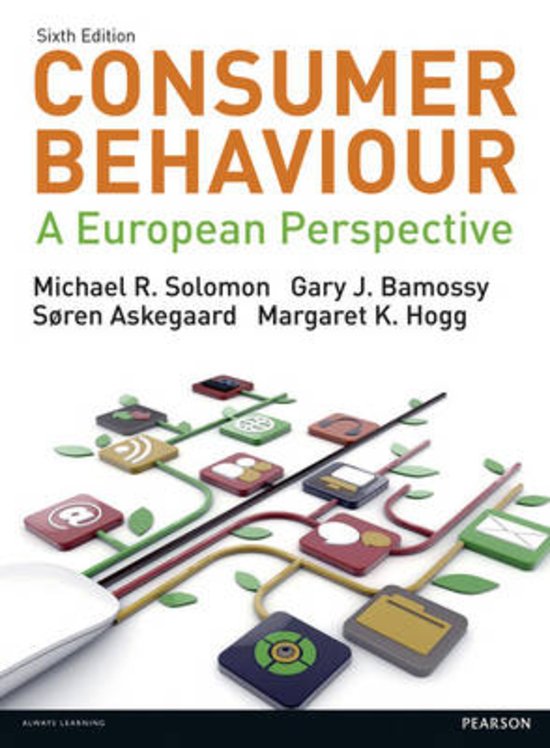
Consumer behaviour
CH 1
Role theory: the perspective in which we look at the different roles played by consumers.
Relationship marketing: Maintaining a bond
Database marketing: tracking the customers
Global consumer culture: people that are dedicated to their brand, popstar etc.
B2C e commerce: buyer to consumer
C2C e commerce: consumer to consumer (marktplaats)
Digital native: student who grew up with the internet
Horizontal revolution; information that flows not only from hierarchy to customers but also from
customer to customer.
Synchronous interactions: real time online communication
Asynchronous interaction: allows you not to apply right away
Culture of participation: democracy through the internet
There are still issues with ethical standards of products and socially responsible behaviour since many
companies lie about their products.
Social marketing: to encourage positive behaviour
Marketers do not create artificial needs they do however heavily influence them
Paradigm: fundamental assumptions formed in research
Positivism: basic assumptions under the dominant ones, encourages to stress the function of objects
and regard the world as rational and ordered
Interpretivism: focuses more on culture and complexity
Our present society has turned into a consumer society through the increased complexity of how we
look at society nowadays.
CH 9
The biggest issue today is that consumers have too much choice of products aka consumer hyper
choice.
,Constructive processing: the strategies used in processing information to finally come to a decision
Mental budget: helps us estimate how we will consume the product and in which time frame so that
we can regulate what to do in the present
People differ in their cognitive processing style aka the way they process information to come to a
decision.
Counteractive construal: when they exaggerate the negative aspects of their behaviour that will
interfere with the ultimate goal.
Executive control center: place in the brain that helps with making decisions, and that can be
distracted or worn down.
Different kinds of decision processes
Extended problem solving: careful rational, information collecting. Weighing out alternatives and
brands
Limited problem solving: making decisions according to the simple guidelines or rules.
Three buckets of decision making:
Congnitive- habitual ( natural)- affective (emotional)
Possible steps in consumer decision making: problem recognition- information research- evaluation
of alternative- product choice- outcomes
Primary demand: the actual need of a product
Secondary demand: the preference of brand colour etc.
Cybermediary: comparison websites
Reputation economy: websites such as tripadvisor and urban spoon that set the reputation for
companies.
Brand advocates: people who supply their opinion online (review)
If a product needs extensive research a perceived risk can be created, the believe that the product
potentially has negative consequences.
Types of risks:
- Monetary risk
- Functional risk
- Physical risk
- Social risk
- Physiological risk
, Weighing up the alternatives in a decision making process exist out of 3 sets: evoked sets which exits
out of products already in memory and in the familiar environment . besides that you have the inert
set and the inept set.
Hybrid product: two products in one
A big things in the decision making process is that we put products in categories we already know.
Superordinate category: like fruit
Subordinate category: in brands
Positioning: is making the product something else then it was intended to be, e.g. orange juice used
to be a breakfast juice but now an all-day juice.
Determinant attributes: are the features that separate a product from the other ones’
The decision making process in which a consumer under goes the cognitive stage is called procedural
learning.
you have two types of rules: compensatory and non-compensatory. Non-compensatory when a
product is low in one attribute and the other attributes cant composite that. Lexicographic rule is
when you select on brand. And then you have the elimination-by-aspects rule is evaluation on the
one most important attribute. And the conjunctive rule choose a brand on the amount of cut offs.
Compensatory decision rules allows to balance out the bad and the good.
Neuromarketing: uses brain measurements to see consumer behaviour.
Feature creep/fatigue: overload of features that makes the customer journey even more complicated.
Steps in the decision making process:
- Problem recognition
- Information search
- Weighing out the alternatives
- Purchase
- Evaluation
Ways of showing dissatisfaction with a product are:
1. Voice response
2. Private response
3. Third-party response
Habitual decision making: decisions made with barely any conscious effort
Purchase momentum: instead of satisfied by the purchase and cancelling out problem recognition
the need for more occurs.
There is a difference between brand loyalty (apple) and inertia (just throwing it in the shopping cart).
Psychology of loss aversion: we emphasize our loses more than our gains.
CH 1
Role theory: the perspective in which we look at the different roles played by consumers.
Relationship marketing: Maintaining a bond
Database marketing: tracking the customers
Global consumer culture: people that are dedicated to their brand, popstar etc.
B2C e commerce: buyer to consumer
C2C e commerce: consumer to consumer (marktplaats)
Digital native: student who grew up with the internet
Horizontal revolution; information that flows not only from hierarchy to customers but also from
customer to customer.
Synchronous interactions: real time online communication
Asynchronous interaction: allows you not to apply right away
Culture of participation: democracy through the internet
There are still issues with ethical standards of products and socially responsible behaviour since many
companies lie about their products.
Social marketing: to encourage positive behaviour
Marketers do not create artificial needs they do however heavily influence them
Paradigm: fundamental assumptions formed in research
Positivism: basic assumptions under the dominant ones, encourages to stress the function of objects
and regard the world as rational and ordered
Interpretivism: focuses more on culture and complexity
Our present society has turned into a consumer society through the increased complexity of how we
look at society nowadays.
CH 9
The biggest issue today is that consumers have too much choice of products aka consumer hyper
choice.
,Constructive processing: the strategies used in processing information to finally come to a decision
Mental budget: helps us estimate how we will consume the product and in which time frame so that
we can regulate what to do in the present
People differ in their cognitive processing style aka the way they process information to come to a
decision.
Counteractive construal: when they exaggerate the negative aspects of their behaviour that will
interfere with the ultimate goal.
Executive control center: place in the brain that helps with making decisions, and that can be
distracted or worn down.
Different kinds of decision processes
Extended problem solving: careful rational, information collecting. Weighing out alternatives and
brands
Limited problem solving: making decisions according to the simple guidelines or rules.
Three buckets of decision making:
Congnitive- habitual ( natural)- affective (emotional)
Possible steps in consumer decision making: problem recognition- information research- evaluation
of alternative- product choice- outcomes
Primary demand: the actual need of a product
Secondary demand: the preference of brand colour etc.
Cybermediary: comparison websites
Reputation economy: websites such as tripadvisor and urban spoon that set the reputation for
companies.
Brand advocates: people who supply their opinion online (review)
If a product needs extensive research a perceived risk can be created, the believe that the product
potentially has negative consequences.
Types of risks:
- Monetary risk
- Functional risk
- Physical risk
- Social risk
- Physiological risk
, Weighing up the alternatives in a decision making process exist out of 3 sets: evoked sets which exits
out of products already in memory and in the familiar environment . besides that you have the inert
set and the inept set.
Hybrid product: two products in one
A big things in the decision making process is that we put products in categories we already know.
Superordinate category: like fruit
Subordinate category: in brands
Positioning: is making the product something else then it was intended to be, e.g. orange juice used
to be a breakfast juice but now an all-day juice.
Determinant attributes: are the features that separate a product from the other ones’
The decision making process in which a consumer under goes the cognitive stage is called procedural
learning.
you have two types of rules: compensatory and non-compensatory. Non-compensatory when a
product is low in one attribute and the other attributes cant composite that. Lexicographic rule is
when you select on brand. And then you have the elimination-by-aspects rule is evaluation on the
one most important attribute. And the conjunctive rule choose a brand on the amount of cut offs.
Compensatory decision rules allows to balance out the bad and the good.
Neuromarketing: uses brain measurements to see consumer behaviour.
Feature creep/fatigue: overload of features that makes the customer journey even more complicated.
Steps in the decision making process:
- Problem recognition
- Information search
- Weighing out the alternatives
- Purchase
- Evaluation
Ways of showing dissatisfaction with a product are:
1. Voice response
2. Private response
3. Third-party response
Habitual decision making: decisions made with barely any conscious effort
Purchase momentum: instead of satisfied by the purchase and cancelling out problem recognition
the need for more occurs.
There is a difference between brand loyalty (apple) and inertia (just throwing it in the shopping cart).
Psychology of loss aversion: we emphasize our loses more than our gains.