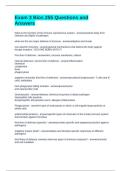
Praxis 5169 Middle School Math Questions and Answers Rated A+
Praxis 5169 Middle School Math Questions and Answers Rated A+ How to find the LCM multiply the number by 1,2,3 and so on until the same number appears to test proportions and make sure the ratios are equal cross multiply percentage as proportions can be solved by part/whole=n/100 (n stands for unknown number) prime factorization start dividing the number with 2 until you can't anymore than go to 3, 5, and so on and so forth greatest common factor list the factors of the numbers in question and find the GCF how to work with radicals factor the number under the radical and then pull out and 2 factors to the outside. multiplying radicals multiply the number under the radical and then find the square root of the number solving problems that have a direct variation use model y=kx (for instance: the value of y varies directly with x. If x=12 and y=30, find the value of y when x=18) you plug the numbers given into the formula and find k, then plug in the second number given in and find x. solving problems that have a indirect variation use the model xy=k (for instance: the value of y varies indirectly with x. If x=12 and y=30, find the value of y when x=18) you plug the numbers given into the formula and find k, then plug in the second number given and find x number lines of linear equations dark circle it is great then or equal too open circle it is not equal too quadratic formula x equal -b plus or minus square root now sing it with me b squared minus 4ac over 2a now divide with me domain and range the x values are domain and the y values are the range The sets of number is a function if the x values don't repeat to find the axis of symmetry use the formula x=-b/2a distance formula d = √[( x₂ - x₁)² + (y₂ - y₁)²] midpoint formula (x₁+x₂)/2, (y₁+y₂)/2 complementary angle Two angles whose sum is 90 degrees supplementary angles Two angles whose sum is 180 degrees triangle the sum of a triangle is 180 degrees equilateral triangle A triangle with three congruent sides isosceles triangle A triangle that has 2 equal sides. scalene triangle a triangle with no congruent sides acute triangle A triangle with 3 acute angles right triangle a triangle with one right angle obtuse triangle a triangle with one obtuse angle pythagorean theorem a²+b²=c² ; used when 2 sides of a right triangle are known, a and b are the legs and c is the hypotenuse quadrilateral A four-sided polygon. the sum of the measures of the four angles is 360 degrees. trapezoid A quadrilateral with exactly one pair of parallel sides parallelogram a quadrilateral with both pairs of opposite sides parallel rhombus has 4 equal sides and the diagonals are perpendicular square A parallelogram with four congruent sides and four right angles. kite A quadrilateral that has two pairs of consecutive congruent sides, but opposite sides are not congruent. side-side-side If three sides of one triangle are congruent to three sides of another triangle, then the triangles are congruent. side-angle-side If two sides and the included angle of one triangle are congruent to the corresponding parts of another triangle, the triangles are congruent. angle-side-angle If a triangles two angles and its included side are congruent to another triangle's two angles and its included side, then they are congruent angle-angle-side If two angles and a non-included side of one triangle are congruent to two angles and the corresponding non included side of a second triangle then the two are congruent hypotenuse leg -if 2 right triangles have congruent hypotenuses and one pair of congruent legs, then the triangles are congruent perimeter The distance around a figure area of a triangle A=1/2bh area of a parallelogram A=bh area of a trapezoid A=1/2h(b1+b2) area of a rectangle A=lw area of a square A=s^2 area of a rhombus A=1/2(d1)(d2) similar geometric figures formula side 1 larger/side 1 smaller=side 2 larger/side 2 smaller circle a circle measures 360 degrees circumference of a circle C = 2πr length of the arc formula m/360(2"pi"r area of a circle A=πr² to find the area of the inscribed circle find the area of the square find the area of the circle subtract the square area from the circle area surface area of a rectangular solid SA= 2LW + 2LW + 2WH surface area of a cube 6s^2 surface area of a cylinder 2πrh+2πr² surface area of a regular pyramid S=1/2Pl+B, where P is the perimeter of the base, l is the slant height, and B is the area of the base surface area of a cone πrl+πr² surface area of a sphere 4πr² volume of a rectangular solid V=L*w*h volume of a cylinder V=πr²h volume of a pyramid V=1/3Bh volume of a cone 1/3πr²h volume of a sphere 4/3πr³ volume of a cube s^3 reflection A transformation that "flips" a figure over a mirror or reflection line. rotation a transformation that turns a figure about a fixed point translation a transformation that changes the location of an image, but not its size or orientation duplicating a line segment Drawing a line segment that is the same length as a given line segment. duplicating an angle Drawing an angle that is the same measure as a given angle. segment bisector a segment, ray, line, or plane that intersects a segment at its midpoint line perpendicular to a given line from a given point A line that is perpendicular to a given line and a given point on that line. angle bisector a ray that divides an angle into two congruent angles 1 cup 8 oz 1 pint 2 cups or 16 oz 1 quart 32 oz 1 gallon 4 quarts interest formula interest formula: A = P(1 + rt) where P is the Principal amount of money to be invested at an Interest Rate R% per period for t Number of Time Periods.
École, étude et sujet
- Établissement
- Praxis 5169 Middle School Math
- Cours
- Praxis 5169 Middle School Math
Infos sur le Document
- Publié le
- 5 décembre 2023
- Nombre de pages
- 10
- Écrit en
- 2023/2024
- Type
- Examen
- Contient
- Questions et réponses
Sujets
-
praxis 5169 middle school math questions and answe

Document également disponible en groupe