CRIMINAL LAW CRYPT SHEET
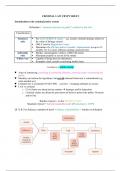
Introduction to the criminal justice system
Defendant = “innocent until proven guilty”+ entitled to fair trial
Classification
Summary For LESS SERIOUS crimes – e.g. assault, criminal damage subject to
only the value of damage caused
ONLY tried in Magistrates Courts
Maximum of a £5k fine and/or 6 months’ imprisonment (or up to 12
months’ for 2 or more offenses running consecutively)
Indictable Murder, manslaughter, robbery, GBH with intent
only Maximum penalty as set out in the statute
‘Either way’ Capable of being tried on indictment
Examples: theft, assault occasioning bodily harm
A crime is a ‘public wrong’
© Aims of sentencing: punishing & reforming offenders, reducing crime + protecting the
public
© Morality can inform the legislature, but not all immoral behaviour is criminalised (e.g.
extra-marital sex)
© Criminal law is constantly EVOLVING – case law + changing attitudes in society
© Civil vs criminal
o Civil claims are about private matters damages and/or injunction
o Criminal claims are about the prevention of harm to protect the public prison
and/or fine
Burden of proof = on the PROSECUTION
Standard of proof = beyond reasonable doubt (Woolmington v DPP)
N.B. For defences, standard of proof = balance of probabilities + burden on defendant
,Topic (1) Core Principles of criminal liability
Criminal liability = actus reus + mens rea + absence of a valid defence
Actus reus (guilty action)
FOUR different categories of offences (a crime can fit into more than one):
1. Conduct Acts must have been committed by D to satisfy actus reus
Example: blackmail (s 21 Theft Act 1968) – not necessary that the
victim gives into the demand or that anything happens as a result, only
that the D makes a demand with menaces
2. Result Action must lead to a specified consequence
Example: murder – actions of D must cause the death of V
3. Circumstances Particular surrounding circumstances is needed
Example: theft (s 1(1) Theft Act 1968) – must appropriate property
‘belonging to another’
4. Omissions While general rule = that there is NO liability to act, in certain
circumstances there may be a legal obligation to act
Example: an on-duty lifeguard could be liable for gross negligence
manslaughter if a swimmer drowns because they fail to intervene
Examples: actus reus
s 1(1) Criminal Damage Act 1971 - damage/destruction + property + belonging to another
+ without lawful excuse
s 1(1) Theft Act 1968 - appropriation + property + belonging to another
Result crimes
Result crimes require that the defendant’s conduct CAUSE a particular result (e.g. murder,
manslaughter, criminal damage & assault occasioning actual bodily harm)
Result crimes = Factual causation + legal causation + absence of NAI
Factual Causation: 'BUT FOR' test - 'but for' the acts or omissions of the accused, the
relevant consequence would not have occurred in the way that it did (R v White)
- N.B. Any action which accelerates death IS a cause (R v Dyson)
Legal Causation: checking the CULPABILITY of the defendant
© D is ‘operating and substantial cause’ of the prohibited consequence (R v Pagett)
o D’s act must be 'substantial' cause = more than minimal (R v Hughes)
o Consequence must be caused BY the defendant's culpable act (R v Dalloway)
o D’s act need NOT be the only cause of the prohibited consequence (R v Benge)
, Use common sense if a new situation
arises! (R v Girdler)
Absence of NAI
Medical negligence Acts of third party Acts of victim Thin skull rule Natural events
1. Medical Courts RELUCTANT to allow medical malpractice to break chain:
negligence 2nd cause must be ‘so overwhelming (R v Smith)
Negligent treatment must be ‘so independent’ and ‘itself so potent in
causing death’ that D’s acts are ‘insignificant’ (R v Cheshire)
2. Acts of Actions of third party will only break the chain of causation if they were
third party ‘free, deliberate and informed’ (R v Pagett)
3. Acts of i) Fright and flight – was V’s actions ‘so daft and unexpected that no
victim reasonable person could have foreseen it’? (R v Roberts)
© Jury has same knowledge D had when they committed act (Roberts)
© Characteristics of victim = that which would be visible to a
reasonable man present at the time of D’s act (Williams and Davies)
ii) Refusing medical treatment
© R v Blaue - must take V as they find them both in mind & in body
(refusal to have a blood transfusion due to religious beliefs)
© R v Holland - does not matter whether wound was instantly mortal, or
cause of death was because V refused recommended treatment
© R v Dear - irrelevant whether V deliberately caused
resumption/continuation of bleeding as D’s conduct continues to be
an operative & significant contribution to death
iii) Suicide – whether a victim’s suicide has been caused BY the defendant =
question of fact that juries should apply their common sense to (R v Wallace)
May NOT break chain where:
V nonetheless dies from the original wound (R v Dear)
Act was reasonably foreseeable (applying the rule in R v Roberts and R v
Williams and Davies)
D’s unlawful act = a significant & operating cause of death + at time of
attack suicide because of injuries = reasonably foreseeable (R v Wallace)
MAY break chain where:
injuries inflicted by D have healed, but V goes on to die by suicide
(distinguishing R v Dear)
Voluntary and informed decision of V to act (R v Kennedy – a person
who supplies a drug to another has NOT caused that drug to be
administered when the other injects it)
4. Thin skull Defendant MUST take the victim as they find them (R v Hayward)
rule
5. Natural Will ONLY break the chain of causation if they are ‘extraordinary’ and NOT
events reasonably foreseeable
Omissions
Introduction to the criminal justice system
Defendant = “innocent until proven guilty”+ entitled to fair trial
Classification
Summary For LESS SERIOUS crimes – e.g. assault, criminal damage subject to
only the value of damage caused
ONLY tried in Magistrates Courts
Maximum of a £5k fine and/or 6 months’ imprisonment (or up to 12
months’ for 2 or more offenses running consecutively)
Indictable Murder, manslaughter, robbery, GBH with intent
only Maximum penalty as set out in the statute
‘Either way’ Capable of being tried on indictment
Examples: theft, assault occasioning bodily harm
A crime is a ‘public wrong’
© Aims of sentencing: punishing & reforming offenders, reducing crime + protecting the
public
© Morality can inform the legislature, but not all immoral behaviour is criminalised (e.g.
extra-marital sex)
© Criminal law is constantly EVOLVING – case law + changing attitudes in society
© Civil vs criminal
o Civil claims are about private matters damages and/or injunction
o Criminal claims are about the prevention of harm to protect the public prison
and/or fine
Burden of proof = on the PROSECUTION
Standard of proof = beyond reasonable doubt (Woolmington v DPP)
N.B. For defences, standard of proof = balance of probabilities + burden on defendant
,Topic (1) Core Principles of criminal liability
Criminal liability = actus reus + mens rea + absence of a valid defence
Actus reus (guilty action)
FOUR different categories of offences (a crime can fit into more than one):
1. Conduct Acts must have been committed by D to satisfy actus reus
Example: blackmail (s 21 Theft Act 1968) – not necessary that the
victim gives into the demand or that anything happens as a result, only
that the D makes a demand with menaces
2. Result Action must lead to a specified consequence
Example: murder – actions of D must cause the death of V
3. Circumstances Particular surrounding circumstances is needed
Example: theft (s 1(1) Theft Act 1968) – must appropriate property
‘belonging to another’
4. Omissions While general rule = that there is NO liability to act, in certain
circumstances there may be a legal obligation to act
Example: an on-duty lifeguard could be liable for gross negligence
manslaughter if a swimmer drowns because they fail to intervene
Examples: actus reus
s 1(1) Criminal Damage Act 1971 - damage/destruction + property + belonging to another
+ without lawful excuse
s 1(1) Theft Act 1968 - appropriation + property + belonging to another
Result crimes
Result crimes require that the defendant’s conduct CAUSE a particular result (e.g. murder,
manslaughter, criminal damage & assault occasioning actual bodily harm)
Result crimes = Factual causation + legal causation + absence of NAI
Factual Causation: 'BUT FOR' test - 'but for' the acts or omissions of the accused, the
relevant consequence would not have occurred in the way that it did (R v White)
- N.B. Any action which accelerates death IS a cause (R v Dyson)
Legal Causation: checking the CULPABILITY of the defendant
© D is ‘operating and substantial cause’ of the prohibited consequence (R v Pagett)
o D’s act must be 'substantial' cause = more than minimal (R v Hughes)
o Consequence must be caused BY the defendant's culpable act (R v Dalloway)
o D’s act need NOT be the only cause of the prohibited consequence (R v Benge)
, Use common sense if a new situation
arises! (R v Girdler)
Absence of NAI
Medical negligence Acts of third party Acts of victim Thin skull rule Natural events
1. Medical Courts RELUCTANT to allow medical malpractice to break chain:
negligence 2nd cause must be ‘so overwhelming (R v Smith)
Negligent treatment must be ‘so independent’ and ‘itself so potent in
causing death’ that D’s acts are ‘insignificant’ (R v Cheshire)
2. Acts of Actions of third party will only break the chain of causation if they were
third party ‘free, deliberate and informed’ (R v Pagett)
3. Acts of i) Fright and flight – was V’s actions ‘so daft and unexpected that no
victim reasonable person could have foreseen it’? (R v Roberts)
© Jury has same knowledge D had when they committed act (Roberts)
© Characteristics of victim = that which would be visible to a
reasonable man present at the time of D’s act (Williams and Davies)
ii) Refusing medical treatment
© R v Blaue - must take V as they find them both in mind & in body
(refusal to have a blood transfusion due to religious beliefs)
© R v Holland - does not matter whether wound was instantly mortal, or
cause of death was because V refused recommended treatment
© R v Dear - irrelevant whether V deliberately caused
resumption/continuation of bleeding as D’s conduct continues to be
an operative & significant contribution to death
iii) Suicide – whether a victim’s suicide has been caused BY the defendant =
question of fact that juries should apply their common sense to (R v Wallace)
May NOT break chain where:
V nonetheless dies from the original wound (R v Dear)
Act was reasonably foreseeable (applying the rule in R v Roberts and R v
Williams and Davies)
D’s unlawful act = a significant & operating cause of death + at time of
attack suicide because of injuries = reasonably foreseeable (R v Wallace)
MAY break chain where:
injuries inflicted by D have healed, but V goes on to die by suicide
(distinguishing R v Dear)
Voluntary and informed decision of V to act (R v Kennedy – a person
who supplies a drug to another has NOT caused that drug to be
administered when the other injects it)
4. Thin skull Defendant MUST take the victim as they find them (R v Hayward)
rule
5. Natural Will ONLY break the chain of causation if they are ‘extraordinary’ and NOT
events reasonably foreseeable
Omissions