SUMMARY POLICY ANALYSIS
,LEARNING GOALS
Lecture 2 – Equity, Efficiency & Welfare:
1. Explaining what the policy goals of equity, efficiency and welfare, mean according to the
polis perspective.
2. Explain what the policy goals of equity, efficiency and welfare mean according to the market
perspective.
3. Compare the polis perspective and market perspective on equity, efficiency and welfare.
4. Apply these insights on concrete policy issues.
Lecture 3 – Liberty & Security:
1. Explain what the policy goals of liberty and security mean according to the polis perspective.
2. Explain what the policy goals of liberty and security mean according to the market
perspective.
3. Compare the polis perspective and market perspective on liberty and security.
4. Apply these insights on concrete policy issues.
5. Compare the rational perspective on policy goals to the political perspective on policy goals.
Lecture 4 – Symbols, Numbers & Causes:
1. You can explain how the polis view on problems differs from the market perspective.
2. You can explain what symbols, numbers and causes according to Stone and how they serve
problem construction.
3. You can apply the characteristics of symbols, numbers and causes to practical cases.
Lecture 6 – Incentives, Rules & Facts
1. You can explain what incentives, rules and facts are according to Stone and how they
function in problem-solving from the polis perspective.
2. You can apply the characteristics of incentives, rules, and facts to practical cases.
Lecture 7 – Rights & Power
1. You can explain what rights and power are according to stone and how they function in
problem-solving from the polis perspective.
2. You can apply the characteristics of rights and power to practical cases.
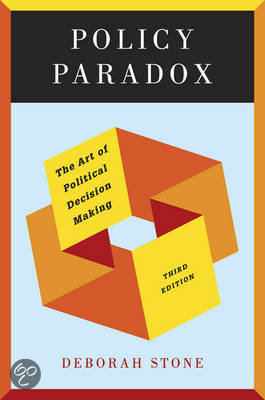
,POLICY PARADOX
LECTURE 1 – INTRODUCTION
CHAPTER 1: THE MARKET AND THE POLIS
There are two concepts of the society; on the one hand we have the Market perspective and on the
other hand we have the polis perspective. They are both ways of looking at public problems and how
they are framed, this is called policy analysis. So there are two approaches of analyzing problems and
proscribe solutions:
1. Analyse political nature of policy (problems/solutions) political.
2. Do a rational policy analysis for a fictional client rational.
We look at policy problems and solutions from the rational perspective (market) and the political
perspective (polis).
1. Rational Perspective: De Haan/De Heer
- Using rational tools on complex problems helps you design optimal solutions.
- Solutions are not really addressing the problem:
o Beware of solution-reflex. If the solution seems logical is does not mean that it
necessarily addresses the problem.
o Systematically dealing with complexity (stakeholder analysis).
2. Political Perspective (policy paradox): Stone
- Critique the idea that policy making is a rational process. You must look for the politics in
things.
- Even within the rational tools there is politics.
- Policy is not rational. Policy is political and at its core is the political community (= polis).
o Policy making is about the battle between ideals and ideas.
o With the aim of convincing others through stories
o Knowledge is part of the battle but is twisted and bended to fit the dominant
storylines.
o This impacts policy analysis, because the things that seem logically if you follow
analytical models do not necessarily reflect the way the world works.
A market is simply defined as a social system in which individuals pursue their own welfare by
exchanging things with others whenever trades are mutually beneficial. Participants in a market
compete with each other for scarce resources. In the market model individuals act only to maximize
their own self-interest = their own welfare.
COMMUNITY
, The polis model on the other hand talks about politics and policy happening in communities.
Communities that are trying to achieve something as communities. A model of the polis must assume
collective will and collective effort. A community must have members and some way of defining
them. For membership definitions and rules determine who is allowed in the community.
A model of the polis must include a distinction between political community and cultural
community.
Political community: a group of people who live under the same political rules and structure
of governance.
Cultural community: a group of people who share a culture and draw their identities from
shared language, history, and traditions.
Membership in a community defines social and economic rights as well as political rights. Members
of a community help each other in all kinds of non-monetary ways mutual aid is a kind of social
insurance. In the polis mutual aid is a good that people create collectively in order to protect each
other and their community.
In the market model, insurance is a financial product that firms sell in order to make a profit and
buyers buy in order to create economic security for themselves.
ALTRUISM
According to the polis, humans are social creatures and care about others as well as themselves.
Altruism means acting in order to benefit others rather than yourself. The rational perspective sees
humans as only self-interested. Thomas Hobbes states that “No man giveth but with intention of
good to himself”. Behind every altruistic behavior lurks self-interested motive. The paradox of
altruism is: when people act to benefit others, they feel satisfaction, fulfillment, and a sense that
helping others gives their lives meaning. In the polis people have both self-interested and altruistic
motivations.
PUBLIC INTEREST
In the polis there is a public interest this can mean several things. For example, individual
interests held in common, things everyone wants for themselves, individuals’ goals for their
community. A private, rather self-interested side and a more public-spirited side. The concept of
public interest is to the polis what self-interest is to the market. We assume that people behave as if
they were trying to realize the public interest or maximize their self-interest. In market theory the
public interest is the net result of all individuals pursuing their self-interest.
COMMONS PROBLEMS
Situations where self-interest and public interest work against each other are known as commons
problems and in the polis commons problems are common. Example:
,LEARNING GOALS
Lecture 2 – Equity, Efficiency & Welfare:
1. Explaining what the policy goals of equity, efficiency and welfare, mean according to the
polis perspective.
2. Explain what the policy goals of equity, efficiency and welfare mean according to the market
perspective.
3. Compare the polis perspective and market perspective on equity, efficiency and welfare.
4. Apply these insights on concrete policy issues.
Lecture 3 – Liberty & Security:
1. Explain what the policy goals of liberty and security mean according to the polis perspective.
2. Explain what the policy goals of liberty and security mean according to the market
perspective.
3. Compare the polis perspective and market perspective on liberty and security.
4. Apply these insights on concrete policy issues.
5. Compare the rational perspective on policy goals to the political perspective on policy goals.
Lecture 4 – Symbols, Numbers & Causes:
1. You can explain how the polis view on problems differs from the market perspective.
2. You can explain what symbols, numbers and causes according to Stone and how they serve
problem construction.
3. You can apply the characteristics of symbols, numbers and causes to practical cases.
Lecture 6 – Incentives, Rules & Facts
1. You can explain what incentives, rules and facts are according to Stone and how they
function in problem-solving from the polis perspective.
2. You can apply the characteristics of incentives, rules, and facts to practical cases.
Lecture 7 – Rights & Power
1. You can explain what rights and power are according to stone and how they function in
problem-solving from the polis perspective.
2. You can apply the characteristics of rights and power to practical cases.
,POLICY PARADOX
LECTURE 1 – INTRODUCTION
CHAPTER 1: THE MARKET AND THE POLIS
There are two concepts of the society; on the one hand we have the Market perspective and on the
other hand we have the polis perspective. They are both ways of looking at public problems and how
they are framed, this is called policy analysis. So there are two approaches of analyzing problems and
proscribe solutions:
1. Analyse political nature of policy (problems/solutions) political.
2. Do a rational policy analysis for a fictional client rational.
We look at policy problems and solutions from the rational perspective (market) and the political
perspective (polis).
1. Rational Perspective: De Haan/De Heer
- Using rational tools on complex problems helps you design optimal solutions.
- Solutions are not really addressing the problem:
o Beware of solution-reflex. If the solution seems logical is does not mean that it
necessarily addresses the problem.
o Systematically dealing with complexity (stakeholder analysis).
2. Political Perspective (policy paradox): Stone
- Critique the idea that policy making is a rational process. You must look for the politics in
things.
- Even within the rational tools there is politics.
- Policy is not rational. Policy is political and at its core is the political community (= polis).
o Policy making is about the battle between ideals and ideas.
o With the aim of convincing others through stories
o Knowledge is part of the battle but is twisted and bended to fit the dominant
storylines.
o This impacts policy analysis, because the things that seem logically if you follow
analytical models do not necessarily reflect the way the world works.
A market is simply defined as a social system in which individuals pursue their own welfare by
exchanging things with others whenever trades are mutually beneficial. Participants in a market
compete with each other for scarce resources. In the market model individuals act only to maximize
their own self-interest = their own welfare.
COMMUNITY
, The polis model on the other hand talks about politics and policy happening in communities.
Communities that are trying to achieve something as communities. A model of the polis must assume
collective will and collective effort. A community must have members and some way of defining
them. For membership definitions and rules determine who is allowed in the community.
A model of the polis must include a distinction between political community and cultural
community.
Political community: a group of people who live under the same political rules and structure
of governance.
Cultural community: a group of people who share a culture and draw their identities from
shared language, history, and traditions.
Membership in a community defines social and economic rights as well as political rights. Members
of a community help each other in all kinds of non-monetary ways mutual aid is a kind of social
insurance. In the polis mutual aid is a good that people create collectively in order to protect each
other and their community.
In the market model, insurance is a financial product that firms sell in order to make a profit and
buyers buy in order to create economic security for themselves.
ALTRUISM
According to the polis, humans are social creatures and care about others as well as themselves.
Altruism means acting in order to benefit others rather than yourself. The rational perspective sees
humans as only self-interested. Thomas Hobbes states that “No man giveth but with intention of
good to himself”. Behind every altruistic behavior lurks self-interested motive. The paradox of
altruism is: when people act to benefit others, they feel satisfaction, fulfillment, and a sense that
helping others gives their lives meaning. In the polis people have both self-interested and altruistic
motivations.
PUBLIC INTEREST
In the polis there is a public interest this can mean several things. For example, individual
interests held in common, things everyone wants for themselves, individuals’ goals for their
community. A private, rather self-interested side and a more public-spirited side. The concept of
public interest is to the polis what self-interest is to the market. We assume that people behave as if
they were trying to realize the public interest or maximize their self-interest. In market theory the
public interest is the net result of all individuals pursuing their self-interest.
COMMONS PROBLEMS
Situations where self-interest and public interest work against each other are known as commons
problems and in the polis commons problems are common. Example: