Garantie de satisfaction à 100% Disponible immédiatement après paiement En ligne et en PDF Tu n'es attaché à rien 4.2 TrustPilot
logo-home
Examen

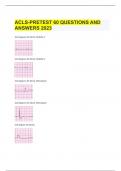
ACLS-PRETEST |60 QUESTIONS AND ANSWERS 2023.

Vendu
-
Pages
10
Grade
A
Publié le
16-10-2023
Écrit en
2023/2024

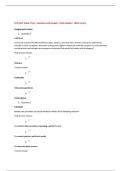
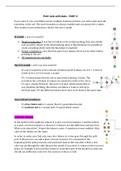
2nd degree AV block: Mobitz II 2nd degree AV block: Mobitz II 2nd degree AV block: Wenebach 2nd degree AV block: Wenebach 3rd degree AV block Atrial fibrillation Atrial flutter Asystole Monomorphic ventricular tachycardia Normal sinus Pulseless electrical activity Polymorphic ventricular tachycardia Sinus bradycardia Sinus bradycardia Sinus tachycardia Supraventricular tachycardia Supraventricular tachycardia Ventricular fibrillation Ventricular fibrillation Ventricular fibrillation You arrive on the scene with the code team. High-quality CPR is in progress, An AED has previously advised 'no shock indicated.' A rhythm check now finds asystole. After resuming high-quality compressions, what is the next action you take? establish IV/IO access A patient has a rapid irregular wide-complex tachycardia. The ventricular rate is 138 bpm. He is asymptomatic, with a blood pressure of 110/70. He has a history of angina. What action is recommended next? seeking expert consultation What is the indication for the use of magnesium in cardiac arrest? Pulseless VT-associated torsades de pointes A patient with possible STEMI has ongoing chest discomfort. What is a contraindication to nitrate administration? use of PDE-i within the previous 24 hrs We have an expert-written solution to this problem! A patient is in cardiac arrest. High-quality chest compressions are being given. The patient is intubated and an IV has been started. The rhythm is asystole. Which is the first drug/dose to administer? epi 1mg IV/IO A patient is in pulseless ventricular tachycardia. Two shocks and 1 dose of epinephrine have been given. Which drug should be given next? amiodarone 300mg We have an expert-written solution to this problem! A patient with STEMI has ongoing chest discomfort. Heparin 4000 units IV bolus and a heparin infusion of 1000 units/hr are being administered. The patient did not take aspirin because he has a history of gastritis, which was treated 5 years ago. What is your next action? ASA 160-325mg to chew A 57-year-old woman has palpitations, chest discomfort, and tachycardia. The monitor shows a regular wide-complex QRS at a rate of 180 bpm. She becomes diaphoretic, and her BP is 80/60 mmHg. Which action do you take next? perform electrical cardioversion What is a situation in which bradycardia requires treatment? hypotension A monitored patient in the ICU developed a sudden onset of narrow-complex tachycardia at a rate of 220 bpm. The patient's BP is 128/58 mmHg, the PETCO2 is 38 mmHg, and the pulse ox is 98%. There is vascular access in the L arm, and the patient has not been given any vasoactive drugs. A 12-lead EKG confirms an SVT with on evidence of ischemia or infarction. The rate has not responded to vagal maneuvers. What is your next action? adenosine 6mg IV push A patient is in refractory vfib and has received multiple appropriate defibrillation shocks, epi 1mg IV 2x, and an initial dose of amiodarone 300mg IV. The patient is intubated. How should the 2nd dose of amiodarone be given? 150mg IV push A patient is in refractory vfib. High-quality CPR is in progress. One dose of epi was given after the 2nd shock. An antiarrhythmic drug was given immediately after the 3rd shock. You are the team leader. Which medication do you order next? epi 1 mg A 35-year-old woman has palpitations, lightheadedness, and a stable tachycardia. The monitor shows a regular narrow-complex QRS at a rate of 180 bpm. Vagal maneuvers have not been effective in terminating the rhythm. An IV has been established. What drug should be administered? adenosine 6mg A patient is in cardiac arrest. Vfib has been refractory to an initial shock. If no pathway for medication administration is in place, what is the preferred method? IV/IO We have an expert-written solution to this problem! A patient is in cardiac arrest. Vfib has been refractory to a 2nd shock. Which drug should be administered 1st? epi 1mg IV/IO A patient has sinus bradycardia with a HR of 36 bpm. Atropine has been administered to a total dose of 3mg. A transcutaneous pacemaker has failed to capture. The patient is confused, and her BP is 88/56 mmHg. What therapy is now indicated? epi 2-10 mcg/min What intervention is most appropriate for the treatment of a patient in asystole? epi A 62-year-old man suddenly experienced difficulty speaking and L-sided weakness. He meets initial criteria for fibrinolytic therapy, and a CT of the brain is ordered. What is a guideline for antiplatelet and fibrinolytic therapy? hold ASA for at least 24hrs if rtPA is administered A patient with sinus bradycardia and a HR of 42 bpm has diaphoresis and a BP of 80/60 mmHg. What is the initial dose of atropine? 0.5 mg You are caring for a 66-year-old man with a history of a large intracerebral hemorrhage 2 months ago. He is being evaluated for another acute stroke. The CT scan is negative for hemorrhage. The patient is receiving oxygen via nasal cannula at 2 L/min and an IV has been established. His BP is 180/100 mmHg. What drug do you anticipate giving to this patient? ASA

Montrer plus Lire moins
Établissement
Cours


Oups ! Impossible de charger votre document. Réessayez ou contactez le support.

École, étude et sujet

Établissement
Cours

Infos sur le Document

Publié le
16 octobre 2023
Nombre de pages
10
Écrit en
2023/2024
Type
Examen
Contient
Questions et réponses

Sujets

Aperçu du contenu

ACLS-PRETEST 60 QUESTIONS AND ANSWERS 2023
2nd degree AV block: Mobitz II
2nd degree AV block: Wenebach
3rd degree AV block Atrial fibrillation
Atrial flutter
Asystole
Monomorphic ventricular tachycardia
Normal sinus
Pulseless electrical activity
€13,11
Accéder à l'intégralité du document:

Garantie de satisfaction à 100%
Disponible immédiatement après paiement
En ligne et en PDF
Tu n'es attaché à rien


Document également disponible en groupe

Reviews from verified buyers

Affichage de tous les avis
2 année de cela

5,0

1 revues

5
1
4
0
3
0
2
0
1
0
Avis fiables sur Stuvia

Tous les avis sont réalisés par de vrais utilisateurs de Stuvia après des achats vérifiés.

Faites connaissance avec le vendeur

Seller avatar
Les scores de réputation sont basés sur le nombre de documents qu'un vendeur a vendus contre paiement ainsi que sur les avis qu'il a reçu pour ces documents. Il y a trois niveaux: Bronze, Argent et Or. Plus la réputation est bonne, plus vous pouvez faire confiance sur la qualité du travail des vendeurs.
BRAINBOOSTERS Chamberlain College Of Nursing
S'abonner Vous devez être connecté afin de suivre les étudiants ou les cours
Vendu
656
Membre depuis
2 année
Nombre de followers
250
Documents
22740
Dernière vente
4 heures de cela

In this page you will find all documents , flashcards and package deals offered by seller BRAINBOOSTERS

4,5

339 revues

5
264
4
30
3
21
2
5
1
19

Récemment consulté par vous

Pourquoi les étudiants choisissent Stuvia

Créé par d'autres étudiants, vérifié par les avis

Une qualité sur laquelle compter : rédigé par des étudiants qui ont réussi et évalué par d'autres qui ont utilisé ce document.

Le document ne convient pas ? Choisis un autre document

Aucun souci ! Tu peux sélectionner directement un autre document qui correspond mieux à ce que tu cherches.

Paye comme tu veux, apprends aussitôt

Aucun abonnement, aucun engagement. Paye selon tes habitudes par carte de crédit et télécharge ton document PDF instantanément.

Student with book image

“Acheté, téléchargé et réussi. C'est aussi simple que ça.”

Alisha Student

Foire aux questions