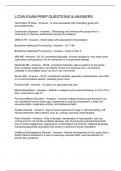
SDI Final Exam Objects under water appear: 1: The same size as they do on land. 2: Twice as large as they do on land. 3: Closer and la rger than they do on land. 4: Smaller and farther away than they do on land. - ✔✔ Closer and larger than they do on land. As you descend: 1: Colors appear to fade. 2: Reds and oranges are among the first colors to disappear. 3: At 30 m/99 ft, little color remains other than blues, grays, blacks and whites. 4: All of the above. - ✔✔ All of the above. Which of the following statements is true? There may be more than one correct answer. 1: Water is 400 times denser than air. 2: Water is 800 times denser than air. 3: Sound travels about four times faster underwater. 4: Both the second and the third answer are correct. - ✔✔ Both the second and the third answer are correct. Which of the following is/are true? 1: Water conducts he at away from your body ten times faster than air does. 2: Water conducts heat away from your body 25 times faster than air does. 3: Fresh water conducts heat away from your body faster than salt water does. 4: Salt water conducts heat away from your body f aster than fresh water does. - ✔✔ Water conducts heat away from your body 25 times faster than air does. When water stratifies itself into layers, according to temperature, the boundary between layers is known as a(n): 1: Halocline. 2: Ichtyocline. 3: Ther modyne. 4: Thermocline. - ✔✔ Thermocline. Which of the following is/are true? 1: Tides can make the water at a particular dive site noticeably deeper or shallower than you may have experienced previously. 2: Tidal currents can be very strong, making diving difficult or even dangerous. 3: Strong tidal currents can have an adverse effect on visibility. 4: All of the above. - ✔✔ All of the above. The sun warming water near the equator, coupled with the earth's rotation, is the primary cause of permanent ocean currents. 1: True. 2: False. - ✔✔ True. Which of the following is/are true? 1: If caught in a rip current, swim directly towards shore, using the most powerful kick possible. 2: If caught in a rip current, swim perpendicular to shore, until you are completely out of the rip current, then swim in towards shore. 3: If caught in a rip current, swim parallel to shore, until you are completely out of the rip current, then swim in to wards shore. 4: Don't fight the rip current; relax and let it carry you closer to shore. - ✔✔ If caught in a rip current, swim parallel to shore, until you are completely out of the rip current, then swim in towards shore. We measure waves by their height and weight. 1: True. 2: False. - ✔✔ False. Explanation: We measure waves by their height and length. Which of the following best describes the formation of surf? 1: Waves energy, rebounding from its impact with shore, crashes into oncoming waves, causing them to break. 2: Entering shallow water forces wave energy upward, making the wave crest unstable and causing it to break. 3: A wave encountering shallow water begins to slow at its bottom, while the top of the wave continues at its previous speed. This c auses the wave to break. 4: As waves enter shallow water, the distance between wave crests (wave length) shortens, increasing the tendency to break. - ✔✔ Only the third answer (A wave encountering shallow water begins to slow at it bottom, while the top of the wave continues at its previous speed; this causes the wave to break) is correct. Surge: 1: Occurs when waves force water between facing rock ledges. 2: Is the back -and-forth movement of water caused by waves passing over head. 3: Is the backwash of wa ter from waves breaking on shore. 4: None of the above. - ✔✔ Surge is the back -and-forth movement of water caused by waves passing over head. Which 'if any' of the following are true? 1: Aquatic animals present a greater risk to divers than any other facto r. 2: Most aquatic animal bites result from an animal's defensive response to a perceived threat or, on rare occasions, from a case of mistaken identify. 3: Because they are perceived as more aggressive, men are more likely to be the victim of an aquatic animal attack than women are. 4: None of the above. - ✔✔ Most aquatic animal bites result from an animal's defensive response to a perceived threat or, on rare occasions, from a case of mistaken identify.
Examen
SDI Final Exam | 64 Questions and Answers(A+ Solution guide)
Note
Vendu
-
Pages
21
Grade
A+
Publié le
08-10-2023
Écrit en
2023/2024
Objects under water appear: 1: The same size as they do on land. 2: Twice as large as they do on land. 3: Closer and larger than they do on land. 4: Smaller and farther away than they do on land. - Closer and larger than they do on land. As you descend: 1: Colors appear to fade. 2: Reds and oranges are among the first colors to disappear. 3: At 30 m/99 ft, little color remains other than blues, grays, blacks and whites. 4: All of the above. - All of the above. Which of the following statements is true? There may be more than one correct answer. 1: Water is 400 times denser than air. 2: Water is 800 times denser than air. 3: Sound travels about four times faster underwater. 4: Both the second and the third answer are correct. - Both the second and the third answer are correct. Which of the following is/are true? 1: Water conducts heat away from your body ten times faster than air does. 2: Water conducts heat away from your body 25 times faster than air does. 3: Fresh water conducts heat away from your body faster than salt water does. 4: Salt water conducts heat away from your body faster than fresh water does. - Water conducts heat away from your body 25 times faster than air does.When water stratifies itself into layers, according to temperature, the boundary between layers is known as a(n): 1: Halocline. 2: Ichtyocline. 3: Thermodyne. 4: Thermocline. - Thermocline.
Montrer plus
Lire moins
Établissement
SDI
Cours
SDI
Oups ! Impossible de charger votre document. Réessayez ou contactez le support.
École, étude et sujet
- Établissement
- SDI
- Cours
- SDI
Infos sur le Document
- Publié le
- 8 octobre 2023
- Nombre de pages
- 21
- Écrit en
- 2023/2024
- Type
- Examen
- Contient
- Questions et réponses
Sujets
-
sdi
Aperçu du contenu
€10,44
Accéder à l'intégralité du document:
Garantie de satisfaction à 100%
Disponible immédiatement après paiement
En ligne et en PDF
Tu n'es attaché à rien
Faites connaissance avec le vendeur

Les scores de réputation sont basés sur le nombre de documents qu'un vendeur a vendus contre paiement ainsi que sur les avis qu'il a reçu pour ces documents. Il y a trois niveaux: Bronze, Argent et Or. Plus la réputation est bonne, plus vous pouvez faire confiance sur la qualité du travail des vendeurs.
Brainarium