CRIM 231: Final Study Guide Questions with Complete Solutions
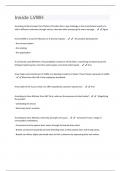
CRIM 231: Final Study Guide Questions with Complete Solutions List the 5 goals of criminal sentencing and define each. Which do you feel is the most important? -Retribution: emphasizes taking revenge on criminal perpetrator -Incapacitation: imprisonment to reduce likelihood of offender committing more crimes -Deterrence: inhibit criminal behavior through punishment of the fear of punishment -Rehabilitation: attempt to reform a criminal offender -Restoration: goal of sentencing that seeks to make the victim "whole again" -I would say that rehabilitation is the most important but when it comes to trying to reform a criminal it is difficult and therefore incapacitation is the most important due to how it prevents and reduces the likelihood that an offender will commit more crimes Name the 4 traditional sentencing options. under which circumstances might each be appropriate? -Fines: minor law violations (DUI's, reckless driving, vandalism, disturbing the peace) usually when offender has a clean record and ability to pay -Probation: sentence of imprisonment that is suspended; also the conditional freedom granted by a judicial officer to a convicted offender, as long as the person meets certain conditions of behavior --After a convicted offender has done good deeds, etc., in jail and his sentenced time has decreased and doesn't show much signs of being harm may be released back into society under certain conditions that must be followed -Imprisonment (jail/prison): certain crimes murder/larceny, drug dealing -Death: 1st degree murder and treason, in some cases kidnapping and aggravated rape (extreme; cannibalism, etc) What are aggravating & mitigating circumstances? -Aggravating circumstances: circumstances relating to the commission of a crime that make it more grave than the average instance of that crime -Mitigating circumstances: circumstances relating to the commission of a crime that may be considered to reduce the blameworthiness of the defendant What is the different between indeterminate and determinate sentencing? -Indeterminate sentencing: model of criminal punishment that encourages rehabilitation through the use of general and relatively unspecific sentences (such as term of imprisonment from one to ten years) -Mitigating circumstances: circumstances relating to the commission of a crime that may be considered to reduce the blameworthiness of the defendant Name and briefly describe the eight stages of a criminal trial -Trial initiation: speedy trial requirement -Jury selection: impartial jury is selected -Opening statements: attorneys present information to jury -Presentation of evidence: state present evidence -Closing arguments: both sides have a final say -Judge's charge to the jury: gives charges to jury -Jury deliberations: how long it takes for jury to reach a verdict -Verdict: jury reaches unanimous verdict What steps are typically taken before a trial? -First appearance Pretrial Release: the release of an accused person from custody, for all or part of the time before or during prosecution on his/her promise to appear in court when required Bail: helps to ensure reappearance of accused; prevents unconnected individuals from suffering imprisonment unnecessarily Attorney Public Safety -Grand Jury --- felony cases if they choose indictment (to take the case to trial/court) TRIAL -indictment: formal charges -arraignment & plea: prosecution states the charge - Plea Bargaining: negotiating an agreement among the defendant, prosecutor, and the court as to an appropriate plea and sentence - Bail hearing: judge sets amount on bail that gives defendant time of jail till trial Preliminary Hearings: -Discovery: prosecution turns over any evidence to the defense -Voire Dire: explanation of elements of case to potential jurors and jury selection What are intermediate sanctions? Name & briefly discuss the 7 intermediate sanctions? -intermediate sanctions are in between probation and imprisonment; alternatives for prison 1. Split sentencing: sentence stated clearly requiring convicted offender to serve a period of confinement in a local, state, or federal prison, followed with probation 2. shock probation/parole: Shock probation/parole: practice of sentencing offenders to prison, allowing them to apply for probationary release. Surprisingly permitting such release (ordered by judicial authority) 3. Shock incarceration: sentencing option that makes use of "boot camp" type prisons to impress convicted offender the reality of prison life 4. Mixed Sentencing: sentencing that requires that a convicted offender serve weekends in a confinement facility while undergoing probationary supervision in the community 5. Community Service: sentencing alternative that requires offenders to spend at least part of their time working for a community agency 6. Intensive supervision: form of probation supervision involving frequent face to face contact between the probationer and probation officer 7. Home confinement: individuals ordered to remain in their homes; sometimes monitored electronically to ensure they don't leave during confinement (can go to work but that's it) Describe the duties of a probation/parole officer-include the process of revocation/ -Consists of four functions Intake procedures Diagnosis & needs assessment Client supervision Presentence investigation -Caseloads: # probation/parole clients assigned to one officer for supervision -Combination of police officer and social worker -Parole revocation: the administrative action of paroling authority removing a person from parole status in response to a violation of lawfully required conditions of parole, including the prohibition against committing a new offense -Usually results in offender's return to prison What is the difference between probation and parole? - Probation: is a sentence of imprisonment that is suspended. Also, the conditional freedom granted by a judicial officer to a convicted offender if the person meets the required conditions -Parole: an offender who has been conditionally released from prison by a paroling authority prior to the expiration of his/her sentence and is placed under the supervision of a parole agency and is required to observe conditions of parole Define Prisons & jails. What are the 3 main differences between each? (Ch. 13) -Prison: state or federal confinement facility that has a custodial authority over adults sentenced to confinement -Jail: locally operated short-term confinement facilities originally built to hold suspects following arrest and pending trial -DIFFERENCES: Length of Sentence Who runs the facility (city, police, county sheriff Size Explain the balancing test established by the Supreme Court in deciding issues of prisoner's rights. -Balancing Test: principle developed by courts and applied to corrections by Pell v. Procunier (1974), that attempts to weigh the rights of an individual, as guaranteed by constitution, against the authority of states to make laws or to otherwise restrict a person's freedom in order to protect the state's interests and citizens -The rights you get once the prison officials find the balance in the prison -Just because you are in a prison does not mean one does not get to keep their constitutional rights -Restrict a person's freedom in order to protect the state's interests and its citizens Name and describe the major problems and issues that prisons face today. -Aids: supplies, food, etc., for inmates -Geriatric offenders: life without possibility of parole as these people get older -Inmates with mental illness -Terror suspects List and Describe the 6 categories of children recognized in most states -Delinquent children: violate the criminal law -Undisciplined children: beyond parental control -Dependent children: have no one to care for them -Neglected children: don't receive proper care -Abused children: suffer physical abuse -Status offender: -violate laws written for them What are the major differences & similarities between the juvenile and adult systems of justice? -Juvenile system: focus on delinquency, limited rights against searches, right against self incrimination, focus on interes of the child, helping context, right to an attorney, closed trial - no right to a jury, goals are protection and treatment, right to treatment, Release into parental custody, sealed record, and separate facilities -Adult system: focus on criminality, rights against search and seizures, right against self-incrimination, assumed innocent until proven guilty, adversarial setting, right to an attorney, public trial, goals are punishment and reformation, no right to treatment, release on bail, public record of trial, and possible incarceration List & describe the changes in vocabulary in the juvenile system and adult systems of justice -Petition: report -Intake and detention: arrest and screening in adult world -Adjudication: trial -Disposition: verdict and sentence -Post Adjudication Review: Appeal List & describe the major categories of drugs that are illegally used in the country. Describe the effects of each. -Marijuana: creates sense of well-being, followed by dreamy relaxation, and a frequent craving for sweets, etc. -Cocaine: topical anesthetic for use on sensitive tissues, intense psychological effects - sense of exhilaration, super abundant energy, hyperactivity, and anesthetics -Heroine: produces euphoria when smoked, tolerance for drug increases with use therefore, larger doses are taken to achieve pleasurable effects -Methamphetamine: increased heart rate and blood pressure, increased wakefulness, insomnia, increased physical activity, decreased appetite, anxiety, paranoia, violent behavior -Club Drugs - ecstasy, meth, and date rape drugs; depressant, unconsciousness What is the relationship between drug use and crime and criminal problems? Robberies are often committed to support drug habits; assaults, rapes, and violent crimes are often linked to drug use Name and describe the strategies that have been used to respond to the drug problem -Strict law enforcement: strict program of anti-drug law enforcement and costly drug sentences with goal of removing dealers from streets -Asset forfeiture: seizure of money, negotiable instruments, securities, or other things of value -Interdiction: the interception of drug traffic at the nation's borders. -Crop control: attempt to limit amount of drugs available for the illicit market by targeting foreign producers -Prevention and treatment: Drug Medicalization, Prevention, and Control Act: purpose was to expand drug-treatment and drug-education services for drug offenders and to utilize probation for nonviolent drug offenders , thereby potentially diverting many non-violent drug abusers from prison -Drug Court: court that offers first time substance abuse offenders judicially mandated court supervised treatment alternatives to prison Interdiction (above) Forfeiture (above) Legalization elimination of the laws and criminal penalties associated with certain behaviors-usually the production, sale, distribution and possession of a controlled substance Decriminalization: redefinition of certain previously criminal behaviors into regulated activities that become ticketable rather than "arrestable" What are the potential benefits of studying criminal justice systems in other countries? what are the problems? Allows to see how other countries have turned out with how they have legalized some things such as prostitution and how they are managing crimes, etc. with that and how the country continue to run and function in regards to crimes around it Serves as examples to other countrie Describe the criminal justice system in Muslim (include discussion of Hadud & Tazir crimes) Islamic law: system of laws operative in some Arab countries basd upon the Muslim religion and especially the holy book of the Koran Hudud crimes: serious violation of islamic law that is regarded as an offense against God Tazir crime: minor violation of islamic law that is regarded as an offense against society, not God Define terrorism. Define the characteristics of terrorism. Terrorism: violent act or an act dangerous to human life in violation of the criminal laws of the US or any other state committed to intimidate or coerce a government, or the population in furtherance of political or social objectives No rules: no moral limitation on the degree of violence No innocents: no distinction between soldiers & civilians Economy: kill one, scare 10,000 Publicity: terrorists seek publicity Meaning: terrorists acts give meaning to the lives of terrorists No clarity; acts usually poorly conceived and impossible to implement Name and define the different types of terrorism -Domestic terrorism: terrorism by a group based entirely within the US and aimed against the US -lone wolf terrorism: person working alone -Cyberterrorism: form of terrorism that makes use of technology especially computers and the internet -International terrorism:L terrorism that transcends national boundaries -Foreign terrorist organization: threaten the security of the US and which is designated by the Secretary of State -Narco Terrorism: political alliance between terrorist organizations and drug-supplying cartels What is the Department of Homeland Security? What are they responsible for? -Department of Homeland Security: US dept. Of Homeland Security is a federal agency designed to protect the United States against threats -Its wide ranging duties include aviation security, border control, emergency response, and cybersecurity Explain how the criminal justice system will be different in the future. -Real time intelligence about crime and criminals, facial and voice recognition data, automated scans for WMD threats, real time language translation, friend of foe technology, robots and unmanned vehicles used for investigation Explain the different types of cyber and computer crimes. -Computer crime: any crime committed through the use of computer technology -Hacker: computer professional of hobbyist with advanced skills -Software Piracy: unauthorized duplication of software or the illegal transfer of data from one storage medium to another -Computer virus: computer program designed to invade systems and modify them -Malware: malicious computer programs like viruses, worms, and trojan horses Protected computer: computer exclusively for the use of a financial institution of the federal government
École, étude et sujet
- Établissement
- CRIM 231:
- Cours
- CRIM 231:
Infos sur le Document
- Publié le
- 7 octobre 2023
- Nombre de pages
- 13
- Écrit en
- 2023/2024
- Type
- Examen
- Contient
- Questions et réponses
Sujets
-
crim 231 final study guide questions with complet