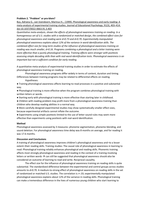
Problem 2. "Problem" or pro-blem?
Bus, Adriana G., van IJzendoorn, Marinus H.,. (1999). Phonological awareness and early reading: A
meta-analysis of experimental training studies. Journal of Educational Psychology, 91(3), 403–414.
doi:10.1037/0022-0663.91.3.403
Quantitative meta-analysis, shown the effects of phonological awareness training on reading. In a
homogeneous set of U.S. studies with a randomized or matched design, the combined effect sizes for
phonological awareness and reading were d=0.73 and d=0.70. Experimentally manipulated
phonological awareness explains about 12% of the variance in word-identification skills. The
combined effect size for long-term studies of the influence of phonological awareness training on
reading was much smaller, d=0.16. Programs combining a phonological and a letter training were
more effective than a purely phonological training. Training effects were stronger with posttests
assessing simple decoding skills than with real-word-identification tests. Phonological awareness is an
important but not a sufficient condition for early reading.
A quantitative meta-analysis of experimental training studies in order to estimate the effects of
phonological awareness training on reading.
Phonological awareness programs differ widely in terms of content, duration and timing.
Differences between training programs may be related to differential effects on reading.
Hypotheses:
● Training phonological awareness affects learning-to-read processes in a positive and substantial
way.
● Phonological training is more effective when the program combines phonological training with
written letters or words.
● Starting early with phonological training is more effective than starting later in childhood.
● Children with reading problem may profit more from a phonological awareness training than
children who develop reading abilities in a normal way.
● More carefully designed experimental studies may show systematically smaller effect sizes,
because experimental artifacts cannot inflate the outcome.
● Experiments using simple posttests limited to the use of letter-sound rules may seem more
effective than experiments using posttests with real-word identification.
Method
Phonological awareness assessed by 3 measures: phoneme segmentation, phoneme blending, and
sound deletion. For phonological awareness time delay was 8 months on average, and for reading it
was 17.6 months.
Discussion and Conclusions
A training of phonological awareness improves children’s phonological awareness and–to a lesser
extent–their reading skills. Training studies: The causal role of phonological awareness in learning to
read: Phonological training reliably enhances phonological and reading skills. Phonemic training
affects most strongly phonological awareness and reading in the context of a training involving
letters or written words can still be suggested that phonological awareness should also be
considered an outcome of learning to read and write. Reciprocal causality.
The effect size for the influence of phonological awareness training on reading skills is quite
substantial. The standardized difference between the experimental and control groups across studies
amounts to d=0.70. A medium-to-strong effect of phonological awareness on reading skills in the set
of randomized or matched U.S. studies. The correlation is r=.33; experimentally manipulated
phonological awareness explains about 12% of the variance in reading skills. Phonological training
can make a tremendous difference in the lives of numerous young children who start learning to
Bus, Adriana G., van IJzendoorn, Marinus H.,. (1999). Phonological awareness and early reading: A
meta-analysis of experimental training studies. Journal of Educational Psychology, 91(3), 403–414.
doi:10.1037/0022-0663.91.3.403
Quantitative meta-analysis, shown the effects of phonological awareness training on reading. In a
homogeneous set of U.S. studies with a randomized or matched design, the combined effect sizes for
phonological awareness and reading were d=0.73 and d=0.70. Experimentally manipulated
phonological awareness explains about 12% of the variance in word-identification skills. The
combined effect size for long-term studies of the influence of phonological awareness training on
reading was much smaller, d=0.16. Programs combining a phonological and a letter training were
more effective than a purely phonological training. Training effects were stronger with posttests
assessing simple decoding skills than with real-word-identification tests. Phonological awareness is an
important but not a sufficient condition for early reading.
A quantitative meta-analysis of experimental training studies in order to estimate the effects of
phonological awareness training on reading.
Phonological awareness programs differ widely in terms of content, duration and timing.
Differences between training programs may be related to differential effects on reading.
Hypotheses:
● Training phonological awareness affects learning-to-read processes in a positive and substantial
way.
● Phonological training is more effective when the program combines phonological training with
written letters or words.
● Starting early with phonological training is more effective than starting later in childhood.
● Children with reading problem may profit more from a phonological awareness training than
children who develop reading abilities in a normal way.
● More carefully designed experimental studies may show systematically smaller effect sizes,
because experimental artifacts cannot inflate the outcome.
● Experiments using simple posttests limited to the use of letter-sound rules may seem more
effective than experiments using posttests with real-word identification.
Method
Phonological awareness assessed by 3 measures: phoneme segmentation, phoneme blending, and
sound deletion. For phonological awareness time delay was 8 months on average, and for reading it
was 17.6 months.
Discussion and Conclusions
A training of phonological awareness improves children’s phonological awareness and–to a lesser
extent–their reading skills. Training studies: The causal role of phonological awareness in learning to
read: Phonological training reliably enhances phonological and reading skills. Phonemic training
affects most strongly phonological awareness and reading in the context of a training involving
letters or written words can still be suggested that phonological awareness should also be
considered an outcome of learning to read and write. Reciprocal causality.
The effect size for the influence of phonological awareness training on reading skills is quite
substantial. The standardized difference between the experimental and control groups across studies
amounts to d=0.70. A medium-to-strong effect of phonological awareness on reading skills in the set
of randomized or matched U.S. studies. The correlation is r=.33; experimentally manipulated
phonological awareness explains about 12% of the variance in reading skills. Phonological training
can make a tremendous difference in the lives of numerous young children who start learning to