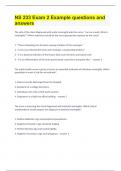
NS 233 Exam 2 Example questions and answers
The wife of the client diagnosed with septic meningitis asks the nurse, "I am so scared. What is meningitis?" Which statement would be the most appropriate response by the nurse? 1. "There is bleeding into his brain causing irritation of the meninges." 2. "A virus has infected the brain and meninges, causing inflammation." 3. "It is a bacterial infection of the tissues that cover the brain and spinal cord." 4. "It is an inflammation of the brain parenchyma caused by a mosquito bite." 3 The public health nurse is giving a lecture on potential outbreaks of infectious meningitis. Which population is most at risk for an outbreak? 1. Clients recently discharged from the hospital. 2. Residents of a college dormitory. 3. Individuals who visit a third world country. 4. Employees in a high-rise office building. 2 The nurse is assessing the client diagnosed with bacterial meningitis. Which clinical manifestations would support the diagnosis of bacterial meningitis? 1. Positive Babinski's sign and peripheral paresthesia. 2. Negative Chvostek's sign and facial tingling. 3. Positive Kernig's sign and nuchal rigidity. 4. Negative Trousseau's sign and nystagmus. 3 The nurse is assessing the client diagnosed with meningococcal meningitis. Which assessment data would warrant notifying the HCP? 1. Purpuric lesions on the face. 2. Complaints of light hurting the eyes. 3. Dull, aching, frontal headache. 4. Not remembering the day of the week. The stem is asking the nurse to identify which assessment data are abnormal for the disease process and require an immediate medical intervention to prevent the client from experiencing a complication or possible death. Which type of precautions should the nurse implement for the client diagnosed with septic meningitis? 1. Standard Precautions. 2. Airborne Precautions. 3. Contact Precautions. 4. Droplet Precautions. 4 The nurse is developing a plan of care for a client diagnosed with aseptic meningitis secondary to a brain tumor. Which nursing goal would be most appropriate for the client problem "altered cerebral tissue perfusion"? 1. The client will be able to complete activities of daily living. 2. The client will be protected from injury if seizure activity occurs. 3. The client will be afebrile for 48 hours prior to discharge. 4. The client will have elastic tissue turgor with ready recoil. 2 The nurse is preparing a client diagnosed with rule-out meningitis for a lumbar puncture. Which interventions should the nurse implement? Select all that apply. 1. Obtain informed consent from the client or significant other. 2. Have the client empty the bladder prior to the procedure. 3. Place the client in a side-lying position with the back arched. 4. Instruct the client to breathe rapidly and deeply during the procedure. 5. Explain to the client what to expect during the procedure. 2, 3, 5 The nurse is caring for a client diagnosed with meningitis. Which collaborative intervention should be included in the plan of care? 1. Administer antibiotics. 2. Obtain a sputum culture. 3. Monitor the pulse oximeter. 4. Assess intake and output. 1 The client is diagnosed with meningococcal meningitis. Which preventive measure would the nurse expect the health-care provider to order for the significant others in the home? 1. The Haemophilus influenzae vaccine. 2. Antimicrobial chemoprophylaxis. 3. A 10-day dose pack of corticosteroids. 4. A gamma globulin injection. 2 Which statement best describes the scientific rationale for alternating a nonnarcotic antipyretic and a nonsteroidal anti-inflammatory drug (NSAID) every two (2) hours to a female client diagnosed with bacterial meningitis? 1. This regimen helps to decrease the purulent exudate surrounding the meninges. 2. These medications will decrease intracranial pressure and brain metabolism. 3. These medications will increase the client's memory and orientation. 4. This will help prevent a yeast infection secondary to antibiotic therapy. 2 The client diagnosed with septic meningitis is admitted to the medical floor at noon. Which health-care provider's order would have the highest priority? 1. Administer an intravenous antibiotic. 2. Obtain the client's lunch tray. 3. Provide a quiet, calm, and dark room. 4. Weigh the client in hospital attire. 4 The 29-year-old client is admitted to the medical floor diagnosed with meningitis. Which assessment by the nurse has priority? 1. Assess lung sounds. 2. Assess the six cardinal fields of gaze. 3. Assess apical pulse. 4. Assess level of consciousness. 4 The male client is sitting in the chair and his entire body is rigid with his arms and legs contracting and relaxing. The client is not aware of what is going on and is making guttural sounds. Which action should the nurse implement first? 1. Push aside any furniture. 2. Place the client on his side. 3. Assess the client's vital signs. 4. Ease the client to the floor. 4 The occupational health nurse is concerned about preventing occupation-related acquired seizures. Which intervention should the nurse implement? 1. Ensure that helmets are worn in appropriate areas. 2. Implement daily exercise programs for the staff. 3. Provide healthy foods in the cafeteria. 4. Encourage employees to wear safety glasses. 1 The client is scheduled for an electroencephalogram (EEG) to help diagnose a seizure disorder. Which preprocedure teaching should the nurse implement? 1. Tell the client to take any routine antiseizure medication prior to the EEG. 2. Tell the client not to eat anything for eight (8) hours prior to the procedure. 3. Instruct the client to stay awake for 24 hours prior to the EEG. 4. Explain to the client that there will be some discomfort during the procedure. 3 The nurse enters the room as the client is beginning to have a tonic-clonic seizure. What action should the nurse implement first? 1. Note the first thing the client does in the seizure. 2. Assess the size of the client's pupils. 3. Determine if the client is incontinent of urine or stool. 4. Provide the client with privacy during the seizure. 1 The client who just had a three (3)-minute seizure has no apparent injuries and is oriented to name, place, and time but is very lethargic and just wants to sleep. Which intervention should the nurse implement? 1. Perform a complete neurological assessment. 2. Awaken the client every 30 minutes. 3. Turn the client to the side and allow the client to sleep. 4. Interview the client to find out what caused the seizure. 3 The unlicensed assistive personnel (UAP) is attempting to put an oral airway in the mouth of a client having a tonic-clonic seizure. Which action should the primary nurse take? 1. Help the UAP to insert the oral airway in the mouth. 2. Tell the UAP to stop trying to insert anything in the mouth. 3. Take no action because the UAP is handling the situation. 4. Notify the charge nurse of the situation immediately. 2 The client is prescribed phenytoin (Dilantin), an anticonvulsant, for a seizure disorder.Which statement indicates the client understands the discharge teaching concerning this medication? 1. "I will brush my teeth after every meal." 2. "I will check my Dilantin level daily." 3. "My urine will turn orange while on Dilantin." 4. "I won't have any seizures while on this medication." 1 The client is admitted to the intensive care unit (ICU) experiencing status epilepticus. Which collaborative intervention should the nurse anticipate? 1. Assess the client's neurological status every hour. 2. Monitor the client's heart rhythm via telemetry. 3. Administer an anticonvulsant medication by intravenous push. 4. Prepare to administer a glucocorticosteroid orally. 3 The client has been newly diagnosed with epilepsy. Which discharge instructions should be taught to the client? Select all that apply. 1. Keep a record of seizure activity. 2. Take tub baths only; do not take showers. 3. Avoid over-the-counter medications. 4. Have anticonvulsant medication serum levels checked regularly. 5. Do not drive alone; have someone in the car. 1 3 4 Which statement by the female client indicates that the client understands factors that may precipitate seizure activity? 1. "It is all right for me to drink coffee for breakfast." 2. "My menstrual cycle will not affect my seizure disorder." 3. "I am going to take a class in stress management." 4. "I should wear dark glasses when I am out in the sun." 3 The nurse asks the male client with epilepsy if he has auras with his seizures. The client says, "I don't know what you mean. What are auras?" Which statement by the nurse would be the best response? 1. "Some people have a warning that the seizure is about to start." 2. "Auras occur when you are physically and psychologically exhausted." 3. "You're concerned that you do not have auras before your seizures?" 4. "Auras usually cause you to be sleepy after you have a seizure." 1 The nurse educator is presenting an in-service on seizures. Which disease process is the leading cause of seizures in the elderly? 1. Alzheimer's disease. 2. Parkinson's disease (PD). 3. Cerebral Vascular Accident (CVA, stroke). 4. Brain atrophy due to aging. 3 A nurse is assessing a client who reports severe headache and a stiff neck. The nurse's assessment reveals positive Kernig's and Brudinski's signs. Which of the following actions should the nurse perform first? 1. Administer antibiotics 2. Implement droplet precautions. 3. Initiate IV access. 4. Decrease bright lights. 2 A nurse is assessing for the presence of Brudzinski;s sign in a client who has suspected meningitis. Which of the following actions should the nurse take when performing this technique? 1. Place client in supine position 2. Flex client's hip and knee. 3. Place hands behind the client's neck. 4. Bend client's head toward chest. 5. Straighten the client's flexed leg at the knee. 1 3 4 A nurse is planning care for a client who has meningitis and is at risk for increased intracranial pressure. Which of the following actions should the nurse plan to take? 1. Implement seizure precautions. 2. Perform neurologic checks four times a day. 3. Administer morphine for the report of the neck and generalized pain. 4. Turn off room lights and television. 5. Monitor for impaired extraocular movements. 6. Encourage the client to cough frequently. 1 4 5 A nurse is reviewing the use of the meningococcal vaccine (MCV 4) for the prevention of meningitis with a newly licensed nurse. Which of the following information should the nurse include? 1. The vaccine is indicated to reduce the risk of respiratory infection. 2. The vaccine is administered in a series of four doses. 3. The vaccine is recommended for adolescents before starting college. 4. The vaccine is initially given at 2 months of age. 3 A nurse is planning care for a client who has bacterial meningitis. Which of the following actions should the nurse include in the plan of care? 1. Monitor for bradycardia. 2. Provide an emesis basin at the bedside. 3. Administer antipyretic medication. 4. Perform a skin assessment. 5. Keep the head of the bed flat. 2 3 4 Ensure infants receive vaccine for bacterial meningitis on schedule. A series of four doses is recommended beginning at 2 months of age, with the final dose at 12 to 15 months Haemophilus influenza type b (Hib) vaccine to prevent respiratory infection and to decrease the risk for CNS infections. Vaccinate adults who are immunocompromised, have a chronic disease, smoke cigarettes, or live in a long-term care facility. Give one dose to adults older than 65 who have not previously been immunized nor have history of disease. pneumococcal polysaccharide vaccine (PPSV) prior to living in a residential setting in college. initial dose is recommended between 11 to 12, with booster administered at age 16. MCV4 Meningococcal vaccine Which patient is most at risk for hypernatremia? A. Has a deficiency of aldosterone B. Has prolonged vomiting and diarrhea C. Receives excessive IV 5% dextrose solution D. Has impaired consciousness and decreased thirst sensitivity D In a patient with sodium imbalances, the primary clinical manifestations are related to alterations in what body system? A. Kidneys B. Cardiovascular system C. Musculoskeletal system D. CNS D Which statements about fluid in the human body are true (select all that apply)? a. The primary hypothalamic mechanism of water intake is thirst b. third spacing refers to the abnormal movement of fluid into interstitial spaces. c. A cell surrounded by hypoosmolar fluid will shrink and die as water moves out of the cell. d. A cell surrounded by hyperosmolar fluid will shrink and die as water moves out of the cell. e. Concentrations of Na+ and K+ in interstitial and intracellular fluids are maintained by the sodium/potassium pump. a d e What stimulates aldosterone secretion from the adrenal cortex? a. Excessive water intake b. Increased serum osmolality c. Decreased serum potassium d. Decreased sodium and water D While caring for an 84- year old patient, the nurse monitors the patient's fluid and electrolyte balance, recognizing what as a normal change of aging? a. hyperkalemia b. hyponatremia c. decreased insensible fluid loss d. increased plasma oncotic pressure B A common collaborative problem related to both hyperkalemia and hypokalemia is which potential complication? a. Seizures b. Paralysis c. Dysrhythmias d. Acue kidney injury C In a patient with a positive Ckvostek's sign, the nurse would anticipate the IV administration of which medication? a. Calcitonin b. Vitamin D c. Loop diuretics d. Calcium gluconate D The nurse is reviewing a patient's morning laboratory results. Which result is of greatest concern? A. Serum Na of 150 mEq/L B. Serum Mg of 1.9 mEq/L C. Serum K of 4.5 mg/dL D. Serum Ca2 (total) of 8.6 mg/dL A You are caring for an older patient who is receiving IV fluids postoperatively. During the 8:00 AM assessment of this patient, you note that the IV solution, which was ordered to infuse at 125 mL/hr, has infused 950 mL since it was hung at 4:00 AM. What is the priority nursing intervention? a. Notify the physician and complete an incident report. b. Slow the rate to keep vein open until next bag is due at noon. c. Obtain a new bag of IV solution to maintain patency of the site. d. Listen to the patient's lung sounds and assess respiratory status. D The nurse is admitting a patient to the clinical unit from surgery. Being alert to potential fluid volume alterations, what assessment data will be important for the nurse to monitor to identify early changes in the patient's postoperative fluid volume (SATA)? a. Intake and output b. skin turgor c. lung sounds d. respiratory rate e. level of consciousness a b c d e A patient is taking diuretics drugs. Which fluid or electrolyte imbalance can occur in this patient? a. Hyperkalemia b. Hyponatremia c. Hypocalcemia d. Hypotonic fluid loss e. Hypertonic fluid loss B C
École, étude et sujet
- Établissement
- Havard School
- Cours
- NSG 233 MEDSURG
Infos sur le Document
- Publié le
- 16 septembre 2023
- Nombre de pages
- 27
- Écrit en
- 2023/2024
- Type
- Examen
- Contient
- Questions et réponses
Sujets
-
ns 233 exam 2
-
ns 233 exam 2 example questions and answers

Document également disponible en groupe