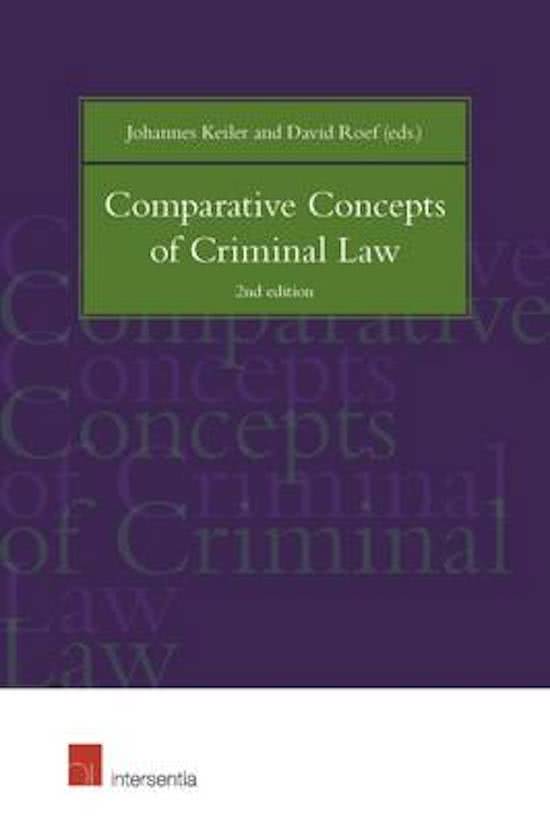
Substantive Criminal Law
Week 3:
Chapter 6: The aspects of Mens Rea
‘Actum non facit reum nisi mens sit rea’ (‘an act does not make a man guilty unless him mind
is also guilty’), is often expressed to indicate that a crime can only be committed if the 2 basic
set of elements are fulfilled. Mens rea includes intention and negligence.
The Latin phrase makes clear that criminal liability cannot be imposed for merely thinking of
doing sth criminal. Someone needs to act before we can punish him/her. A person can only
be convicted for conduct or consequences that he brought about intentionally or at least
negligently.
- The rule that mens rea is an essential element of every offence seems to be applied
with even less consistency.
- The criminal wrong of an offence consists not only of the act or consequences, but
also by the concomitant state of mind. People are recognised as autonomous,
sensible persons, who can be held accountable for the choices they make.
- Retribution is grounded in the fact that the defendant chose to commit the actus reus
of the offence. Both retributive and preventive goals of punishment can only be
fulfilled if criminal liability and punishment follows upon establishing mens rea.
Different fault elements compared:
People can be punished much more severely for intentional crime than for negligent crimes.
The distinction in fault elements enables the limitation of criminal liability; some crimes can
only be committed intentionally.
Dutch and German law only distinguish between 2 major kinds of mens rea: intention and
negligence. English law, adds another subjective element in between intention and
negligence, which is called recklessness. It bridges the gap between the most serious and
the lowest limit of mens rea.
Direct intent or dolus directus:
- Intention is the most serious fault element in all legal systems. Intention has a
cognitive part and a volitional part.
- Direct intent is the intentional conduct in an everyday sense, focusing on the will or
desire of the actor to bring about a certain result.
- Intention in its purest legal and linguistic sense.
- The volitional component is dominant in direct intent. It is not required that the actor
was aware of the certainty or high likelihood of the occurrence of the consequence. It
is important that he had the completion of the offence as his purpose.
- It reflects the highest degree of intent, because behaviour carried out willingly in
considered to reflect the highest possible degree of control and choice.
Indirect intent or dolus indirectus:
- Indirect intent exists when the actor knows his conduct will almost certainly bring
about consequences that he does not desire or primarily aim at. It deals with side
effects that the actor knows are almost certain to occur.
- The cognitive element, knowledge of certainty or high degree of probability, is more
dominant than ay volitional requirement. The result known or believed to be a
condition of the achievement of the purpose is considered to be intended, even when
it is not desired.
- It is called indirectus because the state of mind of the actor is not aimed directly at the
result of the offence definition of the crime but at another, further goal that does not
form part of the offence definition.
- The distinction between the 2 types of the intention can be made by the so-called test
of failure.
Week 3:
Chapter 6: The aspects of Mens Rea
‘Actum non facit reum nisi mens sit rea’ (‘an act does not make a man guilty unless him mind
is also guilty’), is often expressed to indicate that a crime can only be committed if the 2 basic
set of elements are fulfilled. Mens rea includes intention and negligence.
The Latin phrase makes clear that criminal liability cannot be imposed for merely thinking of
doing sth criminal. Someone needs to act before we can punish him/her. A person can only
be convicted for conduct or consequences that he brought about intentionally or at least
negligently.
- The rule that mens rea is an essential element of every offence seems to be applied
with even less consistency.
- The criminal wrong of an offence consists not only of the act or consequences, but
also by the concomitant state of mind. People are recognised as autonomous,
sensible persons, who can be held accountable for the choices they make.
- Retribution is grounded in the fact that the defendant chose to commit the actus reus
of the offence. Both retributive and preventive goals of punishment can only be
fulfilled if criminal liability and punishment follows upon establishing mens rea.
Different fault elements compared:
People can be punished much more severely for intentional crime than for negligent crimes.
The distinction in fault elements enables the limitation of criminal liability; some crimes can
only be committed intentionally.
Dutch and German law only distinguish between 2 major kinds of mens rea: intention and
negligence. English law, adds another subjective element in between intention and
negligence, which is called recklessness. It bridges the gap between the most serious and
the lowest limit of mens rea.
Direct intent or dolus directus:
- Intention is the most serious fault element in all legal systems. Intention has a
cognitive part and a volitional part.
- Direct intent is the intentional conduct in an everyday sense, focusing on the will or
desire of the actor to bring about a certain result.
- Intention in its purest legal and linguistic sense.
- The volitional component is dominant in direct intent. It is not required that the actor
was aware of the certainty or high likelihood of the occurrence of the consequence. It
is important that he had the completion of the offence as his purpose.
- It reflects the highest degree of intent, because behaviour carried out willingly in
considered to reflect the highest possible degree of control and choice.
Indirect intent or dolus indirectus:
- Indirect intent exists when the actor knows his conduct will almost certainly bring
about consequences that he does not desire or primarily aim at. It deals with side
effects that the actor knows are almost certain to occur.
- The cognitive element, knowledge of certainty or high degree of probability, is more
dominant than ay volitional requirement. The result known or believed to be a
condition of the achievement of the purpose is considered to be intended, even when
it is not desired.
- It is called indirectus because the state of mind of the actor is not aimed directly at the
result of the offence definition of the crime but at another, further goal that does not
form part of the offence definition.
- The distinction between the 2 types of the intention can be made by the so-called test
of failure.