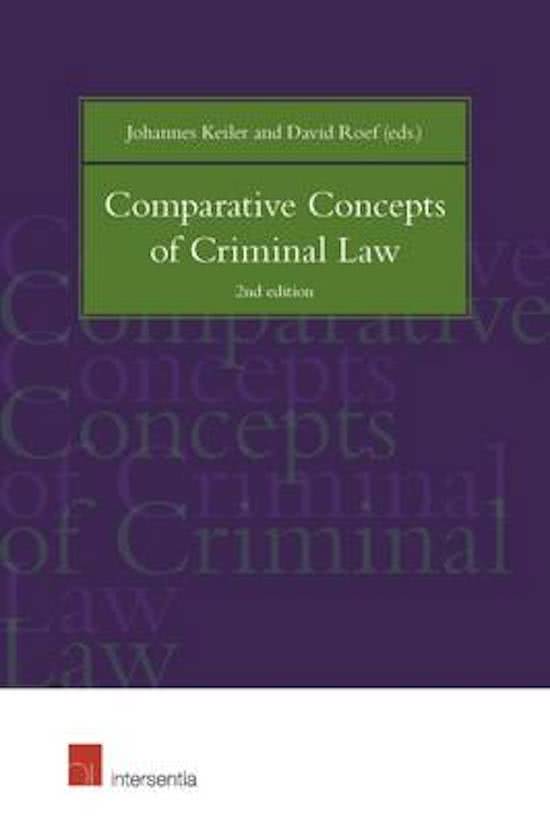
Substantive Criminal Law
Week 2
Chapter 3: Actus Reus and Mens Rea
Most system seems to agree that paradigmatically the main elements of a criminal offence
are twofold, namely harm and fault. However, the fulfilment of the actus reus element alone
is generally however insufficient to constitute a criminal offence. Next to an objective elemant
criminal offences generally also consists of a subjective element, aka the mens rea or ‘guilty
mind’.
- ‘Actus non facit reum nisi mens sit rea’ means ‘an act does not make a man guilty
unless his mind is (also) guilty’.
- In order to be held criminally liable the two concepts need to coincide, as a person
cannot be held liable in a liberal society for conduct which he either did not intend or
merely ‘contemplate about’ (thoughts are free).
Actus Reus:
- At a purely descriptive level the element of actus reus outlines the (objective) conduct
made criminal by some statutory offence or other valid source of criminal law. It is
prima facie fulfilled if a person has committed an instance of the type of conduct
described in it.
- At a more normative level, the core function of the notion of actus reus, besides being
a conceptual tool, is to establish a link between the person and the occurred criminal
harm.
- Consists of 3 elements (not necessarily): conduct, consequences and circumstances.
- Germany and NL: circumstances are usually part and parcel of the actus reus and
are seldom explicitly distinguished.
- England: often requires intention as to the consequence element of the actus reus
while a lower degree of fault is often considered sufficient in regard to the
circumstantial element.
- Distinction between result crimes (offences for which the law requires a specific result
to occur, e.g. murder, manslaughter etc.) and conduct crime (offences which do not
require a specific result, are consummated once the prohibited conduct has taken
place.
- Conduct crimes: the wrongdoing is constituted by the conduct itself, whereas result
crimes prohibit a wide range of conduct if they lead to the proscribed harm.
- Strict liability: only conduct and causation need to be proven, regardless of fault. They
are an integral part of the English and Dutch penal system and are often utilised in
economic and regulatory offences. In Germany it is generally rejected.
- Generally the concept of actus reus is considered to include the doctrines of conduct
(including omissions), as well as causation.
Mens Rea:
- Used to refer to the mental or subjective element required by the offence in question.
- It is possible to distinguish between direct intent, indirect intent, dolus eventualis,
recklessness and conscious and unconscious negligence.
- Distinction between intentional and inadvertent wrongdoing finds expression in the
common distinction between murder and negligent manslaughter. Both are homicide
offences but one is committed intentionally and the other by a failure to comply with
certain standards of care enforce by criminal law.
- Traditionally, mens rea is understood as a state of mind, a psychological disposition
that relates to the actus reus of the offence in question.
- Negligence requires a failure to comply with a certain standard of diligence when
acting. The actor failed to perceive a substantial and unjustified risk of producing the
relevant harm when he should have been aware and more attentive. It constitutes the
Week 2
Chapter 3: Actus Reus and Mens Rea
Most system seems to agree that paradigmatically the main elements of a criminal offence
are twofold, namely harm and fault. However, the fulfilment of the actus reus element alone
is generally however insufficient to constitute a criminal offence. Next to an objective elemant
criminal offences generally also consists of a subjective element, aka the mens rea or ‘guilty
mind’.
- ‘Actus non facit reum nisi mens sit rea’ means ‘an act does not make a man guilty
unless his mind is (also) guilty’.
- In order to be held criminally liable the two concepts need to coincide, as a person
cannot be held liable in a liberal society for conduct which he either did not intend or
merely ‘contemplate about’ (thoughts are free).
Actus Reus:
- At a purely descriptive level the element of actus reus outlines the (objective) conduct
made criminal by some statutory offence or other valid source of criminal law. It is
prima facie fulfilled if a person has committed an instance of the type of conduct
described in it.
- At a more normative level, the core function of the notion of actus reus, besides being
a conceptual tool, is to establish a link between the person and the occurred criminal
harm.
- Consists of 3 elements (not necessarily): conduct, consequences and circumstances.
- Germany and NL: circumstances are usually part and parcel of the actus reus and
are seldom explicitly distinguished.
- England: often requires intention as to the consequence element of the actus reus
while a lower degree of fault is often considered sufficient in regard to the
circumstantial element.
- Distinction between result crimes (offences for which the law requires a specific result
to occur, e.g. murder, manslaughter etc.) and conduct crime (offences which do not
require a specific result, are consummated once the prohibited conduct has taken
place.
- Conduct crimes: the wrongdoing is constituted by the conduct itself, whereas result
crimes prohibit a wide range of conduct if they lead to the proscribed harm.
- Strict liability: only conduct and causation need to be proven, regardless of fault. They
are an integral part of the English and Dutch penal system and are often utilised in
economic and regulatory offences. In Germany it is generally rejected.
- Generally the concept of actus reus is considered to include the doctrines of conduct
(including omissions), as well as causation.
Mens Rea:
- Used to refer to the mental or subjective element required by the offence in question.
- It is possible to distinguish between direct intent, indirect intent, dolus eventualis,
recklessness and conscious and unconscious negligence.
- Distinction between intentional and inadvertent wrongdoing finds expression in the
common distinction between murder and negligent manslaughter. Both are homicide
offences but one is committed intentionally and the other by a failure to comply with
certain standards of care enforce by criminal law.
- Traditionally, mens rea is understood as a state of mind, a psychological disposition
that relates to the actus reus of the offence in question.
- Negligence requires a failure to comply with a certain standard of diligence when
acting. The actor failed to perceive a substantial and unjustified risk of producing the
relevant harm when he should have been aware and more attentive. It constitutes the