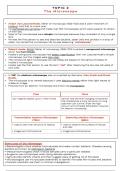
TOPIC 2
The Microscope
• Anton van Leeuwenhoek, father of microscopy (1632-1723) was a cloth merchant of
Holland. (Not rst to invent one)
• He perfected lens grinding and made over 500 microscopes which were superior to others
of their day.
• Most of his microscopes were simple microscopes because they consisted of only a single
lens.
• He was the rst person to see and describe bacteria, yeast cells and protists in a drop of
water. He named the microscopic life he was observing “animalcules”.
• Robert Hooke, British father of microscopy (1635-1703) invented a compound microscope
which had two lenses.
• Hooke's compound microscope had better magni cation than van Leeuwenhoek's simple
microscope, but the images were less clear.
• The compound light microscopes we use today are based on the same principles of
Hooke’s microscope.
• Hooke was the rst person to use the term "cell" after observing the box-like cell walls of
cork cells.
• In 1931 the electron microscope was co-invented by Germans, Max Knott and Ernst
Ruska.
• The microscope is so named because it uses electron waves rather than light waves to
create an image.
• Pictures from an electron microscope are known as micrographs.
Pros Cons
Can magnify objects up to 1 million times Cannot view the ever-changing movements
that characterise a living cell since no living
specimen can survive under the high
vacuum and complete dehydration required
for electron microscopy.
Transmission electron Microscope Scanning election microscope
(TEM) (SEM)
• Used to see inner structure of objects • Used to observe the surfaces of tissues
and cells
• Images are 2-Dimensional • Images are 3-Dimensional
Some uses of the Microscope
• Bacteriologists check whether food samples and water contain bacteria. (Disease causing
bacteria are known as pathogenic bacteria)
• Medical technologists check if blood samples carry a particular disease.
• Surgeons use microscopes when doing delicate operations.
• Agriculturists identify insects and then suggest ways of getting rid of the pests
• Microbiologists use microscopes extensively to identify microbes like viruses and bacteria.
• Forensic scientists use them in criminal investigations.
fi fi fi fi
The Microscope
• Anton van Leeuwenhoek, father of microscopy (1632-1723) was a cloth merchant of
Holland. (Not rst to invent one)
• He perfected lens grinding and made over 500 microscopes which were superior to others
of their day.
• Most of his microscopes were simple microscopes because they consisted of only a single
lens.
• He was the rst person to see and describe bacteria, yeast cells and protists in a drop of
water. He named the microscopic life he was observing “animalcules”.
• Robert Hooke, British father of microscopy (1635-1703) invented a compound microscope
which had two lenses.
• Hooke's compound microscope had better magni cation than van Leeuwenhoek's simple
microscope, but the images were less clear.
• The compound light microscopes we use today are based on the same principles of
Hooke’s microscope.
• Hooke was the rst person to use the term "cell" after observing the box-like cell walls of
cork cells.
• In 1931 the electron microscope was co-invented by Germans, Max Knott and Ernst
Ruska.
• The microscope is so named because it uses electron waves rather than light waves to
create an image.
• Pictures from an electron microscope are known as micrographs.
Pros Cons
Can magnify objects up to 1 million times Cannot view the ever-changing movements
that characterise a living cell since no living
specimen can survive under the high
vacuum and complete dehydration required
for electron microscopy.
Transmission electron Microscope Scanning election microscope
(TEM) (SEM)
• Used to see inner structure of objects • Used to observe the surfaces of tissues
and cells
• Images are 2-Dimensional • Images are 3-Dimensional
Some uses of the Microscope
• Bacteriologists check whether food samples and water contain bacteria. (Disease causing
bacteria are known as pathogenic bacteria)
• Medical technologists check if blood samples carry a particular disease.
• Surgeons use microscopes when doing delicate operations.
• Agriculturists identify insects and then suggest ways of getting rid of the pests
• Microbiologists use microscopes extensively to identify microbes like viruses and bacteria.
• Forensic scientists use them in criminal investigations.
fi fi fi fi