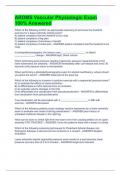
ARDMS Vascular Physiologic Exam 100% Answered
Which of the following is NOT an appropriate reasoning to terminare the treadmill exercise for a lower extremity arterial exam? A) patient complains that the treadmill is too noisy B) patient complains of leg pain C) patient complains of shortness of breath D) patient complains of chest pain - ANSWER-patient complains that the treadmill is too noisy In photoplethysmography, the sensor uses __________________ to detect _______________ change - ANSWER-light, blood volume When performing post-occlusive reactive hyperemia, pressure measurements in the lower extremities are obtained: - ANSWER-immediately after cuff release and every 30 seconds until pressure return to the baseline When performing a photoplethysmography exam for arterial insufficiency, where should you place the senor? - ANSWER-distal pad of the great toe Which of the following is a reason to perform exercise with a segmental pressure exam? A) to evaluate the effects of vasoconstriction B) to differentiate an SFA stenosis from an occlusion C) to evaluate volume changes in the limb D) to differentiate true claudication from pseudoclaudication - ANSWER-to differentiate true claudication from pseudocladication True claudication will be associated with a ____________________ in ABI with exercise - ANSWER-decreased Which of the following patients would undergo reactive hyperemia for a lower extremity exam to evaluate new onset of left leg claudication? - ANSWER-prior history of untreated multilevel disease in the right leg What can be done to inhibit light from the exam room from causing artifact on an upper extremity PPG TRACING? - ANSWER-Cover the patient's hand with a towel or a sheet Which of the following screening techniques for Peripheral Arterial disease can distinguish between a stenosis and an occlusion in a vessel? - ANSWER-Doppler evaluation Lower extremity arterial segmental pressure exam results in a post exercise basal pressure recovery time of 2 to 6 minutes: - ANSWER-single level stenosis If the blood pressure in the ankle is obtained with the patients legs in the dependent position: - ANSWER-the pressure will be falsely elevated You are performing an upper extremity segmental pressure evaluation and obtain the following information: Brachial 140mmhg Upper forearm 132mmHg Wrist-radial 108mmHg wrist- ulnar 130mmHg what correctly describes the findings? - ANSWER-obstruction in the mid radial artery Lower extremity arterial segmental pressure exam results in a post-exercise basal pressure recovery time of >6 minutes which suggests: - ANSWER-multilevel stenosis A 25 year old presents with recent onset of left calf pain when riding his bike. He has been training for a race for the last 6 months without problem until 2 weeks ago. Exercise testing demonstrates a 50 mmHg drop in pressure compared to the right leg with no drop in pressure These findings are most suggestive of: - ANSWER-popliteal entrapment A segmental pressure exam demonstrates the following pressures; dital thigh 144, calf 166, ankle 132. What could explain these results? - ANSWER-incorrect cuff size, medial calcification and improper cuff placement A segmental pressure exam demonstrates the following pressures; right arm: 136mmHg; right thigh: 110mmHg, calf: 100mmHg, ankle: 92mmHg. Which of the following could explain these results? - ANSWER-aortic disease or common iliac disease When preforming a treadmill test for PAD, exercise is preformed for up to _____ minutes. When preforming a reactive hyperemia exam for PAD, the cuffs are inflate for up to _________ minutes - ANSWER-5; 5 Venous PPG tracings are obtained. The right side demonstrates a venous refill time of 30 seconds. The left side demonstrates a refill time of 23 seconds. Which of the following describes the next step in evaluation? - ANSWER-the results are normal. no further evaluation is necessary Normal VRT - ANSWER-> 20 seconds without tourniquet A diabetic patient presents with an injury to his big toe that wont seem to heal and has been open for 3 weeks. Which of the following exam techniques should be used to evaluate this patient? - ANSWER-digital pressures and PPG evaluation
École, étude et sujet
- Établissement
- ARDMS Vascular Physiologic
- Cours
- ARDMS Vascular Physiologic
Infos sur le Document
- Publié le
- 5 août 2023
- Nombre de pages
- 14
- Écrit en
- 2023/2024
- Type
- Examen
- Contient
- Questions et réponses
Sujets
-
ardms vascular physiologic
-
ardms vascular physiologic exam 100 answered

Document également disponible en groupe