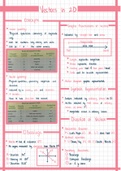
3.6 Taylor Series
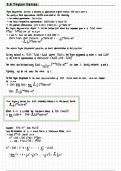
Taylor polynomials provide a
heirarchy ofapproximations to
given function f(x) near a point a
The quality of these approximations improves the
as we move up neirarchy
the constantapproximation:f(x) = f(a)
the linear/tangent line approximation:f(x) = f(a) f((u)(X a)
+ -
thequadratic approximation:f(x) 2f(a) f((a)(x a) 1f"(a)(X a) + -
+
-
-
the taylor polynomial ofdegreen for the function f(x) aboutthe expansion pointa is Tn(x) where
f(x)(a) Tn() (a) for all OCK =n
=
of and in have the same derivative ata up to order n:
f(x) Tr(x) f(a) f'(a)(X a) If"(a)(X a)
...,f(*(a)(X a)n
= =
+
- + +
-
-
ok!f"(a)(x a)
=
-
The infinite Taylor polynomial would be an exactrepresentation of the function
for any naturaln, f(x) Tn(X) En(X) where Tn(x) is the Taylor polynomial of ordern and En(x)
=
+
isthe error in approximation of f(x)=Tn(x) (En(x) f(x) Tn(x)) =
-
the error can be found f *()(X-a)n+ for strictly between a and X
using Ence)=intis! some
Typically, we do notknow the value of 2
for the Taylor polynomial to be exactrepresentation of f(x) En(x) mustbe zero. This can happen
as n +
o
f(x) = Tn(x)
e
=
:(a)(x-a)
f(x) =
if"(a)(X -
a)
The taylory series for f(x) expanded around a is the power series
&
-ot:f"(a)(x -
a)
When a 0 =
it is called the Maclaurin series of f(x) (Mn(x))
eEn(x)
it 0
=
f(x) in!f("(a)(x a) =
-
example:f(x):ex find Mn(x)
find the derivativeata ->
since this is a Maclaurin series, a 0
=
find f" (0) for all K 0
=
eX f(x) f(x)
=
=
f"(X) f(x)(X) =...
=
=
1 f(0) f'(0) f"(0)
=
= =
=
f()(0)
ex f(x) 1 x
2 ...
4 En(x)
+ + + + +
= =
=e(+ x
1x x ...x) =
+
+ +
Taylor polynomials provide a
heirarchy ofapproximations to
given function f(x) near a point a
The quality of these approximations improves the
as we move up neirarchy
the constantapproximation:f(x) = f(a)
the linear/tangent line approximation:f(x) = f(a) f((u)(X a)
+ -
thequadratic approximation:f(x) 2f(a) f((a)(x a) 1f"(a)(X a) + -
+
-
-
the taylor polynomial ofdegreen for the function f(x) aboutthe expansion pointa is Tn(x) where
f(x)(a) Tn() (a) for all OCK =n
=
of and in have the same derivative ata up to order n:
f(x) Tr(x) f(a) f'(a)(X a) If"(a)(X a)
...,f(*(a)(X a)n
= =
+
- + +
-
-
ok!f"(a)(x a)
=
-
The infinite Taylor polynomial would be an exactrepresentation of the function
for any naturaln, f(x) Tn(X) En(X) where Tn(x) is the Taylor polynomial of ordern and En(x)
=
+
isthe error in approximation of f(x)=Tn(x) (En(x) f(x) Tn(x)) =
-
the error can be found f *()(X-a)n+ for strictly between a and X
using Ence)=intis! some
Typically, we do notknow the value of 2
for the Taylor polynomial to be exactrepresentation of f(x) En(x) mustbe zero. This can happen
as n +
o
f(x) = Tn(x)
e
=
:(a)(x-a)
f(x) =
if"(a)(X -
a)
The taylory series for f(x) expanded around a is the power series
&
-ot:f"(a)(x -
a)
When a 0 =
it is called the Maclaurin series of f(x) (Mn(x))
eEn(x)
it 0
=
f(x) in!f("(a)(x a) =
-
example:f(x):ex find Mn(x)
find the derivativeata ->
since this is a Maclaurin series, a 0
=
find f" (0) for all K 0
=
eX f(x) f(x)
=
=
f"(X) f(x)(X) =...
=
=
1 f(0) f'(0) f"(0)
=
= =
=
f()(0)
ex f(x) 1 x
2 ...
4 En(x)
+ + + + +
= =
=e(+ x
1x x ...x) =
+
+ +