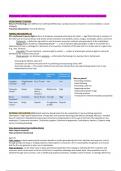
1ST LESSON - WEEK 6 - Introduction to Value Appropriation: Formal and Informal Protection Mechanisms
APPROPRIABILITY REGIME:
Nature of Technology: tacit (difficult to transfer)/codified (easy) | product/ process innovation | social complexity | causal
ambiguity
Protection Mechanisms: Formal & Informal
FORMAL MECHANISMS: (4)
IPR: Intellectual Property Rights (a form of temporary monopoly enforced by the state) → legal field referring to creations of
the mind such as musical, literary, and artistic works; inventions; and symbols, names, images, and designs used in commerce
- Trademarks - a distinctive sign which is used to prevent consumer confusion among products in the marketplace.
- Patents (types of patents: utility/design/plant)* → a set of exclusive rights granted by a state to an inventor for a
fixed period of time in exchange for a disclosure of an invention. Protection of the idea itself in a certain area for a given time
(e.g., max. 20 years).
- Copyrights (70 years duration) - exclusive right to control → creator of artwork gets exclusive rights to control its
distribution for a certain time period.
- (Trade secrets)- non disclosure contracts → information that belongs to a business that is held private.
Enhancing the lifetime value of IP
Companies can enhance the value of IP via combining and sequencing various IPR.
Successful example → The contour bottle of Coca-Cola was covered by a now expired design patent, but is now
trademarked by Coca-Cola.
*Why to patent?
- Preventing imitation
- Patent blocking
- Preventing a law-suit
- Bargaining position
- Improving corporate image
- Licensing revenues
- A measure for internal innovation productivity
INFORMAL MECHANISMS: (11) Market lead time (being faster than the competition) | Secrecy (hiding important
information) | High capital requirements | Production cost reduction (learning/scale effects) |Strategic Alliances | Installed
base of customers | Reputational repercussion (incentive among producers not to copy to not harm the reputation) | Key
employees | Continuous innovation | Exclusivity suppliers ( informal arrangements) / distributors/ retailers | Superior mktg
service ( including branding)
Value Appropriation (two building blocks)
Value Capture (vertical)
Value protection (horizontal)
Open AI:
Value capture is about capturing the economic benefits or profits generated by the firm's activities and resources, such as
through pricing, licensing, or strategic alliances. Value capture is crucial for a firm's sustainability and growth, as it ensures
that the firm can generate a return on its investments.
Value protection, on the other hand, is about preventing competitors from copying or imitating the firm's activities and
resources, which could result in the loss of the firm's competitive advantage and market share. Value protection can be
achieved through various means, such as intellectual property protection, strategic control of assets, or strategic deterrence.
,Occupying more stages in the value chain (vertical integration bypass) to capture more value-
Drake example -> It's difficult for small musicians to capture value, although they can create it and protect it- due to the
record labels complementary assets (relations with press/ producers/ etc)- older research . However, with new platforms
(such as Spotify & Instagram) they might have a chance.
6 dominant strategies that firms use to capture value from innovation
Patents, Secrecy, Lead time, Complementary assets, Patents & secrecy, Patents & complementary assets
Patents
- Patents are one of the best-known isolating mechanisms.
- Costly to create and enforce and does not necessarily guarantee the patent holder expected profits from an innovation.
- Discrete innovations: In industries where there are fewer patentable elements owned/controlled by few firms or even one
firm (e.g., pharmaceuticals), these firms may choose patents as their value capture mechanism since it gives them more
control over their innovation than other mechanisms such as trade secrets would provide.
Secrecy
3 costs→ - Increased monitoring costs | Lower morale and creativity | Reduced R&D efficiency due to restricted transfer of
knowledge.
Paradox of disclosure: Innovators must consider the potential benefits and drawbacks of disclosing technical details. On the
one hand, disclosing technical details can help to signal the value of the innovation, which can lead to increased recognition
and potential financial rewards. On the other hand, disclosing technical details can also make it easier for others to
appropriate the value of the innovation without compensating the innovator.
Two reasons why firms may purposefully disclose proprietary information
1) Signal efficiency or quality in an effort to reduce competition.
2) Encourage others to develop complementary technologies, foster coordination across an ecosystem, or facilitate the
establishment of technical standards.
Benefits of signalling are most salient in contexts when:
There is an information gap between buyers and sellers.
Buyers know less about the commodity than sellers.
Cost to send a credible signal is negatively correlated with the ability to profit from an innovation. In other words, the lower
the cost of sending a credible signal, the higher the potential to make a profit from an innovation. This is because a credible
signal is a way of communicating information about an innovation to potential customers or investors. A credible signal is a
way of demonstrating that the innovation is worth investing in, and that it is likely to be successful.
Lead time advantages
- Early commitment to a course of action can provide firms with preemptive competitive advantages. This is because it allows
them to make decisions and take action before their competitors, giving them a head start in the market. However, this can
also lead to flexibility disadvantages, as the firm may not be able to take advantage of future investment opportunities that
arise.
- Early-mover (late-mover) strategies are most appropriate in contexts with:
1) High (low) degree of uncertainty.
2) Long (short) time spans between innovations.
3) High (low) degree of intergenerational learning.
, Complementary assets
When commercializing an innovation requires (co)specialized assets (vs. generic assets) that cannot be accessed in the factor
market, developing those assets internally helps firms to capture value. (Specialized assets are unique resources and
capabilities that are specific to a particular industry or product, while generic assets are more broadly applicable resources
that can be used across a range of industries and products.)
Patents & Secrecy
- In a weak appropriability environment, where a patent confers limited legal protection, firms might employ both patents and
varying degrees of trade secrets.
- Use of patents along with other disclosure mechanisms to signal a firm’s technological advantages may mitigate the
trade-offs firms face in patenting their innovations under conditions of imperfect legal protection of their innovations.
- Firms that engage in both product and process innovation are more likely to employ a combined value capture strategy of
patents and secrecy.
- Nature of technology: technical knowledge based on inductive procedures is often difficult to codify and thus difficult to
protect through patents. Such knowledge is more likely to be protected with trade secrets, whereas well-articulated
knowledge can be protected with patents that make broader claims of novelty.
Patents & complementary assets
- The effectiveness of the value capture strategy (patenting innovation + controlling related complementary assets) varies
with the strength of the legal appropriability.
- In pro-patent institutional environments, ownership of specialized complementary assets increases the effectiveness of
patents as a value capture mechanism versus patenting alone.
- Firm-specific characteristics: firms that have a technological advantage and own downstream capabilities can deter rivals
from entry by managing disclosure in patent reexamination certificates to signal their competitive advantage.
2ND LESSON - WEEK 7 - Value Appropriation and Teece
Appropriability refers to the ability of a firm to capture the returns from its investments in research and development
(R&D). Patenting strategies refer to the strategies used by firms to protect their inventions and innovations from being copied
or used by competitors.
Teece (1986)
Example: Uber
For customers the value of going from place A to place B is the
same but the price might be different depending on the rush
hours etc. So the pie shares can change a bit from time to time.
FIRST MOVERS
First Movers Advantages: (4)
1) Preemption of scarce assets by the first mover can prevent
later entrants from accessing key locations and important
distribution channels, gainins governments (e.g. broadcast
rights), and can make the developments of relationships with
suppliers more difficult.
Example, late entrants ……..
2) Brand Loyalty & Tech Leadership can result from early entry. Consumers may consider the first firm to enter a new
technology domain to be a technological leader.
This reputation for technological leadership can enhance a company's ability to shape customer expectations (features,
pricing) and can be sustained if the technology is difficult to imitate or is protected by patents or copyrights.
APPROPRIABILITY REGIME:
Nature of Technology: tacit (difficult to transfer)/codified (easy) | product/ process innovation | social complexity | causal
ambiguity
Protection Mechanisms: Formal & Informal
FORMAL MECHANISMS: (4)
IPR: Intellectual Property Rights (a form of temporary monopoly enforced by the state) → legal field referring to creations of
the mind such as musical, literary, and artistic works; inventions; and symbols, names, images, and designs used in commerce
- Trademarks - a distinctive sign which is used to prevent consumer confusion among products in the marketplace.
- Patents (types of patents: utility/design/plant)* → a set of exclusive rights granted by a state to an inventor for a
fixed period of time in exchange for a disclosure of an invention. Protection of the idea itself in a certain area for a given time
(e.g., max. 20 years).
- Copyrights (70 years duration) - exclusive right to control → creator of artwork gets exclusive rights to control its
distribution for a certain time period.
- (Trade secrets)- non disclosure contracts → information that belongs to a business that is held private.
Enhancing the lifetime value of IP
Companies can enhance the value of IP via combining and sequencing various IPR.
Successful example → The contour bottle of Coca-Cola was covered by a now expired design patent, but is now
trademarked by Coca-Cola.
*Why to patent?
- Preventing imitation
- Patent blocking
- Preventing a law-suit
- Bargaining position
- Improving corporate image
- Licensing revenues
- A measure for internal innovation productivity
INFORMAL MECHANISMS: (11) Market lead time (being faster than the competition) | Secrecy (hiding important
information) | High capital requirements | Production cost reduction (learning/scale effects) |Strategic Alliances | Installed
base of customers | Reputational repercussion (incentive among producers not to copy to not harm the reputation) | Key
employees | Continuous innovation | Exclusivity suppliers ( informal arrangements) / distributors/ retailers | Superior mktg
service ( including branding)
Value Appropriation (two building blocks)
Value Capture (vertical)
Value protection (horizontal)
Open AI:
Value capture is about capturing the economic benefits or profits generated by the firm's activities and resources, such as
through pricing, licensing, or strategic alliances. Value capture is crucial for a firm's sustainability and growth, as it ensures
that the firm can generate a return on its investments.
Value protection, on the other hand, is about preventing competitors from copying or imitating the firm's activities and
resources, which could result in the loss of the firm's competitive advantage and market share. Value protection can be
achieved through various means, such as intellectual property protection, strategic control of assets, or strategic deterrence.
,Occupying more stages in the value chain (vertical integration bypass) to capture more value-
Drake example -> It's difficult for small musicians to capture value, although they can create it and protect it- due to the
record labels complementary assets (relations with press/ producers/ etc)- older research . However, with new platforms
(such as Spotify & Instagram) they might have a chance.
6 dominant strategies that firms use to capture value from innovation
Patents, Secrecy, Lead time, Complementary assets, Patents & secrecy, Patents & complementary assets
Patents
- Patents are one of the best-known isolating mechanisms.
- Costly to create and enforce and does not necessarily guarantee the patent holder expected profits from an innovation.
- Discrete innovations: In industries where there are fewer patentable elements owned/controlled by few firms or even one
firm (e.g., pharmaceuticals), these firms may choose patents as their value capture mechanism since it gives them more
control over their innovation than other mechanisms such as trade secrets would provide.
Secrecy
3 costs→ - Increased monitoring costs | Lower morale and creativity | Reduced R&D efficiency due to restricted transfer of
knowledge.
Paradox of disclosure: Innovators must consider the potential benefits and drawbacks of disclosing technical details. On the
one hand, disclosing technical details can help to signal the value of the innovation, which can lead to increased recognition
and potential financial rewards. On the other hand, disclosing technical details can also make it easier for others to
appropriate the value of the innovation without compensating the innovator.
Two reasons why firms may purposefully disclose proprietary information
1) Signal efficiency or quality in an effort to reduce competition.
2) Encourage others to develop complementary technologies, foster coordination across an ecosystem, or facilitate the
establishment of technical standards.
Benefits of signalling are most salient in contexts when:
There is an information gap between buyers and sellers.
Buyers know less about the commodity than sellers.
Cost to send a credible signal is negatively correlated with the ability to profit from an innovation. In other words, the lower
the cost of sending a credible signal, the higher the potential to make a profit from an innovation. This is because a credible
signal is a way of communicating information about an innovation to potential customers or investors. A credible signal is a
way of demonstrating that the innovation is worth investing in, and that it is likely to be successful.
Lead time advantages
- Early commitment to a course of action can provide firms with preemptive competitive advantages. This is because it allows
them to make decisions and take action before their competitors, giving them a head start in the market. However, this can
also lead to flexibility disadvantages, as the firm may not be able to take advantage of future investment opportunities that
arise.
- Early-mover (late-mover) strategies are most appropriate in contexts with:
1) High (low) degree of uncertainty.
2) Long (short) time spans between innovations.
3) High (low) degree of intergenerational learning.
, Complementary assets
When commercializing an innovation requires (co)specialized assets (vs. generic assets) that cannot be accessed in the factor
market, developing those assets internally helps firms to capture value. (Specialized assets are unique resources and
capabilities that are specific to a particular industry or product, while generic assets are more broadly applicable resources
that can be used across a range of industries and products.)
Patents & Secrecy
- In a weak appropriability environment, where a patent confers limited legal protection, firms might employ both patents and
varying degrees of trade secrets.
- Use of patents along with other disclosure mechanisms to signal a firm’s technological advantages may mitigate the
trade-offs firms face in patenting their innovations under conditions of imperfect legal protection of their innovations.
- Firms that engage in both product and process innovation are more likely to employ a combined value capture strategy of
patents and secrecy.
- Nature of technology: technical knowledge based on inductive procedures is often difficult to codify and thus difficult to
protect through patents. Such knowledge is more likely to be protected with trade secrets, whereas well-articulated
knowledge can be protected with patents that make broader claims of novelty.
Patents & complementary assets
- The effectiveness of the value capture strategy (patenting innovation + controlling related complementary assets) varies
with the strength of the legal appropriability.
- In pro-patent institutional environments, ownership of specialized complementary assets increases the effectiveness of
patents as a value capture mechanism versus patenting alone.
- Firm-specific characteristics: firms that have a technological advantage and own downstream capabilities can deter rivals
from entry by managing disclosure in patent reexamination certificates to signal their competitive advantage.
2ND LESSON - WEEK 7 - Value Appropriation and Teece
Appropriability refers to the ability of a firm to capture the returns from its investments in research and development
(R&D). Patenting strategies refer to the strategies used by firms to protect their inventions and innovations from being copied
or used by competitors.
Teece (1986)
Example: Uber
For customers the value of going from place A to place B is the
same but the price might be different depending on the rush
hours etc. So the pie shares can change a bit from time to time.
FIRST MOVERS
First Movers Advantages: (4)
1) Preemption of scarce assets by the first mover can prevent
later entrants from accessing key locations and important
distribution channels, gainins governments (e.g. broadcast
rights), and can make the developments of relationships with
suppliers more difficult.
Example, late entrants ……..
2) Brand Loyalty & Tech Leadership can result from early entry. Consumers may consider the first firm to enter a new
technology domain to be a technological leader.
This reputation for technological leadership can enhance a company's ability to shape customer expectations (features,
pricing) and can be sustained if the technology is difficult to imitate or is protected by patents or copyrights.