Topic 5: Solar System Observation
Specification
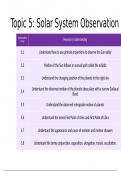
Point Necessary Understanding
5.1 Understand how to use pinhole projections to observe the Sun safely
5.2 Motion of the Sun follows an annual path called the ecliptic
5.3 Understand the changing position of the planets in the night sky
Understand the observed motion of the planets takes place with a narrow Zodiacal
5.4 Band
5.5 Understand the observed retrograde motion of planets
5.6 Understand the terms First Point of Aries and First Point of Libra
5.7 Understand the appearance and cause of meteors and meteor showers
5.8 Understand the terms conjunction, opposition, elongation, transit, occultation.
, Use pinhole projections safely to observe the
5.1 Sun
The Sun’s surface is alive with activity
so much so that astronomers often
desire to observe it.
However, using a standard telescope
would focus and direct too much
intense light into the retina, potentially
causing permanent damage (and…
possibly worse, no clear observations).
We can use pinhole to filter most light
then project over a distance to magnif
the surface for observations.
[1]
[2]
, 5.1 Questions
What is a pinhole projection?
Why do we need to use pinhole projections in astronomy?
When do we use pinhole projections in astronomy?
What can we use pinhole projections to observe on the Sun?
Specification
Point Necessary Understanding
5.1 Understand how to use pinhole projections to observe the Sun safely
5.2 Motion of the Sun follows an annual path called the ecliptic
5.3 Understand the changing position of the planets in the night sky
Understand the observed motion of the planets takes place with a narrow Zodiacal
5.4 Band
5.5 Understand the observed retrograde motion of planets
5.6 Understand the terms First Point of Aries and First Point of Libra
5.7 Understand the appearance and cause of meteors and meteor showers
5.8 Understand the terms conjunction, opposition, elongation, transit, occultation.
, Use pinhole projections safely to observe the
5.1 Sun
The Sun’s surface is alive with activity
so much so that astronomers often
desire to observe it.
However, using a standard telescope
would focus and direct too much
intense light into the retina, potentially
causing permanent damage (and…
possibly worse, no clear observations).
We can use pinhole to filter most light
then project over a distance to magnif
the surface for observations.
[1]
[2]
, 5.1 Questions
What is a pinhole projection?
Why do we need to use pinhole projections in astronomy?
When do we use pinhole projections in astronomy?
What can we use pinhole projections to observe on the Sun?