ENIGEERING THE
IMMUNE SYSTEM;
TREATMENT OF
DISEASE
MBS1202
, Week 1
Introduction lecture
The role of antibodies in medicine;
- Analytical tools;
o Immunohistochemistry
o ELISA
o Western blot
- Therapy
o Passive immunization
o Vaccination
- Highly specific, naturally evolved molecules
- Recognize and eliminate pathogenic and disease antigens
- Versatile therapeutic agents to fight cancer, autoimmune disease and infection.
- Very expensive therapy
- Modifications can be performed on the FAB or FC region of an antibody
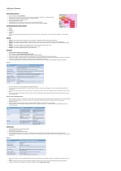
Each domain is encoded by an exon and the greener part is encoded by the intron.
,Ab specificity= Determined by complementarity-determining regions (CDR) to form the
paratope where the epitope of the antigen will bind.
Frame-work regions= A framework region is a subdivision of the variable region (Fab) of the
antibody.
Polyclonal antibodies Monoclonal antibodies
Multiple epitopes Single epitope
Large range in affinity; different range in Single affinity; either strong or weak
how strong the antibody will bind
Rapid and low cost-production in rabbits or Labor-intensive, high cost
goats from the serum
Limited availability Unlimited availability
Low reproducibility High reproducibility
Large animals are often use as this means there can be more antibodies collected.
Considerations prior to immunization of polyclonal antibodies (biological)
1. Antigen selection (what is the specific disease I want to treat ?), purification and
analysis
2. Assessment of antigenicity
1. Small antigen; needs protein carrier
2. Evolutionary conserved; species and adjuvant selection
3. Species selection
Species selection Costs Amount
Rabbit Cheap Max 100 mg
Goat Cheap Max 1 g
Rodents Expensive Max 5-40 mg
, From antigen to antibody-Immunization
- Proteins are seldom good antibody inducers
- Immune response needs ‘’danger’’ signal
- Antigens attached to adjuvants
o Adjuvant = Substance that boosts specific immune response against antigen
through physical or chemical association
▪ Bacterial products (lipoproteins, flagellin, lipopolysaccharides)
▪ Mineral oils with immune-stimulant
▪ Aluminum-based adjuvants (most often used in human vaccines)
▪ Uric acid
▪ Microbiota
▪ Adjuvants for antibody production in experimental animals
• Stimune; water-in-oil adjuvant
• Freund’s; mineral oil, emulsifier mannide monooleate
o Incomplete; only oil and emulsifier
o Complete; contains health-killed mycobacterium
• TiterMax Gold; block copolymer CRL-8300, squalene 9 a
metabolizable oil), unique microparticulate stabilizer.
From antigen to antibody polyclonal antibodies
1. Antigen preparation (peptide design, synthesis and conjugation (carrier protein)
2. Immunization and testing of antisera to boost immune response
3. Injection antigen + adjuvant (e.g., 1x/2 weeks; 8 rounds)
4. Booster injection and bleeding of animal under anesthesia to collect serum.
5. Purification (the more purified the antibody, the less aspecific binding will occur)
6. Class-specific or antigen-specific affinity purification
7. Validation
a. Depending on application (ELISA, disease etc.)
From antigen to antibody of monoclonal antibodies
1. Antigen preparation
a. Peptide design
b. Synthesis
c. Conjugation
2. Immunization of mice (sometimes rats) and testing of antisera
a. Injection antigen + adjuvant ( e.g., 1x week, max 12 rounds)
3. Detect sufficient antibody titer with ELISA
4. Harvest of mouse spleen under anesthesia after booster injection → Isolation of
spleen cells.
5. Fuse mouse spleen cells with mouse myeloma cells (allowing it to grow over and over
again)
IMMUNE SYSTEM;
TREATMENT OF
DISEASE
MBS1202
, Week 1
Introduction lecture
The role of antibodies in medicine;
- Analytical tools;
o Immunohistochemistry
o ELISA
o Western blot
- Therapy
o Passive immunization
o Vaccination
- Highly specific, naturally evolved molecules
- Recognize and eliminate pathogenic and disease antigens
- Versatile therapeutic agents to fight cancer, autoimmune disease and infection.
- Very expensive therapy
- Modifications can be performed on the FAB or FC region of an antibody
Each domain is encoded by an exon and the greener part is encoded by the intron.
,Ab specificity= Determined by complementarity-determining regions (CDR) to form the
paratope where the epitope of the antigen will bind.
Frame-work regions= A framework region is a subdivision of the variable region (Fab) of the
antibody.
Polyclonal antibodies Monoclonal antibodies
Multiple epitopes Single epitope
Large range in affinity; different range in Single affinity; either strong or weak
how strong the antibody will bind
Rapid and low cost-production in rabbits or Labor-intensive, high cost
goats from the serum
Limited availability Unlimited availability
Low reproducibility High reproducibility
Large animals are often use as this means there can be more antibodies collected.
Considerations prior to immunization of polyclonal antibodies (biological)
1. Antigen selection (what is the specific disease I want to treat ?), purification and
analysis
2. Assessment of antigenicity
1. Small antigen; needs protein carrier
2. Evolutionary conserved; species and adjuvant selection
3. Species selection
Species selection Costs Amount
Rabbit Cheap Max 100 mg
Goat Cheap Max 1 g
Rodents Expensive Max 5-40 mg
, From antigen to antibody-Immunization
- Proteins are seldom good antibody inducers
- Immune response needs ‘’danger’’ signal
- Antigens attached to adjuvants
o Adjuvant = Substance that boosts specific immune response against antigen
through physical or chemical association
▪ Bacterial products (lipoproteins, flagellin, lipopolysaccharides)
▪ Mineral oils with immune-stimulant
▪ Aluminum-based adjuvants (most often used in human vaccines)
▪ Uric acid
▪ Microbiota
▪ Adjuvants for antibody production in experimental animals
• Stimune; water-in-oil adjuvant
• Freund’s; mineral oil, emulsifier mannide monooleate
o Incomplete; only oil and emulsifier
o Complete; contains health-killed mycobacterium
• TiterMax Gold; block copolymer CRL-8300, squalene 9 a
metabolizable oil), unique microparticulate stabilizer.
From antigen to antibody polyclonal antibodies
1. Antigen preparation (peptide design, synthesis and conjugation (carrier protein)
2. Immunization and testing of antisera to boost immune response
3. Injection antigen + adjuvant (e.g., 1x/2 weeks; 8 rounds)
4. Booster injection and bleeding of animal under anesthesia to collect serum.
5. Purification (the more purified the antibody, the less aspecific binding will occur)
6. Class-specific or antigen-specific affinity purification
7. Validation
a. Depending on application (ELISA, disease etc.)
From antigen to antibody of monoclonal antibodies
1. Antigen preparation
a. Peptide design
b. Synthesis
c. Conjugation
2. Immunization of mice (sometimes rats) and testing of antisera
a. Injection antigen + adjuvant ( e.g., 1x week, max 12 rounds)
3. Detect sufficient antibody titer with ELISA
4. Harvest of mouse spleen under anesthesia after booster injection → Isolation of
spleen cells.
5. Fuse mouse spleen cells with mouse myeloma cells (allowing it to grow over and over
again)