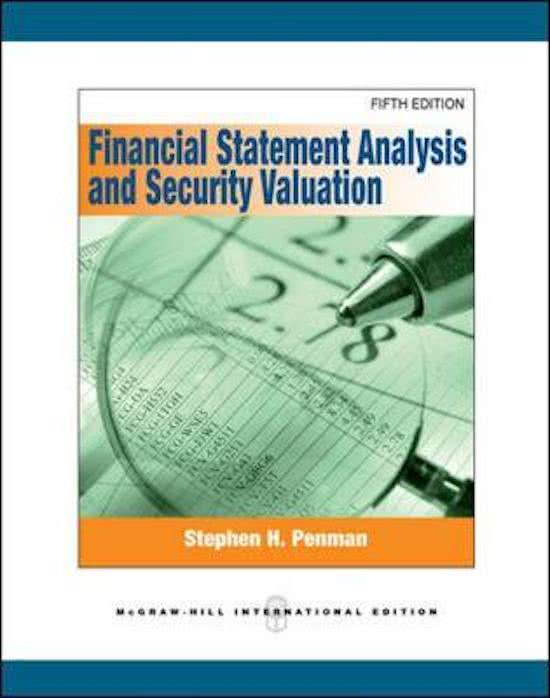
Summary financial statement analysis and Security valuation (Stephen H. Penman)
Chapter one: Introduction to investing and valuation
Financial statement analysis is the method by which users extract information to
answer their questions about the firm. Financial statements are the primary information
that firms publish about themselves, and investors are the primary users of financial
statements. Investors typically invest in a firm by buying equity shares of the firm’s debt.
Their primary concern is the amount to pay. The analysis of information that focuses on
valuation is called valuation analysis, fundamental analysis, or, when securities like
stocks and bonds are involved, security analysis.
Investors need to ask themselves when trading whether they pay the right price and
what the share actually are worth. In the absence of any clear indication of what stocks
are worth, investors cope in different ways. Intuitive investors rely on their own
instincts. Passive investors trust market efficiency meaning that the market price is a
fair price and the market forces the price to a appropriate point.
Thoroughly examining information about firms and reaching conclusions about the
underlying value that the information implies can reduce the risk of incurring a loss.
This is fundamental analysis and the investor who relies on fundamental analysis is a
fundamental investor. “What you get” from the investment is future payoffs, so the
fundamental investor evaluates likely payoffs to ascertain whether the asking price is a
reasonable one. The defensive investor does this to avoid trading at the wrong price.
The active investor uses fundamental analysis to discover mispriced stocks that might
earn exceptional rates of return.
Fundamental investors speak of discovering intrinsic values, warranted values, or
fundamental values. Intrinsic value is the worth of an investment that is justified by the
information about its payoffs. But this term should not be taken to imply precision. This
is because that fundamental analysis does not take away all uncertainty. It offers
principles, which reduce uncertainty. Since information is important to investors, it
must be well organized.
By frequently trading, stock markets have increased enormously. Sometimes, a stock
market bubble occurred that damages economies. People form unreasonable
expectations of likely returns and so make misguided consumption and investment
decisions. Investors adopt speculative beliefs that are then fed on to other people. A
bubble forms, only to burst as the speculative beliefs are not fulfilled. The popular
investing style called momentum investing has features of a chain letter. The most well
known bubble is the mortgage market bubble that led to the Financial Crisis in 2008.
Bubbles can work in reverse: Rather than prices becoming inflated, they become
depressed.
When individuals or institutions invest in firms, they give up cash in hope of a higher
return of cash in the future. The investment gives them a claim on the firm for a return.
This claim is formalized in a contract, which may not be tradable, or in a security, which
can be traded in security markets. Claims can be “plain vanilla” such as equity and debt.
Moreover, contingent claims such as convertible bonds, options and warrants are
derivative claims whose payoffs are based on the price of firms’ stock or bonds.
Chapter one: Introduction to investing and valuation
Financial statement analysis is the method by which users extract information to
answer their questions about the firm. Financial statements are the primary information
that firms publish about themselves, and investors are the primary users of financial
statements. Investors typically invest in a firm by buying equity shares of the firm’s debt.
Their primary concern is the amount to pay. The analysis of information that focuses on
valuation is called valuation analysis, fundamental analysis, or, when securities like
stocks and bonds are involved, security analysis.
Investors need to ask themselves when trading whether they pay the right price and
what the share actually are worth. In the absence of any clear indication of what stocks
are worth, investors cope in different ways. Intuitive investors rely on their own
instincts. Passive investors trust market efficiency meaning that the market price is a
fair price and the market forces the price to a appropriate point.
Thoroughly examining information about firms and reaching conclusions about the
underlying value that the information implies can reduce the risk of incurring a loss.
This is fundamental analysis and the investor who relies on fundamental analysis is a
fundamental investor. “What you get” from the investment is future payoffs, so the
fundamental investor evaluates likely payoffs to ascertain whether the asking price is a
reasonable one. The defensive investor does this to avoid trading at the wrong price.
The active investor uses fundamental analysis to discover mispriced stocks that might
earn exceptional rates of return.
Fundamental investors speak of discovering intrinsic values, warranted values, or
fundamental values. Intrinsic value is the worth of an investment that is justified by the
information about its payoffs. But this term should not be taken to imply precision. This
is because that fundamental analysis does not take away all uncertainty. It offers
principles, which reduce uncertainty. Since information is important to investors, it
must be well organized.
By frequently trading, stock markets have increased enormously. Sometimes, a stock
market bubble occurred that damages economies. People form unreasonable
expectations of likely returns and so make misguided consumption and investment
decisions. Investors adopt speculative beliefs that are then fed on to other people. A
bubble forms, only to burst as the speculative beliefs are not fulfilled. The popular
investing style called momentum investing has features of a chain letter. The most well
known bubble is the mortgage market bubble that led to the Financial Crisis in 2008.
Bubbles can work in reverse: Rather than prices becoming inflated, they become
depressed.
When individuals or institutions invest in firms, they give up cash in hope of a higher
return of cash in the future. The investment gives them a claim on the firm for a return.
This claim is formalized in a contract, which may not be tradable, or in a security, which
can be traded in security markets. Claims can be “plain vanilla” such as equity and debt.
Moreover, contingent claims such as convertible bonds, options and warrants are
derivative claims whose payoffs are based on the price of firms’ stock or bonds.