Apoptosis
Lecture 1
Cell death is a common procces
→ example; red blood cells: they already lost their nucleus, so they have a short
life span
Types of cell death:
- Apoptosis: controlled form of cell death. via apoptotic bodies formed from the
membrane, so contents are not ‘freely’ released
- Necrossis: an uncontrolled form of cell death (=passive cell death)
- programmed cell death: Genetically encoded cell death
- Anoikis: Programmed cell death that is induced in anchorage-dependent
cells when they detach from the surrounding extracellular matrix → occurs
often when cells are detached from their environment, no more signals =
cell death. Soft tissue cells
- Autophagic cell death: Dying cells displaying a large-scale accumulation of
autophagosomes. Autophagy is considered to be a pro-survival pathway in the dying
cell. Cells die with autophagy, rather than by autophagy
- Necroptosis: necrosis + apoptosis = controlled form of necrosis
- Pyroptosis: Inflammation associated programmed cell death. intermediate between
apoptosis and necrosis and highly dependent on caspase-1
- Parthanatos: In response on extreme genomic stress, dependent on PARP-1
- Ferroptosis: programmed cell death caused by iron-dependent accumulation of lipid
peroxides. initiated by failure of the glutathione-dependent antioxidant defenses,
resulting in unchecked lipid peroxidation and eventually cell death
- Mitotic catastrophe: Due to premature or inappropiate entry of cells into mitosis
leading to programmed cell death, often induced by radiation, chemotherapeutic
drugs, or hyperthermia
- NETosis: Pathogen-induced cell death of neutrophils, which excrete their DNA
leading to Neutrophil Extracellular Traps able to catch and kill extracellular
pathogens.
What is the function of programmed cell death in animal development
1. Sculpting: example removing of skin in between the digits
2. Deleting unwanted structures: example tail of a frog or sex organs
3. Adjusting cell numbers: example epithelial cells
4. Eliminating dangerous, injured, nonfunctional, abnormal or misplaced cells.
So,
programmed cell death → Developmental function
Apoptosis → Maintenance function
Specialized cell death → ?
- form of specialized cell death is terminal differentiation: almost death cells with a
function
→ some cells have a suspended death program for a unique function, such as
, - skin cells for cornification
- platelets for blood coagulation
- lens cells for transparency
- red blood cells for oxygen transport
Stress → cells can also proliferate: results in tumor formation
- how to prevent this?
stressed cells can choose between apoptosis and
senescence
Senescence: cells do not divide anymore, but remain in a stable
and metabolically viable state. You can recognize senescent
cells by their morphology: flattened and enlarged
However, also riks for disease here: associated with aging and
aging-diseases
Death pathways
→ Different types of cell death are !not! independent of
each other
the death pathway is most frequently used through apoptosis
- via either caspase-9 activation and the mitochondrial
route
- or directly via caspase-8 to caspase-3 as a primary
effector caspase.
example: cell starts the death pathway via apoptosis, but there is
not enough energy to complete this process, so it switches to
necrosis
So apoptosis is
→ a controlled process to efficiently deplete cells without cell lysis and is a crucial
process in
1. development
2. growth/ maintenance
3. immune system
Morphology of apoptotic cells
- Shrink, blabs on membrane, DNA condensation and fragmentation
- in early stages of apoptosis, mitochondrial network becomes highly fragmented
Apoptosis vs necrosis
apoptosis: DNA condensation + cell shrinkage, fragmentation and apoptotic bodies, death of
single cells, energy dependent
→ if not normal clearance of apoptotic bodies: secondary necrosis
necrosis: Cell swelling, pressure high, membrane breaks, release of contents, death of cell
groups, random digestion of DNA = smear of DNA after gel electrophoresis
Apoptotic players
Important receptors: Fas-APO-1, TNF-R1
, → works via activation of caspase which leads to an activation cascade by
cleavage = apoptosis
Three important phases
1. Activation
a. Extrinsic pathway →
receptor-mediated (death
receptors activation, works
via caspases)
b. Intrinsic pathway → cellular
stress signals
(mitochondrial signaling, via
caspase 9 and cleavage of
cytochrome C )
2. Execution phase = caspase cascade
3. Burial phase
TNF family death receptors
1. CD95/Fas receptor
2. DR4 and DR5 receptors
3. TNF receptor
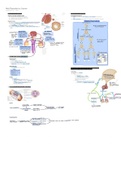
Signaling by CD95/Fas receptor
→ Receptor will trimerize upon activation by
ligand
- Formation of death domain (DD)
- protein-protein interaction to other death
domain of FADD → Fas-activated death
domain
- and interaction to DED-containing caspases:
DED = death effector domain
= DISC formation: Death inducing signaling complex
1. complex (DISC) formation
2. caspase 8 cleavage
3. caspase 3 cleavage and activation
apoptosis
CD95/Fas signaling can also interact with intrinsic pathway
1. DISC formation
2. caspase 8 cleavage
3. cleavage of Bid to tBid
4. Bax, Bak formation at mitochondrial membrane
5. release of Cytochrome C and SMAC
6. Cytochrome C will activate caspase 9 by cleavage
of Afap-1
7. SMAC inhibits IAPs = inhibitor of caspases
8. Active caspase 9
9. Cleavage of caspase 3 and activation
Lecture 1
Cell death is a common procces
→ example; red blood cells: they already lost their nucleus, so they have a short
life span
Types of cell death:
- Apoptosis: controlled form of cell death. via apoptotic bodies formed from the
membrane, so contents are not ‘freely’ released
- Necrossis: an uncontrolled form of cell death (=passive cell death)
- programmed cell death: Genetically encoded cell death
- Anoikis: Programmed cell death that is induced in anchorage-dependent
cells when they detach from the surrounding extracellular matrix → occurs
often when cells are detached from their environment, no more signals =
cell death. Soft tissue cells
- Autophagic cell death: Dying cells displaying a large-scale accumulation of
autophagosomes. Autophagy is considered to be a pro-survival pathway in the dying
cell. Cells die with autophagy, rather than by autophagy
- Necroptosis: necrosis + apoptosis = controlled form of necrosis
- Pyroptosis: Inflammation associated programmed cell death. intermediate between
apoptosis and necrosis and highly dependent on caspase-1
- Parthanatos: In response on extreme genomic stress, dependent on PARP-1
- Ferroptosis: programmed cell death caused by iron-dependent accumulation of lipid
peroxides. initiated by failure of the glutathione-dependent antioxidant defenses,
resulting in unchecked lipid peroxidation and eventually cell death
- Mitotic catastrophe: Due to premature or inappropiate entry of cells into mitosis
leading to programmed cell death, often induced by radiation, chemotherapeutic
drugs, or hyperthermia
- NETosis: Pathogen-induced cell death of neutrophils, which excrete their DNA
leading to Neutrophil Extracellular Traps able to catch and kill extracellular
pathogens.
What is the function of programmed cell death in animal development
1. Sculpting: example removing of skin in between the digits
2. Deleting unwanted structures: example tail of a frog or sex organs
3. Adjusting cell numbers: example epithelial cells
4. Eliminating dangerous, injured, nonfunctional, abnormal or misplaced cells.
So,
programmed cell death → Developmental function
Apoptosis → Maintenance function
Specialized cell death → ?
- form of specialized cell death is terminal differentiation: almost death cells with a
function
→ some cells have a suspended death program for a unique function, such as
, - skin cells for cornification
- platelets for blood coagulation
- lens cells for transparency
- red blood cells for oxygen transport
Stress → cells can also proliferate: results in tumor formation
- how to prevent this?
stressed cells can choose between apoptosis and
senescence
Senescence: cells do not divide anymore, but remain in a stable
and metabolically viable state. You can recognize senescent
cells by their morphology: flattened and enlarged
However, also riks for disease here: associated with aging and
aging-diseases
Death pathways
→ Different types of cell death are !not! independent of
each other
the death pathway is most frequently used through apoptosis
- via either caspase-9 activation and the mitochondrial
route
- or directly via caspase-8 to caspase-3 as a primary
effector caspase.
example: cell starts the death pathway via apoptosis, but there is
not enough energy to complete this process, so it switches to
necrosis
So apoptosis is
→ a controlled process to efficiently deplete cells without cell lysis and is a crucial
process in
1. development
2. growth/ maintenance
3. immune system
Morphology of apoptotic cells
- Shrink, blabs on membrane, DNA condensation and fragmentation
- in early stages of apoptosis, mitochondrial network becomes highly fragmented
Apoptosis vs necrosis
apoptosis: DNA condensation + cell shrinkage, fragmentation and apoptotic bodies, death of
single cells, energy dependent
→ if not normal clearance of apoptotic bodies: secondary necrosis
necrosis: Cell swelling, pressure high, membrane breaks, release of contents, death of cell
groups, random digestion of DNA = smear of DNA after gel electrophoresis
Apoptotic players
Important receptors: Fas-APO-1, TNF-R1
, → works via activation of caspase which leads to an activation cascade by
cleavage = apoptosis
Three important phases
1. Activation
a. Extrinsic pathway →
receptor-mediated (death
receptors activation, works
via caspases)
b. Intrinsic pathway → cellular
stress signals
(mitochondrial signaling, via
caspase 9 and cleavage of
cytochrome C )
2. Execution phase = caspase cascade
3. Burial phase
TNF family death receptors
1. CD95/Fas receptor
2. DR4 and DR5 receptors
3. TNF receptor
Signaling by CD95/Fas receptor
→ Receptor will trimerize upon activation by
ligand
- Formation of death domain (DD)
- protein-protein interaction to other death
domain of FADD → Fas-activated death
domain
- and interaction to DED-containing caspases:
DED = death effector domain
= DISC formation: Death inducing signaling complex
1. complex (DISC) formation
2. caspase 8 cleavage
3. caspase 3 cleavage and activation
apoptosis
CD95/Fas signaling can also interact with intrinsic pathway
1. DISC formation
2. caspase 8 cleavage
3. cleavage of Bid to tBid
4. Bax, Bak formation at mitochondrial membrane
5. release of Cytochrome C and SMAC
6. Cytochrome C will activate caspase 9 by cleavage
of Afap-1
7. SMAC inhibits IAPs = inhibitor of caspases
8. Active caspase 9
9. Cleavage of caspase 3 and activation