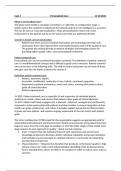
Case 5 Personalized Care 11-10-2022
What is personalized care?
The phase were health is nowadays currently in, is called the co-configuration stage; a
system where the customer is linked into the network and his or her intelligence is accessed.
This can be seen as ‘mass personalization’. Mass personalization means even more
involvement of the patient and his or her wants and needs are addressed directly.
Growth in health care personalization
- Patient have more access to medical information and technology now than ever,
which gives them more input in their own health decisions and in their quality of care
- The growth also related directly to medical strategies and emerging science for
providing higher quality, safer, more personalized treatments.
Patient centered care
Personalized care can be translated into patient centered. The definition of patient centered
care is a multidimensional concept and is difficult to grasp and to measure. Patient centered
care can be seen as the following shift: ‘The shift in control and power out of hands of those
who give care into the hands of those who receive it’
Definition patient-centered care
- Respect, autonomy, dignity
- Accessible, confidential, continuity of care, holistic, emotional supportive
- Responsive to patient preferences, needs and values, ensuring that patient values
guide all clinical decisions
- Patient empowerment
2001: Patient centered care is respectful of and responsive to individual patient
preferences, needs, values and ensures that patient values guide all clinical decisions
2017: Patient and family engaged care is planned, delivered, managed and continuously
improved in active partnership with patients and their families to ensure integration of their
health care goals, preferences, and values. It includes explicit and partnered determination
of goals and care options, and requires ongoing assessment of the care match with patient
goals.
The Victor and Boynton (1998) model for the organization suggests an appropriate path for
organizational development and improvement. Health care processes and product lines have
begun to move from the craft stage to positions in all of the other stages of that model. Each
stage requires its own approach to quality: *about normal company
1. Craft -> requires that the individual improve with experience and use the tacit
knowledge produced to develop a better individual reputation and group reputation.
Craft activities can be leveraged to a limited extent by a community of cooperating
and teaching craft persons.
2. Mass production -> Requires the discipline that produces conformance quality in high
volume at low cost. Critics call it industrialization/deskilling of the profession/Henry
Ford’s assembly lines, strives for little or no variation in order to reduce costs. Such as
vaccines.
, 3. Process enhancement -> Requires that processes be analyzed and modified to
develop a best-practice approach using worker feedback and process-owning teams
within the organization. Such as CQI
4. Mass customization -> Requires that the organization takes that best practice,
modularizes and supports it independently, and then uses those modules to build
efficient, low-cost processes that are responsive to individual customer wants and
needs.
5. Co-configuration: co-create with patient the care that you deliver.
6. Mass personalization. Right now, there is a large shift towards mass personalization
(tailor made drug) and patient centered care. Another example of mass
personalization is personalized rehabilitation. Due to mass personalization, the
health care organization becomes better in meeting the needs of the patient and
evolves to be more nimble. ‘developing, producing, marketing and delivering
affordable goods and services with enough variety and customization that nearly
everyone finds exactly what they want.
Craft = tacit knowledge + experience
Mass = articulated knowledge that creates machine like
system
Process = practical knowledge used to enhance and improve
(by learning & linking)
Custom = incorporating what client wants but once!
(architectural knowledge)
Co-configuration = continuous incorporation of client needs
As computer technologies have become more personalized, the concepts of mass
customization and co-configuration have evolved into personalization.
- Customization relates to changing, assembling, or modifying product or service
components according to customers’ needs and desires (with enough variety and
customization that nearly everyone finds exactly what they want).
- Personalization involves intense communication and interaction between the
customer and supplier. Personalization is about selecting or filtering information
objects for an individual by using the customer profile and then negotiating the
selection with the individual. This leads to strategies directed at “a market of one”.
Mass production targets a mass market, customization a market of few, and mass
personalization a market of one (meaningful exchange of information and co- configuration
and cocreation of products. Personalization can be seen as the ultimate vision for the health
care system, and mass customization is the key process for realizing personalization.
Facilitating factors in personalization
A number of factors are making personalization more possible for health care systems:
- Better, more robust information systems (electronic medical record)
- Advances in genetics and genomics;
- The ability to better match pharmaceutical products with individual patient needs
- Increased patient self-care interest and the use of internet for information
What is personalized care?
The phase were health is nowadays currently in, is called the co-configuration stage; a
system where the customer is linked into the network and his or her intelligence is accessed.
This can be seen as ‘mass personalization’. Mass personalization means even more
involvement of the patient and his or her wants and needs are addressed directly.
Growth in health care personalization
- Patient have more access to medical information and technology now than ever,
which gives them more input in their own health decisions and in their quality of care
- The growth also related directly to medical strategies and emerging science for
providing higher quality, safer, more personalized treatments.
Patient centered care
Personalized care can be translated into patient centered. The definition of patient centered
care is a multidimensional concept and is difficult to grasp and to measure. Patient centered
care can be seen as the following shift: ‘The shift in control and power out of hands of those
who give care into the hands of those who receive it’
Definition patient-centered care
- Respect, autonomy, dignity
- Accessible, confidential, continuity of care, holistic, emotional supportive
- Responsive to patient preferences, needs and values, ensuring that patient values
guide all clinical decisions
- Patient empowerment
2001: Patient centered care is respectful of and responsive to individual patient
preferences, needs, values and ensures that patient values guide all clinical decisions
2017: Patient and family engaged care is planned, delivered, managed and continuously
improved in active partnership with patients and their families to ensure integration of their
health care goals, preferences, and values. It includes explicit and partnered determination
of goals and care options, and requires ongoing assessment of the care match with patient
goals.
The Victor and Boynton (1998) model for the organization suggests an appropriate path for
organizational development and improvement. Health care processes and product lines have
begun to move from the craft stage to positions in all of the other stages of that model. Each
stage requires its own approach to quality: *about normal company
1. Craft -> requires that the individual improve with experience and use the tacit
knowledge produced to develop a better individual reputation and group reputation.
Craft activities can be leveraged to a limited extent by a community of cooperating
and teaching craft persons.
2. Mass production -> Requires the discipline that produces conformance quality in high
volume at low cost. Critics call it industrialization/deskilling of the profession/Henry
Ford’s assembly lines, strives for little or no variation in order to reduce costs. Such as
vaccines.
, 3. Process enhancement -> Requires that processes be analyzed and modified to
develop a best-practice approach using worker feedback and process-owning teams
within the organization. Such as CQI
4. Mass customization -> Requires that the organization takes that best practice,
modularizes and supports it independently, and then uses those modules to build
efficient, low-cost processes that are responsive to individual customer wants and
needs.
5. Co-configuration: co-create with patient the care that you deliver.
6. Mass personalization. Right now, there is a large shift towards mass personalization
(tailor made drug) and patient centered care. Another example of mass
personalization is personalized rehabilitation. Due to mass personalization, the
health care organization becomes better in meeting the needs of the patient and
evolves to be more nimble. ‘developing, producing, marketing and delivering
affordable goods and services with enough variety and customization that nearly
everyone finds exactly what they want.
Craft = tacit knowledge + experience
Mass = articulated knowledge that creates machine like
system
Process = practical knowledge used to enhance and improve
(by learning & linking)
Custom = incorporating what client wants but once!
(architectural knowledge)
Co-configuration = continuous incorporation of client needs
As computer technologies have become more personalized, the concepts of mass
customization and co-configuration have evolved into personalization.
- Customization relates to changing, assembling, or modifying product or service
components according to customers’ needs and desires (with enough variety and
customization that nearly everyone finds exactly what they want).
- Personalization involves intense communication and interaction between the
customer and supplier. Personalization is about selecting or filtering information
objects for an individual by using the customer profile and then negotiating the
selection with the individual. This leads to strategies directed at “a market of one”.
Mass production targets a mass market, customization a market of few, and mass
personalization a market of one (meaningful exchange of information and co- configuration
and cocreation of products. Personalization can be seen as the ultimate vision for the health
care system, and mass customization is the key process for realizing personalization.
Facilitating factors in personalization
A number of factors are making personalization more possible for health care systems:
- Better, more robust information systems (electronic medical record)
- Advances in genetics and genomics;
- The ability to better match pharmaceutical products with individual patient needs
- Increased patient self-care interest and the use of internet for information