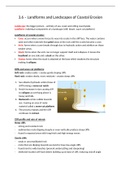
3.6 – Landforms and Landscapes of Coastal Erosion
Landscape: the bigger picture – entirety of sea, coast and rolling countryside.
Landform: individual components of a landscape (cliff, beach, wave cut platform)
Landforms of coastal erosion:
Cave: occurs when a wave forces its way into cracks in the cliff face. The water contains
sand and other materials that grind away at the rock until the cracks become a cave.
Arch: forms when a cave breaks through due to hydraulic action and attrition on those
weaker areas.
Stack: forms when the arch can no longer support itself and collapses. It leaves the
headland on one side and a stack on the other.
Stump: forms when the stack is attacked at the base which weakens the structure
making it collapse.
Cliffs and wave cut platforms:
Soft rock: erodes easily - creates gently sloping cliffs
Hard rock: erodes slowly, more resistant - creates steep cliffs
1. Sea attacks (hydraulic action) base of
cliff forming a wave-cut notch
2. Notch increases in size causing cliff
to collapse as overhang above is
heavy and falls.
3. Backwash carries rubble towards
sea - leaving an area of rocky
material called a wave-cut platform.
4. The process repeats and the cliff
continues to retreat.
Cliff profile and rate of retreat:
Steep cliffs
- strong and resistant rock
- sedimentary rocks dipping steeply or even vertically produce steep cliffs
- found in exposed areas with long fetch and high-energy waves
Gentle cliffs
- weak or unconsolidated rock
- rocks that are dipping towards sea tend to have low-angle cliffs
- found next to wide beaches (prevent undercutting and steepening)
- sheltered location will have debris building up at base of cliff, reducing overall angle
Landscape: the bigger picture – entirety of sea, coast and rolling countryside.
Landform: individual components of a landscape (cliff, beach, wave cut platform)
Landforms of coastal erosion:
Cave: occurs when a wave forces its way into cracks in the cliff face. The water contains
sand and other materials that grind away at the rock until the cracks become a cave.
Arch: forms when a cave breaks through due to hydraulic action and attrition on those
weaker areas.
Stack: forms when the arch can no longer support itself and collapses. It leaves the
headland on one side and a stack on the other.
Stump: forms when the stack is attacked at the base which weakens the structure
making it collapse.
Cliffs and wave cut platforms:
Soft rock: erodes easily - creates gently sloping cliffs
Hard rock: erodes slowly, more resistant - creates steep cliffs
1. Sea attacks (hydraulic action) base of
cliff forming a wave-cut notch
2. Notch increases in size causing cliff
to collapse as overhang above is
heavy and falls.
3. Backwash carries rubble towards
sea - leaving an area of rocky
material called a wave-cut platform.
4. The process repeats and the cliff
continues to retreat.
Cliff profile and rate of retreat:
Steep cliffs
- strong and resistant rock
- sedimentary rocks dipping steeply or even vertically produce steep cliffs
- found in exposed areas with long fetch and high-energy waves
Gentle cliffs
- weak or unconsolidated rock
- rocks that are dipping towards sea tend to have low-angle cliffs
- found next to wide beaches (prevent undercutting and steepening)
- sheltered location will have debris building up at base of cliff, reducing overall angle