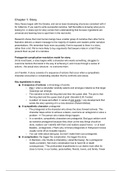
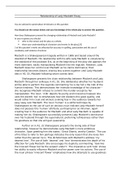
Notes on the lectures from the course (2023) Environmental Politics. INCLUDES notes from lectures
1-9 (Total: 27 pages).
Environmental Politics Lecture Notes (Lectures 1-9)
Table of Contents
Lecture 1: Introduction 1
Lecture 2: Power & the Environment 1
Lecture 3: Modernity & the Environment 3
Lecture 4: Environmental Authoritarianism & Fascism 6
Lecture 5: Eco-Socialism 10
Lecture 6: Colonialism, Racism & Environmental Justice 13
Lecture 7: Migration, Gender, & Environment 16
Lecture 8: The Politics of Eco-Grief, -Guilt & -Anxiety 21
Lecture 9: Climate (In)Action & (Dis)Engagement 23
, 1
Lecture 1: Introduction
Environmental Politics
What is environmental politics? Focus = the environment &:
● Multi-sub-disciplinary within Political Science: ● POWER
○ IR ● EQUALITY
○ Comparative politics ● JUSTICE
○ Political theory ● FREEDOM
● Multi-disciplinary beyond Political Science:
○ History
○ Geography
○ Sociology
Lecture 2: Power & the Environment
Political Ecology
“Theorein”: Consider, speculate → how we look shapes what we see.
Power shapes the environment = access, use, distribution & degradation. Political ecologists focus
on those in the margin (working class).
➔ Implications: Key concepts:
◆ Social construction. ● Marginality
◆ Entanglement/dichotomy of nature & society (e.g., ● Ecology
● Political economy
environmental management; radical ecocentrism).
◆ Environmental disrepair as a social problem (historical
contingency) → NOT only biological, organisational &
technological diagnoses.
Political Ecology Example: Water Use in Chile
Neoliberal economic development led to the privatisation & marketisation of natural resources → 1981
Chilean Water Code. Resulted in:
● Increased commercial agriculture for export (annual crops → fruit production).
● Increased demand for scarce water.
● Large producers claim water rights
Environment shapes power = dominant energy sources (e.g., coal, oil) shape political activity &
actors (Mitchell).
➔ COAL = rise of modern mass democratic politics (demos).
◆ Extraction, production, & transportation empowered workers, who could make
effective demands regarding:
● Labour power (e.g., strike, sabotage, slow down coal production).
● Political power (e.g., suffrage, rights to unionise, mass parties).
◆ Traditional renewable energy that buried solar energy & concentrated:
, 2
●Energy = in large quantities at specific sites.
●People = denser human populations → industrialisation & mass democratic
politics (actors that could slow/disrupt energy).
◆ Movement = tree-like.
➔ OIL = changed with its adoption, chipping away at power.
◆ Oil regions became more industrially & geographically isolated (NOT centralised).
◆ Resulted in:
● Smaller workforces & poorer worker surveillance.
● Fewer opportunities for worker disruption & to translate labour power into
political demands.
◆ Movement = grid-like.
Depoliticisation
Depoliticisation: Removes/decouples issues from political discourse & power + closes issues to
debate, deliberation & contestation.
➔ Post-politics = political modality focusing on consensus > dissensus. Universalises particular
political positions & demands, leaving politics behind altogether.
◆ Hidden normative power.
◆ Expert-led administration (discourages heterodoxy & sideline demos).
◆ Associated with the “end of history” = absence of ideological contestation.
➔ Depoliticised environments:
◆ Timing & character = larger post-political context & lack of emancipatory subjects
(e.g., feminism).
◆ Urgency & immediacy = scale of denialism & commonplace notions of “nature”
(uniform & singular → realm of necessity).
● Realm of Necessity: Beyond human society’s reach → what is natural =
given.
➔ Discursive mechanisms = depoliticisation via: ○ Predetermines environmental
}
◆ Scientisation = technological solutions politics → democratic
with an evidence-based road map (e.g., deliberation unnecessary.
○ NO need to be discrete; one
emission controls).
can support the other.
◆ Economisation = economic challenges, ○ Empowers experts,
market problems/sustainable solutions disempowers citizens.
(production & investment strategies).
◆ Moralisation = NO need for scientisation/economisation. Contestation ethically:
● Good (depoliticisation beyond debate & permissible).
● Bad (depoliticisation is impermissible).
Repoliticisation
Repoliticisation (Swyngedouw): Done by understanding that nature = open/multiple + recognizing
that politics = always divisive → affirming equality & acting from a place of “can”.
➔ Risks of depoliticised environmental discourse:
◆ Tends to be ‘business as usual’.
1-9 (Total: 27 pages).
Environmental Politics Lecture Notes (Lectures 1-9)
Table of Contents
Lecture 1: Introduction 1
Lecture 2: Power & the Environment 1
Lecture 3: Modernity & the Environment 3
Lecture 4: Environmental Authoritarianism & Fascism 6
Lecture 5: Eco-Socialism 10
Lecture 6: Colonialism, Racism & Environmental Justice 13
Lecture 7: Migration, Gender, & Environment 16
Lecture 8: The Politics of Eco-Grief, -Guilt & -Anxiety 21
Lecture 9: Climate (In)Action & (Dis)Engagement 23
, 1
Lecture 1: Introduction
Environmental Politics
What is environmental politics? Focus = the environment &:
● Multi-sub-disciplinary within Political Science: ● POWER
○ IR ● EQUALITY
○ Comparative politics ● JUSTICE
○ Political theory ● FREEDOM
● Multi-disciplinary beyond Political Science:
○ History
○ Geography
○ Sociology
Lecture 2: Power & the Environment
Political Ecology
“Theorein”: Consider, speculate → how we look shapes what we see.
Power shapes the environment = access, use, distribution & degradation. Political ecologists focus
on those in the margin (working class).
➔ Implications: Key concepts:
◆ Social construction. ● Marginality
◆ Entanglement/dichotomy of nature & society (e.g., ● Ecology
● Political economy
environmental management; radical ecocentrism).
◆ Environmental disrepair as a social problem (historical
contingency) → NOT only biological, organisational &
technological diagnoses.
Political Ecology Example: Water Use in Chile
Neoliberal economic development led to the privatisation & marketisation of natural resources → 1981
Chilean Water Code. Resulted in:
● Increased commercial agriculture for export (annual crops → fruit production).
● Increased demand for scarce water.
● Large producers claim water rights
Environment shapes power = dominant energy sources (e.g., coal, oil) shape political activity &
actors (Mitchell).
➔ COAL = rise of modern mass democratic politics (demos).
◆ Extraction, production, & transportation empowered workers, who could make
effective demands regarding:
● Labour power (e.g., strike, sabotage, slow down coal production).
● Political power (e.g., suffrage, rights to unionise, mass parties).
◆ Traditional renewable energy that buried solar energy & concentrated:
, 2
●Energy = in large quantities at specific sites.
●People = denser human populations → industrialisation & mass democratic
politics (actors that could slow/disrupt energy).
◆ Movement = tree-like.
➔ OIL = changed with its adoption, chipping away at power.
◆ Oil regions became more industrially & geographically isolated (NOT centralised).
◆ Resulted in:
● Smaller workforces & poorer worker surveillance.
● Fewer opportunities for worker disruption & to translate labour power into
political demands.
◆ Movement = grid-like.
Depoliticisation
Depoliticisation: Removes/decouples issues from political discourse & power + closes issues to
debate, deliberation & contestation.
➔ Post-politics = political modality focusing on consensus > dissensus. Universalises particular
political positions & demands, leaving politics behind altogether.
◆ Hidden normative power.
◆ Expert-led administration (discourages heterodoxy & sideline demos).
◆ Associated with the “end of history” = absence of ideological contestation.
➔ Depoliticised environments:
◆ Timing & character = larger post-political context & lack of emancipatory subjects
(e.g., feminism).
◆ Urgency & immediacy = scale of denialism & commonplace notions of “nature”
(uniform & singular → realm of necessity).
● Realm of Necessity: Beyond human society’s reach → what is natural =
given.
➔ Discursive mechanisms = depoliticisation via: ○ Predetermines environmental
}
◆ Scientisation = technological solutions politics → democratic
with an evidence-based road map (e.g., deliberation unnecessary.
○ NO need to be discrete; one
emission controls).
can support the other.
◆ Economisation = economic challenges, ○ Empowers experts,
market problems/sustainable solutions disempowers citizens.
(production & investment strategies).
◆ Moralisation = NO need for scientisation/economisation. Contestation ethically:
● Good (depoliticisation beyond debate & permissible).
● Bad (depoliticisation is impermissible).
Repoliticisation
Repoliticisation (Swyngedouw): Done by understanding that nature = open/multiple + recognizing
that politics = always divisive → affirming equality & acting from a place of “can”.
➔ Risks of depoliticised environmental discourse:
◆ Tends to be ‘business as usual’.