People in Business and Society
Lecture slides 1-6
Lecture 1
Different layers/dimensions of culture – Schein
Different types of cultures – national, organizational, occupational
Different conceptualizations of and interpretations about culture – Hofstede vs. THT
With a deeper understanding of (the dynamics of) culture…
- You can take distance but not be too distant: you become engaged
- You more easily feel comfortable within a diverse (work) environment
- You are enabled to effectively cooperate and collaborate in a diverse environment
- Your aptitude in cross-cultural communication increases, fostering adaptation
- You better understand and solve work-related issues dealing with a diverse workforce
- Your empathy increases
Lecture 2: introduction to culture
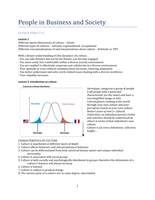
Stereotype: categorize a group of people
(=all people with a particular
characteristic are the same) and have a
oversimplified image or idea
Colored glasses: looking at the world
through your own culture and your
perception based on your own culture.
Native’s point of view (= cultural
relativism): an individual person’s belief
and activities should be understood by
others in terms of that individual’s own
culture.
Culture is (in every definition): collective,
taught, …
CHARACTERISTICS OF CULTURE
1. Culture is manifested at different layers of depth
2. Culture affects behaviors and interpretations of behavior
3. Culture can be differentiated from both universal human nature and unique individual
personality
4. Culture is associated with social groups
5. Culture is both socially and psychologically distributed in groups, therefore the delineation of a
culture’s features will always be fuzzy
6. Culture is learned
7. Culture is subject to gradual change
8. The various parts of a culture are, to some degree, interrelated
1
Lecture slides 1-6
Lecture 1
Different layers/dimensions of culture – Schein
Different types of cultures – national, organizational, occupational
Different conceptualizations of and interpretations about culture – Hofstede vs. THT
With a deeper understanding of (the dynamics of) culture…
- You can take distance but not be too distant: you become engaged
- You more easily feel comfortable within a diverse (work) environment
- You are enabled to effectively cooperate and collaborate in a diverse environment
- Your aptitude in cross-cultural communication increases, fostering adaptation
- You better understand and solve work-related issues dealing with a diverse workforce
- Your empathy increases
Lecture 2: introduction to culture
Stereotype: categorize a group of people
(=all people with a particular
characteristic are the same) and have a
oversimplified image or idea
Colored glasses: looking at the world
through your own culture and your
perception based on your own culture.
Native’s point of view (= cultural
relativism): an individual person’s belief
and activities should be understood by
others in terms of that individual’s own
culture.
Culture is (in every definition): collective,
taught, …
CHARACTERISTICS OF CULTURE
1. Culture is manifested at different layers of depth
2. Culture affects behaviors and interpretations of behavior
3. Culture can be differentiated from both universal human nature and unique individual
personality
4. Culture is associated with social groups
5. Culture is both socially and psychologically distributed in groups, therefore the delineation of a
culture’s features will always be fuzzy
6. Culture is learned
7. Culture is subject to gradual change
8. The various parts of a culture are, to some degree, interrelated
1