A Cook 2015
Chemistry Led Specification Revision:
Topic 1 - The Atomic Structure and Periodic Table
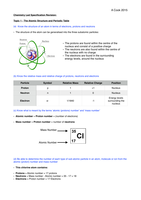
(a) Know the structure of an atom in terms of electrons, protons and neutrons
• The structure of the atom can be generalised into the three subatomic particles:
• The protons are found within the centre of the
nucleus and consist of a positive charge
• The neutrons are also found within the centre of
the nucleus with no charge
• The electrons are found in the surrounding
energy levels, around the nucleus
(b) Know the relative mass and relative charge of protons, neutrons and electrons
Particle Symbol Relative Mass Relative Charge Position
Proton p 1 +1 Nucleus
Neutron n 1 0 Nucleus
Energy levels
Electron e- 1/1840 -1 surrounding the
nucleus
(c) Know what is meant by the terms ‘atomic (protons) number’ and ‘mass number’
• Atomic number = Proton number = (number of electrons)
• Mass number = Proton number + number of neutrons
Mass Number
Atomic Number
(d) Be able to determine the number of each type of sub-atomic particle in an atom, molecule or ion from the
atomic (proton) number and mass number
• This chlorine atom contains:
• Protons = Atomic number = 17 protons
• Neutrons = Mass number - Atomic number = 35 - 17 = 18
• Electrons = Proton number = 17 Electrons
, A Cook 2015
(e) Understand the term ‘isotope’
• An isotope is the same element but with different numbers of neutrons
• They have the same number of electrons and so as a result have the same chemical structure and
properties (react in the same way) because it is the electrons which give elements their properties
• Chlorine - 35 Isotope = Protons = 17 // Neutrons = 18 // Electrons = 17
• Chlorine - 37 Isotope = Protons = 17 // Neutrons = 20 // Electrons = 17
(f) Be able to define the terms ‘relative isotopic mass’ and ‘relative atomic mass’, based on the 12C scale.
• Relative Isotopic Mass = The mass of an atom of an isotope of the element compared to 1/12 mass of an
atom of carbon -12, which has a mass of 12.
• Relative Atomic Mass = The weighted mean mass of an element compared to 1/12 the mass of a
Carbon-12 atom, which has a mass of 12
(g) understand the terms ‘relative molecular mass’ and ‘relative formula mass’ including calculating these
values from relative atomic mass
• Relative molecular Mass = Add up all the molecular masses of all the atoms in the molecule
• i.e. Mr(C2H6O) = ((2 x 12.0) + (6 x 1.0) + 16.0) = 46.0
• Relative Formula Mass = Add up all the relative atomic masses of all the ions or atoms in the formula
• i.e. Mr(CaF2) = 40.1 + (2 x 19.0) = 78.1
(h) Be able to analyse and interpret data from mass spectrometry to calculate the relative atomic mass from
relative abundance of isotopes and vice versa
• A mass spectrometer measures the masses of atoms and molecules.
• You need to know how to work out the relative atomic mass (Ar) of an element from its isotopic masses
1) Different isotopes of an element occur in different quantities, or isotopic abundances
2) Work out the average mass of all the atoms to find the relative atomic mass
3) if you're given the isotopic abundances in percentages, follow these steps:
1) Multiply each relative isotopic mass by its % relative isotopic abundance, and then add up the
results
2) Divide by 100
Q) Find the relative atomic mass of boron, given that 20.0% of the boron atoms found on Earth have relative
isotopic mass of 10.0, while 80.0% have a relative isotopic mass of 11.0.
1. ((20.0 x 10.0) + (80.0 + 11.0)) = 1080
2. = 10.8
, A Cook 2015
(i) Be able to predict the mass spectra, including relative peak heights, for diatomic molecules, including
chlorine
• Some elements contain two or more atoms covalently bonded together, if these substances are analyses
by mass spec, you can obtain the relative molecular mass of the element or compound by observing the
peaks with the largest m/z ratios.
• The Y axis on a mass spectra is the relative abundance of the substance
• The X axis on a mass spectra is the m/z ratio
The relative atomic mass can be established from a mass spectra by:
1. Multiplying all the relative abundances by its relative isotopic abundance, and add up all the results
2. Divide by the sum of the isotopic abundances
Using the chlorine mass spectra:
1. (3.0 x 35) + (1.0 x 37.0) = 142
2. 142 / (3+1) = 35.5
Calculate isotopic masses from relative atomic mass
Silicon can exist in three isotopes. 92.23% of silicon is Si-28 and and 4.67% of silicon is Si-29. Given that the
relative atomic mass is 28.1, calculate the abundance and isotopic mass of the third isotope.
Calculate the abundance of third isotope:
92.23 + 4.67 = 96.90
100- 96.9 = 3.10% (3rd isotope)
Now work out isotopic mass of third isotope:
Ar = 28.1
28.1 = ((92.23 x 28.0) + (4.67 x 29.0) + (Y x 3.10)) / 100
28.1 = 2717.87 + (Y x 3.10) / 100
2810 = 2717.87 + (Y x 3.10)
2810 - 2717.87 = Y x 3.10
92.13 = Y x 3.10
92..10 = Y
29.719 = Y
Y = 30
3rd isotope = Si-30
, A Cook 2015
Determining relative molecular mass of diatomic molecules:
Q) Chlorine has two isotopes. Cl-35 with abundance of
75% and Cl-37 with an abundance of 25%. predict the mass spectrum of Cl2
Express the percentages as a decimal. 75% = 0.75 and 25% = 0.25
Make a table showing all the different Cl2 molecules. Multiply the abundances of the isotopes to get the
relative abundance of each one
Cl-35 Cl-37
Cl-35 Cl-35 - Cl-35: 0.75 x 0.75 = 0.5625 Cl-35 - Cl-37: 0.75 x 0.25 = 0.1875
Cl-37 Cl-37 - Cl-35: 0.25 x 0.75 = 0.1875 Cl-37 - Cl-37: 0.25 x 0.25 = 0.0625
Look for molecules that are the same and then add up their abundances
Cl-37 - Cl- 35 and Cl-35 - Cl-37 are the same and so 0.1875 + 0.1875 = 0.375
Divide all of the abundances by the smallest abundance to get the smallest whole number ratio and by
working out the mass of each molecule you can predict the mass spectrum of Chlorine diatomic molecule.
Molecule Relative Molecular Mass Relative Abundance
Cl-35 - Cl-35 35 + 35 = 70 0..0625 = 9
Cl-75 - Cl-75 75 + 35 = 72 0..0625 = 6
Cl-75 - Cl-75 75 + 75 = 74 0..0625 = 1
Relative abundance = m/z: 70 = 9 // 72 = 6 // 74 = 1
, A Cook 2015
(j) understand how mass spectrometry can be used to determine the relative molecular mass of a molecule
Mass spectrometry can also help identify compounds
• When electrons are bombarding a sample of molecules then an electron is removed which forms a
molecular ion, M+ (g)
•To find the Molecular Ion peak (the M
peak) on the mass spectrum. This is
the peak with the highest m/z value.
•The mass/charge value of the
molecular ion peak is the molecular
mass.
• The highest m/z peak here is 46.
• So the molecular mass is 46
• An alcohol with a molecular mass of
46 is:
C2H5OH = 2 x 12 + 5 x 1.0 + 16.0 + 1.0 = 46.0
(k) be able to define the terms ‘first ionisation energy’ and ‘successive ionisation energy’
First Ionisation Energy:
• The first ionisation energy - The energy required to remove 1 electron from each atom of 1 mole of
gaseous atoms to form 1 mole of gaseous 1+ ions.
A(g) —> A+(g) + e-
• Second ionisation energy - The energy required to remove 1 electron from each atom of 1 mole of
gaseous 1+ positive ions to form 1 mole of 2+ gaseous ions.
A+(g)—> A2+ (g) + e-
Successive ionisation energies:
• When successive ionisation energies are listed there is steady increases and big jumps that occur in
defined places.
• The big jumps is electrons being removed from a different quantum shell to the last (closer to the nucleus)
• This is once piece of evidence for the quantum shells existing
Successive ionisation energies of Na :
1st 2nd 3rd 4th 5th 6th 7th 8th 9th 10th 11th
496 4563 6913 9544 13352 16611 20115 25491 28943 141367 159079
Chemistry Led Specification Revision:
Topic 1 - The Atomic Structure and Periodic Table
(a) Know the structure of an atom in terms of electrons, protons and neutrons
• The structure of the atom can be generalised into the three subatomic particles:
• The protons are found within the centre of the
nucleus and consist of a positive charge
• The neutrons are also found within the centre of
the nucleus with no charge
• The electrons are found in the surrounding
energy levels, around the nucleus
(b) Know the relative mass and relative charge of protons, neutrons and electrons
Particle Symbol Relative Mass Relative Charge Position
Proton p 1 +1 Nucleus
Neutron n 1 0 Nucleus
Energy levels
Electron e- 1/1840 -1 surrounding the
nucleus
(c) Know what is meant by the terms ‘atomic (protons) number’ and ‘mass number’
• Atomic number = Proton number = (number of electrons)
• Mass number = Proton number + number of neutrons
Mass Number
Atomic Number
(d) Be able to determine the number of each type of sub-atomic particle in an atom, molecule or ion from the
atomic (proton) number and mass number
• This chlorine atom contains:
• Protons = Atomic number = 17 protons
• Neutrons = Mass number - Atomic number = 35 - 17 = 18
• Electrons = Proton number = 17 Electrons
, A Cook 2015
(e) Understand the term ‘isotope’
• An isotope is the same element but with different numbers of neutrons
• They have the same number of electrons and so as a result have the same chemical structure and
properties (react in the same way) because it is the electrons which give elements their properties
• Chlorine - 35 Isotope = Protons = 17 // Neutrons = 18 // Electrons = 17
• Chlorine - 37 Isotope = Protons = 17 // Neutrons = 20 // Electrons = 17
(f) Be able to define the terms ‘relative isotopic mass’ and ‘relative atomic mass’, based on the 12C scale.
• Relative Isotopic Mass = The mass of an atom of an isotope of the element compared to 1/12 mass of an
atom of carbon -12, which has a mass of 12.
• Relative Atomic Mass = The weighted mean mass of an element compared to 1/12 the mass of a
Carbon-12 atom, which has a mass of 12
(g) understand the terms ‘relative molecular mass’ and ‘relative formula mass’ including calculating these
values from relative atomic mass
• Relative molecular Mass = Add up all the molecular masses of all the atoms in the molecule
• i.e. Mr(C2H6O) = ((2 x 12.0) + (6 x 1.0) + 16.0) = 46.0
• Relative Formula Mass = Add up all the relative atomic masses of all the ions or atoms in the formula
• i.e. Mr(CaF2) = 40.1 + (2 x 19.0) = 78.1
(h) Be able to analyse and interpret data from mass spectrometry to calculate the relative atomic mass from
relative abundance of isotopes and vice versa
• A mass spectrometer measures the masses of atoms and molecules.
• You need to know how to work out the relative atomic mass (Ar) of an element from its isotopic masses
1) Different isotopes of an element occur in different quantities, or isotopic abundances
2) Work out the average mass of all the atoms to find the relative atomic mass
3) if you're given the isotopic abundances in percentages, follow these steps:
1) Multiply each relative isotopic mass by its % relative isotopic abundance, and then add up the
results
2) Divide by 100
Q) Find the relative atomic mass of boron, given that 20.0% of the boron atoms found on Earth have relative
isotopic mass of 10.0, while 80.0% have a relative isotopic mass of 11.0.
1. ((20.0 x 10.0) + (80.0 + 11.0)) = 1080
2. = 10.8
, A Cook 2015
(i) Be able to predict the mass spectra, including relative peak heights, for diatomic molecules, including
chlorine
• Some elements contain two or more atoms covalently bonded together, if these substances are analyses
by mass spec, you can obtain the relative molecular mass of the element or compound by observing the
peaks with the largest m/z ratios.
• The Y axis on a mass spectra is the relative abundance of the substance
• The X axis on a mass spectra is the m/z ratio
The relative atomic mass can be established from a mass spectra by:
1. Multiplying all the relative abundances by its relative isotopic abundance, and add up all the results
2. Divide by the sum of the isotopic abundances
Using the chlorine mass spectra:
1. (3.0 x 35) + (1.0 x 37.0) = 142
2. 142 / (3+1) = 35.5
Calculate isotopic masses from relative atomic mass
Silicon can exist in three isotopes. 92.23% of silicon is Si-28 and and 4.67% of silicon is Si-29. Given that the
relative atomic mass is 28.1, calculate the abundance and isotopic mass of the third isotope.
Calculate the abundance of third isotope:
92.23 + 4.67 = 96.90
100- 96.9 = 3.10% (3rd isotope)
Now work out isotopic mass of third isotope:
Ar = 28.1
28.1 = ((92.23 x 28.0) + (4.67 x 29.0) + (Y x 3.10)) / 100
28.1 = 2717.87 + (Y x 3.10) / 100
2810 = 2717.87 + (Y x 3.10)
2810 - 2717.87 = Y x 3.10
92.13 = Y x 3.10
92..10 = Y
29.719 = Y
Y = 30
3rd isotope = Si-30
, A Cook 2015
Determining relative molecular mass of diatomic molecules:
Q) Chlorine has two isotopes. Cl-35 with abundance of
75% and Cl-37 with an abundance of 25%. predict the mass spectrum of Cl2
Express the percentages as a decimal. 75% = 0.75 and 25% = 0.25
Make a table showing all the different Cl2 molecules. Multiply the abundances of the isotopes to get the
relative abundance of each one
Cl-35 Cl-37
Cl-35 Cl-35 - Cl-35: 0.75 x 0.75 = 0.5625 Cl-35 - Cl-37: 0.75 x 0.25 = 0.1875
Cl-37 Cl-37 - Cl-35: 0.25 x 0.75 = 0.1875 Cl-37 - Cl-37: 0.25 x 0.25 = 0.0625
Look for molecules that are the same and then add up their abundances
Cl-37 - Cl- 35 and Cl-35 - Cl-37 are the same and so 0.1875 + 0.1875 = 0.375
Divide all of the abundances by the smallest abundance to get the smallest whole number ratio and by
working out the mass of each molecule you can predict the mass spectrum of Chlorine diatomic molecule.
Molecule Relative Molecular Mass Relative Abundance
Cl-35 - Cl-35 35 + 35 = 70 0..0625 = 9
Cl-75 - Cl-75 75 + 35 = 72 0..0625 = 6
Cl-75 - Cl-75 75 + 75 = 74 0..0625 = 1
Relative abundance = m/z: 70 = 9 // 72 = 6 // 74 = 1
, A Cook 2015
(j) understand how mass spectrometry can be used to determine the relative molecular mass of a molecule
Mass spectrometry can also help identify compounds
• When electrons are bombarding a sample of molecules then an electron is removed which forms a
molecular ion, M+ (g)
•To find the Molecular Ion peak (the M
peak) on the mass spectrum. This is
the peak with the highest m/z value.
•The mass/charge value of the
molecular ion peak is the molecular
mass.
• The highest m/z peak here is 46.
• So the molecular mass is 46
• An alcohol with a molecular mass of
46 is:
C2H5OH = 2 x 12 + 5 x 1.0 + 16.0 + 1.0 = 46.0
(k) be able to define the terms ‘first ionisation energy’ and ‘successive ionisation energy’
First Ionisation Energy:
• The first ionisation energy - The energy required to remove 1 electron from each atom of 1 mole of
gaseous atoms to form 1 mole of gaseous 1+ ions.
A(g) —> A+(g) + e-
• Second ionisation energy - The energy required to remove 1 electron from each atom of 1 mole of
gaseous 1+ positive ions to form 1 mole of 2+ gaseous ions.
A+(g)—> A2+ (g) + e-
Successive ionisation energies:
• When successive ionisation energies are listed there is steady increases and big jumps that occur in
defined places.
• The big jumps is electrons being removed from a different quantum shell to the last (closer to the nucleus)
• This is once piece of evidence for the quantum shells existing
Successive ionisation energies of Na :
1st 2nd 3rd 4th 5th 6th 7th 8th 9th 10th 11th
496 4563 6913 9544 13352 16611 20115 25491 28943 141367 159079