Medical-Surgical Nursing
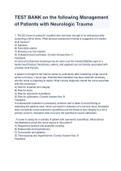
TEST BANK on the following Management of Patients with Neurologic Trauma 1. The ED nurse is caring for a patient who has been brought in by ambulance after sustaining a fall at home. What physical assessment finding is suggestive of a basilar skull fracture? A) Epistaxis B) Periorbital edema C) Bruising over the mastoid D) Unilateral facial numbness -Correct Answer-Ans: C Feedback: An area of ecchymosis (bruising) may be seen over the mastoid (Battles sign) in a basilar skull fracture. Numbness, edema, and epistaxis are not directly associated with a basilar skull fracture. A patient is brought to the trauma center by ambulance after sustaining a high cervical spinal cord injury 1 hours ago. Endotracheal intubation has been deemed necessary and the nurse is preparing to assist. What nursing diagnosis should the nurse associate with this procedure? A) Risk for impaired skin integrity B) Risk for injury C) Risk for autonomic dysreflexia D) Risk for suffocation -Correct Answer-Ans: B Feedback: If endotracheal intubation is necessary, extreme care is taken to avoid flexing or extending the patients neck, which can result in extension of a cervical injury. Intubation does not directly cause autonomic dysreflexia and the threat to skin integrity is a not a primary concern. Intubation does not carry the potential to cause suffocation. . A nurse is caring for a critically ill patient with autonomic dysreflexia. What clinical manifestations would the nurse expect in this patient? A) Respiratory distress and projectile vomiting B) Bradycardia and hypertension C) Tachycardia and agitation D) Third-spacing and hyperthermia -Correct Answer-Ans: B Feedback: Autonomic dysreflexia is characterized by a pounding headache, profuse sweating, nasal congestion, piloerection (goose bumps), bradycardia, and hypertension. It occurs in cord lesions above T6 after spinal shock has resolved; it does not result in vomiting, tachycardia, or third-spacing. The nurse is caring for a patient with increased intracranial pressure (ICP) caused by a traumatic brain injury. Which of the following clinical manifestations would suggest that the patient may be experiencing increased brain compression causing brain stem damage? A) Hyperthermia B) Tachycardia C) Hypertension D) Bradypnea -Correct Answer-Ans: A Feedback: Signs of increasing ICP include slowing of the heart rate (bradycardia), increasing systolic BP, and widening pulse pressure. As brain compression increases, respirations become rapid, BP may decrease, and the pulse slows further. A rapid rise in body temperature is regarded as unfavorable. Hyperthermia increases the metabolic demands of the brain and may indicate brain stem damage. A patient is brought to the ED by her family after falling off the roof. A family member tells the nurse that when the patient fell she was knocked out, but came to and seemed okay. Now she is complaining of a severe headache and not feeling well. The care team suspects an epidural hematoma, prompting the nurse to prepare for which priority intervention? A) Insertion of an intracranial monitoring device B) Treatment with antihypertensives C) Emergency craniotomy D) Administration of anticoagulant therapy -Correct Answer-Ans: C Feedback: An epidural hematoma is considered an extreme emergency. Marked neurologic deficit or respiratory arrest can occur within minutes. Treatment consists of making an opening through the skull to decrease ICP emergently, remove the clot, and control the bleeding. Antihypertensive medications would not be a priority. Anticoagulant therapy should not be ordered for a patient who has a cranial bleed. This could further increase bleeding activity. Insertion of an intracranial monitoring device may be done during the surgery, but is not priority for this patient. The staff educator is precepting a nurse new to the critical care unit when a patient with a T2 spinal cord injury is admitted. The patient is soon exhibiting manifestations of neurogenic shock. In addition to monitoring the patient closely, what would be the nurses most appropriate action? A) Prepare to transfuse packed red blood cells. B) Prepare for interventions to increase the patients BP. C) Place the patient in the Trendelenberg position. D) Prepare an ice bath to lower core body temperature. -Correct Answer-Ans: B Feedback: Manifestations of neurogenic shock include decreased BP and heart rate. Cardiac markers would be expected to rise in cardiogenic shock. Transfusion, repositioning, and ice baths are not indicated interventions. . An ED nurse has just received a call from EMS that they are transporting a 17-year-old man who has just sustained a spinal cord injury (SCI). The nurse recognizes that the most common cause of this type of injury is what? A) Sports-related injuries B) Acts of violence C) Injuries due to a fall D) Motor vehicle accidents -Correct Answer-Ans: D Feedback: The most common causes of SCIs are motor vehicle crashes (46%), falls (22%), violence (16%), and sports (12%). 8. A patient with spinal cord injury has a nursing diagnosis of altered mobility and the nurse recognizes the increased the risk of deep vein thrombosis (DVT). Which of the following would be included as an appropriate nursing intervention to prevent a DVT from occurring? A) Placing the patient on a fluid restriction as ordered B) Applying thigh-high elastic stockings C) Administering an antifibrinolyic agent D) Assisting the patient with passive range of motion (PROM) exercises -Correct Answer-Ans: B Feedback: It is important to promote venous return to the heart and prevent venous stasis in a patient with altered mobility. Applying elastic stockings will aid in the prevention of a DVT. The patient should not be placed on fluid restriction because a dehydrated state will increase the risk of clotting throughout the body. Antifibrinolytic agents cause the blood to clot, which is absolutely contraindicated in this situation. PROM exercises are not an effective protection against the development of DVT. Paramedics have brought an intubated patient to the RD following a head injury due to accelerationdeceleration motor vehicle accident. Increased ICP is suspected. Appropriate nursing interventions would include which of the following? A) Keep the head of the bed (HOB) flat at all times. B) Teach the patient to perform the Valsalva maneuver. C) Administer benzodiazepines on a PRN basis. D) Perform endotracheal suctioning every hour. -Correct Answer-ANS: C FEEDBACK: If the patient with a brain injury is very agitated, benzodiazepines are the most commonly used sedatives and do not affect cerebral blood flow or ICP. The HOB should be elevated 30 degrees. Suctioning should be done a limited basis, due to increasing the pressure in the cranium. The Valsalva maneuver is to be avoided. This also causes increased ICP. A patient who has sustained a nondepressed skull fracture is admitted to the acute medical unit. Nursing care should include which of the following? A) Preparation for emergency craniotomy B) Watchful waiting and close monitoring C) Administration of inotropic drugs D) Fluid resuscitation -Correct Answer-Ans: B Feedback: Nondepressed skull fractures generally do not require surgical treatment; however, close observation of the patient is essential. A craniotomy would not likely be needed if the fracture is nondepressed. Even if treatment is warranted, it is unlikely to include inotropes or fluid resuscitation. A patient who suffered a spinal cord injury is experiencing an exaggerated autonomic response. What aspect of the patients current health status is most likely to have precipitated this event? A) The patient received a blood transfusion. B) The patients analgesia regimen was recent changed. C) The patient was not repositioned during the night shift. D) The patients urinary catheter became occluded -Correct Answer-Ans: D Feedback: A distended bladder is the most common cause of autonomic dysreflexia. Infrequent positioning is a less likely cause, although pressure ulcers or tactile stimulation can cause it. Changes in mediations or blood transfusions are unlikely causes. A patient is admitted to the neurologic ICU with a spinal cord injury. In writing the patients care plan, the nurse specifies that contractures can best be prevented by what action? A) Repositioning the patient every 2 hours B) Initiating range-of-motion exercises (ROM) as soon as the patient initiates C) Initiating (ROM) exercises as soon as possible after the injury D) Performing ROM exercises once a day -Correct Answer-Ans: C Feedback:
École, étude et sujet
- Établissement
- Medical-surgical nusrsing
- Cours
- Medical-surgical nusrsing
Infos sur le Document
- Publié le
- 25 mars 2023
- Nombre de pages
- 14
- Écrit en
- 2022/2023
- Type
- Examen
- Contient
- Questions et réponses
Sujets
-
medical surgical nursi
-
management of patients with neurologic trauma in class activity
-
management of patients with neurologic trauma
-
management of patients with neurologic trauma questions and answers

Document également disponible en groupe