CHEM 103 Module 6 Problem Set 2023 Portage learning
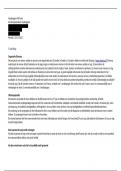
Module 6: Problem Set Question 1 Define or describe: (a) Amorphous solid (k) Molality (b) Colligative property (l) Molarity (c) Colloid (m) Nonelectrolyte (d) Condensation (n) Phase (e) Critical point (o) Strong electrolyte (f) Critical pressure (p) Sublimation (g) Crystalline solid (q) Surface tension (h) Electrolyte (r) Triple point (i) Fluid (s) Vapor pressure (j) Ionization (t) Weak electrolyte Answer: (a) Amorphous solids are ones in which the particles are arranged in a random fashion. (b) Colligative properties are physical properties of solvents that are dependent on the concentration of the solute present and the identity of the solvent but not on the identity of the solute. They include vapor pressure, freezing point and boiling point. (c) Colloids are heterogeneous mixtures which appear to homogeneous one-phase mixtures but are actually composed of particles too small to be seen with the naked eye. (d) Condensation is the process of gas being converted to liquid. (e) Critical point is the temperature above which a substance cannot exist in the liquid phase. (f) Critical pressure is the lowest pressure required for the substance to exist as a liquid at the critical point. (g) Crystalline solids are ones in which the particles are arranged in one of several different orderly, repeating, geometric patterns. This study source was downloaded by from CourseH on :43:35 GMT -06:00 (h) Electrolytes are ionic or very polar compounds which dissolve to form solutions of ions which conduct an electric current. (i) Fluids are substances like liquids and gases which have no fixed shape and so they flow. (j) Ionization is the splitting of molecules to form ions. (k) Molality is a term which expresses concentration in moles of solute present per kilogram of solvent. (l) Molarity is a term which expresses concentration in moles of solute present per liter of solution. (m) Nonelectrolytes are compounds which dissolve to form solutions of molecules which do not conduct an electric current. (n) Phase is any state of matter such as solid, liquid or gas. (o) Strong electrolytes are solutes that ionize completely. (p) Sublimation is the conversion of a solid directly to the gas state. (q) Surface tension is the force that causes a liquid which is in contact with a gas like air to assume a shape that has the least amount of surface area causing the surface to act like a thin elastic sheet. (r) Triple point is the temperature and pressure at which the solid, liquid and gas phases can coexist. (s) Vapor pressure is pressure exerted by vapor molecules above a liquid. (t) Weak electrolytes are solutes that only partially ionize. Question 2 What rule is used to predict the solubility of materials?
École, étude et sujet
- Établissement
- CHEM 103
- Cours
- CHEM 103
Infos sur le Document
- Publié le
- 6 mars 2023
- Nombre de pages
- 6
- Écrit en
- 2022/2023
- Type
- Examen
- Contient
- Questions et réponses
Sujets
-
module 6 problem set question 1 define or describe a amorphous solid k molality b colligative property l molarity c colloid m nonelectrolyte d condensation n phase e critical