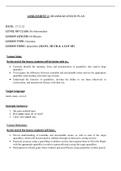
ASSIGNMENT 2: GRAMMAR LESSON PLAN
DATE: 27.12.22
LEVEL OF CLASS: Pre-Intermediate
LESSON LENGTH: 60 Minutes
LESSON TYPE: Grammar
LESSON TOPIC: Quantifiers [MANY, MUCH & A LOT OF]
Lesson Aims:
By the end of the lesson, students will be better able to…
Correctly identify the meaning, form, and pronunciation of quantifiers that express large
quantities.
To recognize the difference between countable and uncountable nouns and use the appropriate
quantifier when dealing with each type of noun.
Understand the function of quantifiers, develop the ability to use them effectively in
conversation, and demonstrate fluency with their use.
Target language:
much, many, a lot of.
Example Sentence:
1. She plays a lot of sport.
2. How many chairs do we need?
3. I don’t have much time.
Lesson Outcomes:
By the end of the lesson, students will have…
Proved understanding of countable and uncountable nouns, as well as each of the target
quantifiers, which will be presented to students through an interactive sorting activity.
Practiced accuracy using a gap-filling worksheet activity that required them to fill in the blanks
with the appropriate quantifier in order to gain proficiency using the target quantifiers.
Participated in a board game where students practiced fluency using quantifiers in their speech.
,Anticipated difficulties:
1. Language differences
Students come from different nations (France and Italy) and speak different languages;
consequently, their native language may have different grammatical rules than English,
which may cause confusion., such as in French it is common and acceptable to use a
double negative yet in English it is considered to be slang.
The presence of multiple languages in the classroom may lead to a lot of confusion
among the students.
2. Cultural differences
Interactions between students from diverse cultural backgrounds may be difficult, which
could result in misunderstandings and interruptions during a lesson, putting learning at
risk.
3. Age related difficulties
Young learners at the age of 11 and 12 may lack interest in the topic and find grammar
boring.
Students at the Pre intermediate level may find the lesson difficulty because of their
grammatical difficulties.
4. Class management
Some students' presence at International Summer School may be the result of parental
decision rather than their own free will, which could result in a lack of focus and
disruption in the classroom.
Suggested solutions:
1. Consider the degree of similarity between the target L2 and the student's native language when
designing learning activities to help students understand the proper and relevant grammatical
structures. Establishing a rule at the beginning of class that forbids the use of any language
other than the target language during the lesson is essential. There will be less room for
misunderstandings and the students' English skills will improve as a result.
2. Establish an emotionally supportive classroom environment as well as a physical environment
that celebrates diversity. Despite their cultural differences, students are encouraged to feel
respected and cared for in this type of atmosphere, which enables them to relax and focus on
their lesson.
3. Make the class engaging by include lots of enjoyable activities and level-appropriate charts that
clearly and vividly illustrate the grammar so that the students will be interested.
, 4. Keep an eye on your students and give the students who appear to be paying less attention
leadership duties, such as those of group leader or person in charge of distributing and
collecting worksheets from students, to encourage them to pay more attention and behave more
quietly during the lesson.
Target language analysis:
1. What is the use Much, many, and a lot (of) are quantifiers used to express the amount or quantity of a
or function of countable noun (nouns that can be counted, such as two apples) or uncountable noun
this language? (nouns that cannot be counted e.g., water). We use many, much, a lot (of) to refer to
(Include a large amounts.
timeline if
appropriate)
Many and much
We generally use much and many in questions and negative sentences, they are not
common in affirmative sentences though still possible. Many is used with countable
nouns, whereas much is used with uncountable nouns.
Examples:
How many people were at the party?
I don’t have many apples.
How much homework do you have?
She doesn’t have much time left
When we want to emphasize a really big quantity we can add ‘so’ in front of ‘many’ and
‘much’.
Example:
There were so many passengers on the train, it was difficult to get off.
She had so much work to do, she stayed at the office until midnight.
A lot (of)
‘A lot (of)’ means a large amount or number, we generally use ‘a lot (of)’ in affirmative,
negative sentences and questions. This expression can be used with both countable and
uncountable nouns. In modern English it is very common to use ‘a lot (of)’ in affirmative
sentences instead of ‘many’ and ‘much’.
Example:
I need a lot of coffee.
She has a lot of friends.
We did have a lot of fun, didn't we?
DATE: 27.12.22
LEVEL OF CLASS: Pre-Intermediate
LESSON LENGTH: 60 Minutes
LESSON TYPE: Grammar
LESSON TOPIC: Quantifiers [MANY, MUCH & A LOT OF]
Lesson Aims:
By the end of the lesson, students will be better able to…
Correctly identify the meaning, form, and pronunciation of quantifiers that express large
quantities.
To recognize the difference between countable and uncountable nouns and use the appropriate
quantifier when dealing with each type of noun.
Understand the function of quantifiers, develop the ability to use them effectively in
conversation, and demonstrate fluency with their use.
Target language:
much, many, a lot of.
Example Sentence:
1. She plays a lot of sport.
2. How many chairs do we need?
3. I don’t have much time.
Lesson Outcomes:
By the end of the lesson, students will have…
Proved understanding of countable and uncountable nouns, as well as each of the target
quantifiers, which will be presented to students through an interactive sorting activity.
Practiced accuracy using a gap-filling worksheet activity that required them to fill in the blanks
with the appropriate quantifier in order to gain proficiency using the target quantifiers.
Participated in a board game where students practiced fluency using quantifiers in their speech.
,Anticipated difficulties:
1. Language differences
Students come from different nations (France and Italy) and speak different languages;
consequently, their native language may have different grammatical rules than English,
which may cause confusion., such as in French it is common and acceptable to use a
double negative yet in English it is considered to be slang.
The presence of multiple languages in the classroom may lead to a lot of confusion
among the students.
2. Cultural differences
Interactions between students from diverse cultural backgrounds may be difficult, which
could result in misunderstandings and interruptions during a lesson, putting learning at
risk.
3. Age related difficulties
Young learners at the age of 11 and 12 may lack interest in the topic and find grammar
boring.
Students at the Pre intermediate level may find the lesson difficulty because of their
grammatical difficulties.
4. Class management
Some students' presence at International Summer School may be the result of parental
decision rather than their own free will, which could result in a lack of focus and
disruption in the classroom.
Suggested solutions:
1. Consider the degree of similarity between the target L2 and the student's native language when
designing learning activities to help students understand the proper and relevant grammatical
structures. Establishing a rule at the beginning of class that forbids the use of any language
other than the target language during the lesson is essential. There will be less room for
misunderstandings and the students' English skills will improve as a result.
2. Establish an emotionally supportive classroom environment as well as a physical environment
that celebrates diversity. Despite their cultural differences, students are encouraged to feel
respected and cared for in this type of atmosphere, which enables them to relax and focus on
their lesson.
3. Make the class engaging by include lots of enjoyable activities and level-appropriate charts that
clearly and vividly illustrate the grammar so that the students will be interested.
, 4. Keep an eye on your students and give the students who appear to be paying less attention
leadership duties, such as those of group leader or person in charge of distributing and
collecting worksheets from students, to encourage them to pay more attention and behave more
quietly during the lesson.
Target language analysis:
1. What is the use Much, many, and a lot (of) are quantifiers used to express the amount or quantity of a
or function of countable noun (nouns that can be counted, such as two apples) or uncountable noun
this language? (nouns that cannot be counted e.g., water). We use many, much, a lot (of) to refer to
(Include a large amounts.
timeline if
appropriate)
Many and much
We generally use much and many in questions and negative sentences, they are not
common in affirmative sentences though still possible. Many is used with countable
nouns, whereas much is used with uncountable nouns.
Examples:
How many people were at the party?
I don’t have many apples.
How much homework do you have?
She doesn’t have much time left
When we want to emphasize a really big quantity we can add ‘so’ in front of ‘many’ and
‘much’.
Example:
There were so many passengers on the train, it was difficult to get off.
She had so much work to do, she stayed at the office until midnight.
A lot (of)
‘A lot (of)’ means a large amount or number, we generally use ‘a lot (of)’ in affirmative,
negative sentences and questions. This expression can be used with both countable and
uncountable nouns. In modern English it is very common to use ‘a lot (of)’ in affirmative
sentences instead of ‘many’ and ‘much’.
Example:
I need a lot of coffee.
She has a lot of friends.
We did have a lot of fun, didn't we?