Health and Social Care National Extended Diploma Tabitha Roxburgh Unit 8
Psychological Perspective: Social Learning Theory
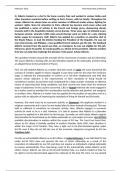
The social learning theory approach is a psychological perspective that people learn from those
around them. Such as close relatives, friends and society itself. Social learning theory focuses on the
learning that takes place within a social context. People learn from one another, including such
concepts as observational learning, imitation, and modelling. However, learning can occur without
even a change in behaviour. Cognition plays a role in learning. Awareness and expectations of
future reinforcements or punishments can have a major effect on the behaviours that people
exhibit. Vicarious reinforcement is one way to encourage others as it means they see others getting
a reward and then want one for themselves.
Key Theorists of Social learning theory includes Albert Bandura. Albert Bandura (1925-
Present day, aged 90) is a psychologist who is the professor of Social Science in Psychology
at Stanford University. For almost six decades, he has been responsible for contributions
to many fields of psychology, including social cognitive theory, therapy and personality
psychology, and was also influential in the transition between behaviourism and cognitive
psychology. He is known as the originator of social learning theory and is also responsible
for the influential 1961 Bobo doll experiment.
The Bobo doll experiment was conducted on 36 boys and 36 girls from the Stanford University
Nursery School aged 3 to 5 years old. Bandura hypothesised that by watching aggression, you will
purge your own aggression. He was proved wrong. All the children witnessed an adult be aggressive
towards an inflatable doll, it was found that they all imitated the levels of aggression after they
were left alone with the doll. A similar study was also done a few years later where by the children
witnessing the aggression on TV rather than in real life. The same results were shown. Therefore
watching aggression doesn’t purge you of it but rather, is more influential. Especially to children and
those who witnessed adult aggression who were the same sex. Bandura came up with 4 different
ways in which we learn behaviour. They are the following:
Observation Imitation Modelling Identification
Without changing the Copying the Basing behaviour on a Adopting the
behaviour behaviour perceived required trait behaviour/value/belief
Examples of these include:
Watching practitioners A child copying their Role models, people you Smoking because their
in the job role to learn parents and relatives aspire to be like so adapt peers are and they
best practice e.g. behaviour and/or behaviour to suit that want to be accepted
paramedics mannerisms role by that social group
Principles of social learning theory have been applied to health and social care settings.
For example, one is the study of media violence. Observed or experienced positive
rewards and lack of punishment for aggressive behaviours reinforces aggression. Many
research studies have discovered significant correlations between viewing violent
television and aggression later in life, as well as playing violent video. The role of
observational learning has also been cited as an important factor in the rise of rating
systems for TV, movies, and video games. Many classroom and teaching strategies draw
on principles of social learning. Using the technique of guided participation, a teacher
says a phrase and asks the class to repeat the phrase. Students both imitate and reproduce the
teacher's action. Additionally, teachers can shape the classroom behaviour of students by modelling
appropriate behaviour and visibly rewarding students for good behaviour. By emphasizing the
teacher's role as model and encouraging the students to adopt the position of observer, the teacher
can make knowledge and practices explicit to students, enhancing their learning outcomes.
Psychological Perspective: Social Learning Theory
The social learning theory approach is a psychological perspective that people learn from those
around them. Such as close relatives, friends and society itself. Social learning theory focuses on the
learning that takes place within a social context. People learn from one another, including such
concepts as observational learning, imitation, and modelling. However, learning can occur without
even a change in behaviour. Cognition plays a role in learning. Awareness and expectations of
future reinforcements or punishments can have a major effect on the behaviours that people
exhibit. Vicarious reinforcement is one way to encourage others as it means they see others getting
a reward and then want one for themselves.
Key Theorists of Social learning theory includes Albert Bandura. Albert Bandura (1925-
Present day, aged 90) is a psychologist who is the professor of Social Science in Psychology
at Stanford University. For almost six decades, he has been responsible for contributions
to many fields of psychology, including social cognitive theory, therapy and personality
psychology, and was also influential in the transition between behaviourism and cognitive
psychology. He is known as the originator of social learning theory and is also responsible
for the influential 1961 Bobo doll experiment.
The Bobo doll experiment was conducted on 36 boys and 36 girls from the Stanford University
Nursery School aged 3 to 5 years old. Bandura hypothesised that by watching aggression, you will
purge your own aggression. He was proved wrong. All the children witnessed an adult be aggressive
towards an inflatable doll, it was found that they all imitated the levels of aggression after they
were left alone with the doll. A similar study was also done a few years later where by the children
witnessing the aggression on TV rather than in real life. The same results were shown. Therefore
watching aggression doesn’t purge you of it but rather, is more influential. Especially to children and
those who witnessed adult aggression who were the same sex. Bandura came up with 4 different
ways in which we learn behaviour. They are the following:
Observation Imitation Modelling Identification
Without changing the Copying the Basing behaviour on a Adopting the
behaviour behaviour perceived required trait behaviour/value/belief
Examples of these include:
Watching practitioners A child copying their Role models, people you Smoking because their
in the job role to learn parents and relatives aspire to be like so adapt peers are and they
best practice e.g. behaviour and/or behaviour to suit that want to be accepted
paramedics mannerisms role by that social group
Principles of social learning theory have been applied to health and social care settings.
For example, one is the study of media violence. Observed or experienced positive
rewards and lack of punishment for aggressive behaviours reinforces aggression. Many
research studies have discovered significant correlations between viewing violent
television and aggression later in life, as well as playing violent video. The role of
observational learning has also been cited as an important factor in the rise of rating
systems for TV, movies, and video games. Many classroom and teaching strategies draw
on principles of social learning. Using the technique of guided participation, a teacher
says a phrase and asks the class to repeat the phrase. Students both imitate and reproduce the
teacher's action. Additionally, teachers can shape the classroom behaviour of students by modelling
appropriate behaviour and visibly rewarding students for good behaviour. By emphasizing the
teacher's role as model and encouraging the students to adopt the position of observer, the teacher
can make knowledge and practices explicit to students, enhancing their learning outcomes.