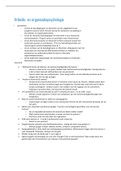
H1: Food Production
Cleaning, preservation, packaging (simple)
Raw material End
product
Ingredient production -- > end product production (more complex)
Food is treated for:
- a longer shelf life,
- make them digestible
- improve their taste
- extend our food sources
Types of operations:
- Separation
o Any process that separates different parts of the material into two or
more streams
Cleaning: removing dirt, soil, stones, weed
Separation: filtration, centrifuging, extraction, evaporation
Vacuum filter: separation of small particles
Ultrafiltration: moleculary sized filters, proteins retained
Nanofiltration: sugars and amino acids are retained
Smallest pores: only water can pass
Purification: removal of molecular contaminants
- Conversion and structuring
o Changing the molecular composition by reaction
Fermentation
(enzymatic) reaction
Enzyme and microbial inactivation
Structuring: physical changes (by changing the composition /
texture, there are big changes in the properties)
Mixing ingredients to the right formulation,
emulsification, homogenisation, crystallisation, curing
of meat, smoking
- Stabilisation (inactivation and packaging)
o By heating, freezing, pressurising, irradiation, electric fields
o Large-scale and consumer scale
Not every step is always present and steps will be repeated.
Producing food on larger-scale for better quality and lower costs, so:
- Safety and peripheral infrastructure
- Energy and water use (re-use of water and heat)
- Cost of equipment
William’s 0.6 rule: costs α capacity0.6
When the capacity of a factory increases by a factor 2, the costs only increase by
a factor of ~ 1.6.
Central production:
- Safety (central labs, control and expertise is much easier maintained)
- Costs (larger installations are cheaper)
- Similar products mean better market
- But products more homogeneous, and inhibits innovation
Page 1 of 19
, - Higher transport costs (but these are small)
Products require: initial cleaning, treatment or purification, preservation and
packaging
Productions of food and ingredients:
- Fresh food (vegetables, meat, dairy)
o Just a few steps
o cleaning preservation packaging chilling
o Fruits and vegetables are often canned, frozen or dried
- Ingredients (wheat, potato, legumes, cocoa, dairy, specialties, additives)
o Cleaning/purification, preparation for fractionation, fractionation,
purification & concentration, stabilisation
- End-user products (soups, sauces, ice cream)
o Mixing (re)hydration stabilisation (by solidifation or heating)
extra steps for right structure
H2: Traditional preservation
Traditional preservation methods have become part of our culture like drying in
the sun/wind, often combined with other preservation measures and controlled
fermentation
- Addition of preservatives
o Sugar, salt, acids, caustic (lye)
- Curing
- Smoking
- fermentation
Often the methods are combined
Salt will give complete preservation if the concentration is high enough. Often
salt is used at lower concentrations to avoid growth of growth of unwanted
bacteria, but allow growth of lactic producing bacteria (by lowering the water
activity). Example: salted herring (allows moderate fermentation by the
proteases of pyloric caescum of the matrix) and Surströmming (more strongly
fermented by Haloanaerobica).
Phosphate, tri-, polyphosphate is added to meat, poultry, fish, dairy and bakery
product, because
- it chelates Ca, Mg and Fe ions (preserve colour and reduce oxidation)
- it is a preservative (inhibits growth of C. botulinum)
- It is an emulsifier (for better physical product stability, like freeze/thaw
stability)
- It is chemical leavening (NaHCO3 + Na5P3O10 gives CO2 (+ Na2CO3 +
Na4HP3O10))
More sugar is needed than salt for a lower water activity.
Sugar in combination with heat gives release of pectin loss of physical stability.
Preservation by sugar and heating, but not stable against moulds
Acidification by pH <4.6 by adding acetic-, citric-, fumaric-, lactic-, malic-,
phosphoric- or tartaric acid.
Acetic acid is an excellent preservant. Weak acids work better. Charged,
dissociated ions cannot penetrate the cell membrane. Undissociated acids
penetrate cell membrane, acids dissociate and establish lower intercellular pH.
Page 2 of 19
Cleaning, preservation, packaging (simple)
Raw material End
product
Ingredient production -- > end product production (more complex)
Food is treated for:
- a longer shelf life,
- make them digestible
- improve their taste
- extend our food sources
Types of operations:
- Separation
o Any process that separates different parts of the material into two or
more streams
Cleaning: removing dirt, soil, stones, weed
Separation: filtration, centrifuging, extraction, evaporation
Vacuum filter: separation of small particles
Ultrafiltration: moleculary sized filters, proteins retained
Nanofiltration: sugars and amino acids are retained
Smallest pores: only water can pass
Purification: removal of molecular contaminants
- Conversion and structuring
o Changing the molecular composition by reaction
Fermentation
(enzymatic) reaction
Enzyme and microbial inactivation
Structuring: physical changes (by changing the composition /
texture, there are big changes in the properties)
Mixing ingredients to the right formulation,
emulsification, homogenisation, crystallisation, curing
of meat, smoking
- Stabilisation (inactivation and packaging)
o By heating, freezing, pressurising, irradiation, electric fields
o Large-scale and consumer scale
Not every step is always present and steps will be repeated.
Producing food on larger-scale for better quality and lower costs, so:
- Safety and peripheral infrastructure
- Energy and water use (re-use of water and heat)
- Cost of equipment
William’s 0.6 rule: costs α capacity0.6
When the capacity of a factory increases by a factor 2, the costs only increase by
a factor of ~ 1.6.
Central production:
- Safety (central labs, control and expertise is much easier maintained)
- Costs (larger installations are cheaper)
- Similar products mean better market
- But products more homogeneous, and inhibits innovation
Page 1 of 19
, - Higher transport costs (but these are small)
Products require: initial cleaning, treatment or purification, preservation and
packaging
Productions of food and ingredients:
- Fresh food (vegetables, meat, dairy)
o Just a few steps
o cleaning preservation packaging chilling
o Fruits and vegetables are often canned, frozen or dried
- Ingredients (wheat, potato, legumes, cocoa, dairy, specialties, additives)
o Cleaning/purification, preparation for fractionation, fractionation,
purification & concentration, stabilisation
- End-user products (soups, sauces, ice cream)
o Mixing (re)hydration stabilisation (by solidifation or heating)
extra steps for right structure
H2: Traditional preservation
Traditional preservation methods have become part of our culture like drying in
the sun/wind, often combined with other preservation measures and controlled
fermentation
- Addition of preservatives
o Sugar, salt, acids, caustic (lye)
- Curing
- Smoking
- fermentation
Often the methods are combined
Salt will give complete preservation if the concentration is high enough. Often
salt is used at lower concentrations to avoid growth of growth of unwanted
bacteria, but allow growth of lactic producing bacteria (by lowering the water
activity). Example: salted herring (allows moderate fermentation by the
proteases of pyloric caescum of the matrix) and Surströmming (more strongly
fermented by Haloanaerobica).
Phosphate, tri-, polyphosphate is added to meat, poultry, fish, dairy and bakery
product, because
- it chelates Ca, Mg and Fe ions (preserve colour and reduce oxidation)
- it is a preservative (inhibits growth of C. botulinum)
- It is an emulsifier (for better physical product stability, like freeze/thaw
stability)
- It is chemical leavening (NaHCO3 + Na5P3O10 gives CO2 (+ Na2CO3 +
Na4HP3O10))
More sugar is needed than salt for a lower water activity.
Sugar in combination with heat gives release of pectin loss of physical stability.
Preservation by sugar and heating, but not stable against moulds
Acidification by pH <4.6 by adding acetic-, citric-, fumaric-, lactic-, malic-,
phosphoric- or tartaric acid.
Acetic acid is an excellent preservant. Weak acids work better. Charged,
dissociated ions cannot penetrate the cell membrane. Undissociated acids
penetrate cell membrane, acids dissociate and establish lower intercellular pH.
Page 2 of 19