23/10/15 Gender: Feminist literary criticism: Gilbert &
Gubar
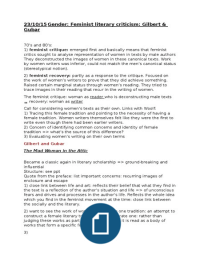
70’s and 80’s:
1) feminist critique: emerged first and basically means that feminist
critics sought to analyse representation of women in texts by male authors
They deconstructed the images of women in these canonical texts. Work
by women writers was inferior, could not match the men’s canonical status
(stereotypical notion).
2) feminist recovery: partly as a response to the critique. Focused on
the work of women’s writers to prove that they did achieve something.
Raised certain marginal status through women’s reading. They tried to
trace images in their reading that recur in the writing of women.
The feminist critique: woman as reader who is deconstructing male texts
recovery: woman as writer
Call for considering women’s texts as their own. Links with Woolf:
1) Tracing this female tradition and pointing to the necessity of having a
female tradition. Women writers themselves felt like they were the first to
write even though there had been earlier writers.
2) Concern of identifying common concerns and identity of female
tradition => what’s the source of this difference?
3) Evaluating women’s writing on their own terms
Gilbert and Gubar
The Mad Woman in the Attic
Became a classic again in literary scholarship => ground-breaking and
influential
Structure: see ppt
Quote from the preface: list important concerns: recurring images of
enclosure and escape
1) close link between life and art: reflects their belief that what they find in
the text is a reflection of the author’s situation and life => of unconscious
fears and drives and processes in the author’s life. Reflects the whole idea
which you find in the feminist movement at the time: close link between
the socially and the literary.
2) want to see the work of women’s writing as one tradition: an attempt to
construct a female literary tradition and a separate one: rather than
judging these works as part of a larger tradition it is read as a body of
works that form a specific female tradition.
3)
, 4) idea that they tended to read all these women authors as proto-
feminists in a way
Success: compelling image of mad woman in the attic: became generally
accepted in literary studies as well as in wider cultures: powerful
metaphor: it’s very much like Woolf’s A room of one’s own. => powerful
allegory: created new works of seeing works of literature. Similar metaphor
which they reinforced is the idea of the angel/whore : splitting of the
female figure in the good and the bad image
Book changed the way people read women’s texts. Look at the richness of
women’s writing => precisely close reading of complexity and different
layers: on the one hand they wanted to construct a separate tradition and
on the on the other hand they wanted to construct the literary status by
discovering this complexity.
Chapter 1
Trace the way in which creativity has throughout the century being
construed as something masculine. They went through a whole load of
text to show this. As a result the role of women in the process of creativity
was seen as that of the muse and women writer who did attempt to write
were considered freaks, mad, monsters. This ties in with this dichotomy of
angel/whore => split personality in good and bad.
Chapter 2
Shift from critique of patriarchal writing to the women’s response
themselves.
Do women writers want to imitate male writers or do they by contrast
speak in their own voice?
One the one hand an anxiety but also a motivation to outdo the father and
kill him in the metaphorical sense. G&G highlight how Bloom makes
explicit which was always already the conception of literary history. His
ideas are part of this widespread and universally accepted way of seeing a
literary tradition at that time.
=> How do women writers fit there? They don’t. But why?
1) Difference in male/female: significant problem: you confront the
predecessor.
2) There was no sense of a tradition, not in a way that it would be felt
as an overpowering force that you had to counter. Male have in their
work stereotyping, negative images of women.
For Bloom it’s a positive anxiety: it challenges you in a positive way.
Anxiety of authorship: why can that not be similarly positive and
stimulating for women writers?
Gubar
70’s and 80’s:
1) feminist critique: emerged first and basically means that feminist
critics sought to analyse representation of women in texts by male authors
They deconstructed the images of women in these canonical texts. Work
by women writers was inferior, could not match the men’s canonical status
(stereotypical notion).
2) feminist recovery: partly as a response to the critique. Focused on
the work of women’s writers to prove that they did achieve something.
Raised certain marginal status through women’s reading. They tried to
trace images in their reading that recur in the writing of women.
The feminist critique: woman as reader who is deconstructing male texts
recovery: woman as writer
Call for considering women’s texts as their own. Links with Woolf:
1) Tracing this female tradition and pointing to the necessity of having a
female tradition. Women writers themselves felt like they were the first to
write even though there had been earlier writers.
2) Concern of identifying common concerns and identity of female
tradition => what’s the source of this difference?
3) Evaluating women’s writing on their own terms
Gilbert and Gubar
The Mad Woman in the Attic
Became a classic again in literary scholarship => ground-breaking and
influential
Structure: see ppt
Quote from the preface: list important concerns: recurring images of
enclosure and escape
1) close link between life and art: reflects their belief that what they find in
the text is a reflection of the author’s situation and life => of unconscious
fears and drives and processes in the author’s life. Reflects the whole idea
which you find in the feminist movement at the time: close link between
the socially and the literary.
2) want to see the work of women’s writing as one tradition: an attempt to
construct a female literary tradition and a separate one: rather than
judging these works as part of a larger tradition it is read as a body of
works that form a specific female tradition.
3)
, 4) idea that they tended to read all these women authors as proto-
feminists in a way
Success: compelling image of mad woman in the attic: became generally
accepted in literary studies as well as in wider cultures: powerful
metaphor: it’s very much like Woolf’s A room of one’s own. => powerful
allegory: created new works of seeing works of literature. Similar metaphor
which they reinforced is the idea of the angel/whore : splitting of the
female figure in the good and the bad image
Book changed the way people read women’s texts. Look at the richness of
women’s writing => precisely close reading of complexity and different
layers: on the one hand they wanted to construct a separate tradition and
on the on the other hand they wanted to construct the literary status by
discovering this complexity.
Chapter 1
Trace the way in which creativity has throughout the century being
construed as something masculine. They went through a whole load of
text to show this. As a result the role of women in the process of creativity
was seen as that of the muse and women writer who did attempt to write
were considered freaks, mad, monsters. This ties in with this dichotomy of
angel/whore => split personality in good and bad.
Chapter 2
Shift from critique of patriarchal writing to the women’s response
themselves.
Do women writers want to imitate male writers or do they by contrast
speak in their own voice?
One the one hand an anxiety but also a motivation to outdo the father and
kill him in the metaphorical sense. G&G highlight how Bloom makes
explicit which was always already the conception of literary history. His
ideas are part of this widespread and universally accepted way of seeing a
literary tradition at that time.
=> How do women writers fit there? They don’t. But why?
1) Difference in male/female: significant problem: you confront the
predecessor.
2) There was no sense of a tradition, not in a way that it would be felt
as an overpowering force that you had to counter. Male have in their
work stereotyping, negative images of women.
For Bloom it’s a positive anxiety: it challenges you in a positive way.
Anxiety of authorship: why can that not be similarly positive and
stimulating for women writers?