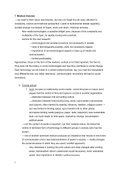
7. Medium theories
→ we need to think about new theories, but also not forget the old ones; attention to
complexity, nuance and historical perspective. Leads to fundamental debate regarding
societal change; but beware of hypes, boom and doom, historical amnesia…
- New media technologies; a possible twilight zone, because of the complexity and
multiplicity of the topic, its rapidly moving and uncertain
- Axioms for the new research;
→ technological and societal evolutions not necessarily in parallel
→ what is technologically possible, does not necessarily happen
→ importance of non-technological aspects in take up of media and
communication
→ limited predictability
Approaches; focus on the form of the medium; content is not that important, the form is.
They look into the history in comm technologies and how they contribute to social change.
Each technology can be linked to a certain preference/bias. (eg; you read the newspapers
very differently than you watch television), communication revolutions will lead to social
revolutions.
1) Toronto school
1. Innis: focuses on relationship comm media - social structure on macro level,
argues that the control of time and space is crucial in societal organisation
→ distinction between oral and writing culture
→ distinction between time binding (clay, stone, hand-written manuscripts);
oral cultures, often marked by stability, hierarchy, tradition, religious power →
but very limited in binding space, eg to transfer info to other places
and space binding media (papyrus, paper, radio, television); less sustainable,
fluid, nut much easier to bind space, marked by change, secularisation,
political power
→ not the content of media is important, but their material nature. He linked the
control of dominant form of technology to different groups in society (who has the
power).
→ rise of another dominant medium produces an imbalance that results in new forms
of communication and a new balance/division of power in society → media changes
the social structures in which they are used (=conflict approach)
- Very interested in looking into print culture and what changed after printing
press; individualism (which undermines social structures), more centralised
power, less importance to debate ≈ political economy
1
→ we need to think about new theories, but also not forget the old ones; attention to
complexity, nuance and historical perspective. Leads to fundamental debate regarding
societal change; but beware of hypes, boom and doom, historical amnesia…
- New media technologies; a possible twilight zone, because of the complexity and
multiplicity of the topic, its rapidly moving and uncertain
- Axioms for the new research;
→ technological and societal evolutions not necessarily in parallel
→ what is technologically possible, does not necessarily happen
→ importance of non-technological aspects in take up of media and
communication
→ limited predictability
Approaches; focus on the form of the medium; content is not that important, the form is.
They look into the history in comm technologies and how they contribute to social change.
Each technology can be linked to a certain preference/bias. (eg; you read the newspapers
very differently than you watch television), communication revolutions will lead to social
revolutions.
1) Toronto school
1. Innis: focuses on relationship comm media - social structure on macro level,
argues that the control of time and space is crucial in societal organisation
→ distinction between oral and writing culture
→ distinction between time binding (clay, stone, hand-written manuscripts);
oral cultures, often marked by stability, hierarchy, tradition, religious power →
but very limited in binding space, eg to transfer info to other places
and space binding media (papyrus, paper, radio, television); less sustainable,
fluid, nut much easier to bind space, marked by change, secularisation,
political power
→ not the content of media is important, but their material nature. He linked the
control of dominant form of technology to different groups in society (who has the
power).
→ rise of another dominant medium produces an imbalance that results in new forms
of communication and a new balance/division of power in society → media changes
the social structures in which they are used (=conflict approach)
- Very interested in looking into print culture and what changed after printing
press; individualism (which undermines social structures), more centralised
power, less importance to debate ≈ political economy
1