Fuels and Earth Science CGP Topic 8
Alkanes
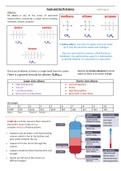
An alkane is any of the series of saturated
hydrocarbons containing a single bond including
methane, ethane, propane
A hydrocarbon is any class of organic chemicals made
up of only the elements carbon and hydrogen.
They are separated by a process called fractional
distillation. You add bromine water to a hydrocarbon
to identify whether it is saturated or unsaturated.
These are all alkanes as there is a single bond from the carbon. Alkanes do not de-colourise bromine
There is a general formula for alkanes: CnH2n+2 water so there is no colour change
Longer chain alkanes Shorter chain alkanes
• High boiling point • Low boiling point
• Viscous • Runny
• Low flammability • High flammability
• Burns with a smoky flame • Burns with a clean flame
Acronym
1 2 3 4 5 6 7 8 9 10
meth eth prop but pent hex sep oct non dec
Mary Eats Peanut Butter…….
Crude oil is a finite resource that is found in
the Earth’s crust. Crude oil is a
complex mixture of hydrocarbons.
• heated crude oil enters a tall fractionating
column, which is hot at the bottom and
gets cooler towards the top
• vapours from the oil rise through the
column
• vapours condense when they become cool
enough
• liquids are led out of the column at
different heights
, The different, useful mixtures are
Small hydrocarbon molecules have weak intermolecular
called fractions. This is because they
forces, so they have low boiling points. They do not condense,
are only part of the original crude oil.
but leave the column as gases. Long hydrocarbon molecules
You can tell they are mixtures as it
have stronger intermolecular forces, so they have high boiling
boils over a range of temperatures,
points. They leave the column as hot liquid bitumen.
not specific.
Refinery gases, petrol, kerosene, diesel, fuel oil, bitumen
(shortest chain length) (longest chain length)
Alkenes
An alkene is any of the series of unsaturated
hydrocarbons containing a double bond, including
ethylene and propene.
Alkenes de-colourise bromine water so there is a
colour change making it, brown à clear
A homologous series is a group of organic
compounds that have the same functional group
and so react in similar ways and have the same
general formula (but can differ in chain length)
*A functional group is an atom(s) that give the molecule its properties
The general formula for the alkenes is: CnH2n
Acronym
2 3 4 5 6 7 8 9 10
eth prop but pen hex sep oct non dec
There is no ‘1’ as all alkenes are double bonds
Cracking
Cracking is where longer chain, less useful hydrocarbons are broken down into simpler, more useful
shorter chain hydrocarbons, some of which are unsaturated.
There is a greater demand for smaller
hydrocarbons than larger ones.
decane → octane + ethene
C10H22 → C8H18 + C2H4
The process is as follows à
It can either be catalytic cracking involving
a catalyst, or thermal cracking with high
temperatures and pressures
Alkanes
An alkane is any of the series of saturated
hydrocarbons containing a single bond including
methane, ethane, propane
A hydrocarbon is any class of organic chemicals made
up of only the elements carbon and hydrogen.
They are separated by a process called fractional
distillation. You add bromine water to a hydrocarbon
to identify whether it is saturated or unsaturated.
These are all alkanes as there is a single bond from the carbon. Alkanes do not de-colourise bromine
There is a general formula for alkanes: CnH2n+2 water so there is no colour change
Longer chain alkanes Shorter chain alkanes
• High boiling point • Low boiling point
• Viscous • Runny
• Low flammability • High flammability
• Burns with a smoky flame • Burns with a clean flame
Acronym
1 2 3 4 5 6 7 8 9 10
meth eth prop but pent hex sep oct non dec
Mary Eats Peanut Butter…….
Crude oil is a finite resource that is found in
the Earth’s crust. Crude oil is a
complex mixture of hydrocarbons.
• heated crude oil enters a tall fractionating
column, which is hot at the bottom and
gets cooler towards the top
• vapours from the oil rise through the
column
• vapours condense when they become cool
enough
• liquids are led out of the column at
different heights
, The different, useful mixtures are
Small hydrocarbon molecules have weak intermolecular
called fractions. This is because they
forces, so they have low boiling points. They do not condense,
are only part of the original crude oil.
but leave the column as gases. Long hydrocarbon molecules
You can tell they are mixtures as it
have stronger intermolecular forces, so they have high boiling
boils over a range of temperatures,
points. They leave the column as hot liquid bitumen.
not specific.
Refinery gases, petrol, kerosene, diesel, fuel oil, bitumen
(shortest chain length) (longest chain length)
Alkenes
An alkene is any of the series of unsaturated
hydrocarbons containing a double bond, including
ethylene and propene.
Alkenes de-colourise bromine water so there is a
colour change making it, brown à clear
A homologous series is a group of organic
compounds that have the same functional group
and so react in similar ways and have the same
general formula (but can differ in chain length)
*A functional group is an atom(s) that give the molecule its properties
The general formula for the alkenes is: CnH2n
Acronym
2 3 4 5 6 7 8 9 10
eth prop but pen hex sep oct non dec
There is no ‘1’ as all alkenes are double bonds
Cracking
Cracking is where longer chain, less useful hydrocarbons are broken down into simpler, more useful
shorter chain hydrocarbons, some of which are unsaturated.
There is a greater demand for smaller
hydrocarbons than larger ones.
decane → octane + ethene
C10H22 → C8H18 + C2H4
The process is as follows à
It can either be catalytic cracking involving
a catalyst, or thermal cracking with high
temperatures and pressures