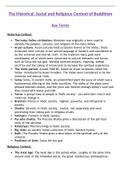
The Historical, Social and Religious Context of Buddhism
Key Terms
Historical Context:
The Indus Valley civilisation: Hinduism was originally a term used to
identify the peoples, cultures, and religions of the Indus Valley.
Aryan culture: Aryan cultures held scriptures known as the Vedas, these
scriptures were written in the sacred language of Sanskrit and considered to
be the universal and eternal truth. In the tradition many gods were
worshipped, all of whom were connected to natural elements and forces,
such as Surya the sun god. Worship involved prayers, chanting, animal
sacrifice and the taking of intoxicants to increase the spiritual experience.
The Vedic period: Around 1500 BC, based on Aryan scriptures called the
Vedas– introduced by Aryan invaders. The Vedas were considered to be the
universal and eternal truth.
Soma: Soma, in ancient India, an unidentified plant the juice of which was a
fundamental offering of the Vedic sacrifices. The stalks of the plant were
pressed between stones, and the juice was filtered through sheep’s wool and
then mixed with water and milk.
Varna: A group/class of people in Vedic society – you were born into it and
could not change it.
Brahmin: Priests in Vedic society – highest, powerful, and influential in
society.
Shudra: Servants in Vedic society – lowest, live separately and were
preventing from taking part in religious rituals.
Vaishya's: Farmers in Vedic society.
Purusha shukta: The Purusha Shukta gives a description of the spiritual
unity of the universe.
Kshatriyas: Warriors/kings in Vedic society.
Rig veda: An ancient Indian collection of Vedic Sanskrit hymns.
Dalit: The Purusha Shukta gives a description of the spiritual unity of the
universe.
Pantheon of Gods: Surya the sun god.
Religious Context:
The Axial Age: The Axial Age is the period when, roughly at the same time
around most of the inhabited world, the great intellectual, philosophical,
, and religious systems that came to shape subsequent human society and
culture emerged.
The Vedic period: Around 1500 BC, based on Aryan scriptures called the
Vedas– introduced by Aryan invaders. The Vedas were considered to be the
universal and eternal truth.
The Upanishads: A set of scriptures and teachings from Hinduism – they are
said to conclude the Vedas. They describe God or Brahman as ‘one divine
energy’ and present the ideas of reincarnation, kamma and the ‘atman’
(SOUL).
Vedanta: Vedanta, one of the six systems (darshans) of Indian philosophy. It
is the conclusion of the Vedas.
Brahman: A Hindu God. They are described as ‘one divine energy.’
Atman: The Hindu idea of a soul.
Jainism: Grew out from the Shramana movement at the same time as
Buddhism. Jains practice non-violence (ahimsa), believe in reincarnation and
the existence of a soul and their goal is liberation (freedom) from continuing
rebirths.
Soma: Soma, in ancient India, an unidentified plant the juice of which was a
fundamental offering of the Vedic sacrifices. The stalks of the plant were
pressed between stones, and the juice was filtered through sheep’s wool and
then mixed with water and milk.
Varna: A group/class of people in Vedic society – you were born into it and
could not change it.
Brahmin: Priests in Vedic society – highest, powerful, and influential in
society.
Shudra: Servants in Vedic society – lowest, live separately and were
preventing from taking part in religious rituals.
Vaishya's: Farmers in Vedic society.
Purusha shukta: The Purusha Shukta gives a description of the spiritual
unity of the universe.
Kshatriyas: Warriors/kings in Vedic society.
Rig veda: An ancient Indian collection of Vedic Sanskrit hymns.
Dalit: (in the traditional Indian caste system) a member of the lowest caste.
Pantheon of Gods: Buddha vamanan Bakasaura
Mahivara: Father of Jainism – the name means “Brave” and “Courageous.”
Jiva: The idea that we all have a permanent, eternal entity within us,
whether it be a force, power, or soul, was firmly rejected by the Buddha.
Asceticism: Ascetics subject themselves to physical suffering through
practices such as maintaining painful postures, denying themselves food, and
living naked in the wild. The aim of this ‘self-mortification’ is to spiritually
develop oneself. They seek to free the mind from the desires of the body.
Key Terms
Historical Context:
The Indus Valley civilisation: Hinduism was originally a term used to
identify the peoples, cultures, and religions of the Indus Valley.
Aryan culture: Aryan cultures held scriptures known as the Vedas, these
scriptures were written in the sacred language of Sanskrit and considered to
be the universal and eternal truth. In the tradition many gods were
worshipped, all of whom were connected to natural elements and forces,
such as Surya the sun god. Worship involved prayers, chanting, animal
sacrifice and the taking of intoxicants to increase the spiritual experience.
The Vedic period: Around 1500 BC, based on Aryan scriptures called the
Vedas– introduced by Aryan invaders. The Vedas were considered to be the
universal and eternal truth.
Soma: Soma, in ancient India, an unidentified plant the juice of which was a
fundamental offering of the Vedic sacrifices. The stalks of the plant were
pressed between stones, and the juice was filtered through sheep’s wool and
then mixed with water and milk.
Varna: A group/class of people in Vedic society – you were born into it and
could not change it.
Brahmin: Priests in Vedic society – highest, powerful, and influential in
society.
Shudra: Servants in Vedic society – lowest, live separately and were
preventing from taking part in religious rituals.
Vaishya's: Farmers in Vedic society.
Purusha shukta: The Purusha Shukta gives a description of the spiritual
unity of the universe.
Kshatriyas: Warriors/kings in Vedic society.
Rig veda: An ancient Indian collection of Vedic Sanskrit hymns.
Dalit: The Purusha Shukta gives a description of the spiritual unity of the
universe.
Pantheon of Gods: Surya the sun god.
Religious Context:
The Axial Age: The Axial Age is the period when, roughly at the same time
around most of the inhabited world, the great intellectual, philosophical,
, and religious systems that came to shape subsequent human society and
culture emerged.
The Vedic period: Around 1500 BC, based on Aryan scriptures called the
Vedas– introduced by Aryan invaders. The Vedas were considered to be the
universal and eternal truth.
The Upanishads: A set of scriptures and teachings from Hinduism – they are
said to conclude the Vedas. They describe God or Brahman as ‘one divine
energy’ and present the ideas of reincarnation, kamma and the ‘atman’
(SOUL).
Vedanta: Vedanta, one of the six systems (darshans) of Indian philosophy. It
is the conclusion of the Vedas.
Brahman: A Hindu God. They are described as ‘one divine energy.’
Atman: The Hindu idea of a soul.
Jainism: Grew out from the Shramana movement at the same time as
Buddhism. Jains practice non-violence (ahimsa), believe in reincarnation and
the existence of a soul and their goal is liberation (freedom) from continuing
rebirths.
Soma: Soma, in ancient India, an unidentified plant the juice of which was a
fundamental offering of the Vedic sacrifices. The stalks of the plant were
pressed between stones, and the juice was filtered through sheep’s wool and
then mixed with water and milk.
Varna: A group/class of people in Vedic society – you were born into it and
could not change it.
Brahmin: Priests in Vedic society – highest, powerful, and influential in
society.
Shudra: Servants in Vedic society – lowest, live separately and were
preventing from taking part in religious rituals.
Vaishya's: Farmers in Vedic society.
Purusha shukta: The Purusha Shukta gives a description of the spiritual
unity of the universe.
Kshatriyas: Warriors/kings in Vedic society.
Rig veda: An ancient Indian collection of Vedic Sanskrit hymns.
Dalit: (in the traditional Indian caste system) a member of the lowest caste.
Pantheon of Gods: Buddha vamanan Bakasaura
Mahivara: Father of Jainism – the name means “Brave” and “Courageous.”
Jiva: The idea that we all have a permanent, eternal entity within us,
whether it be a force, power, or soul, was firmly rejected by the Buddha.
Asceticism: Ascetics subject themselves to physical suffering through
practices such as maintaining painful postures, denying themselves food, and
living naked in the wild. The aim of this ‘self-mortification’ is to spiritually
develop oneself. They seek to free the mind from the desires of the body.