WEEK 4 LITERATURE
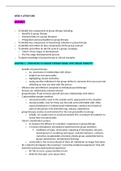
LECTURE 7
o To identify key components of group therapy including:
o Benefits to group therapy
o Characteristics of a group therapist
o Preparation and practicalities to group therapy
o To identify key components to (improving) cohesion in group therapy
o To identify and reflect on (key components of) the group contract
o To identify and reflect on the life cycle of a group, including:
o Yalom's three stages of development
o The five-stage developmental process
o To apply knowledge of group therapy to clinical examples
CHAPTER 3 – FEHR INTRO TO GROUP THERAPY BOOK: WHY GROUP THERAPY?
- benefits of group therapy:
o inc. awareness in relationships with others
o insight into own personality
o highlighting shared similarities
o seeing another individual in the group similar to someone from your past and
reflecting on how you deal with this person
- efficient and cost-effective compared to individual psychotherapy
- humans are relationship-oriented animals
- group therapy get to know yourself and your relationships with others
- 2 personalities people manifest:
o social personality: used to the outside world, appropriate to the situation
o real personality: only for those you feel safe and comfortable with, often
causes disturbance in interpersonal relationships, contains true historical
story of the person’s life with both neg. and pos. experiences
- group therapy creates an environment for the real personality to emerge
o initially, we usually work on social personality first, to prepare the patients to
reveal their true personality
- Yalom’s classification system:
o to measure the efficacy of a member’s experience in group therapy
o 11 factors/therapeutic mechanisms experienced by group members:
instillation of hope, universality, imparting of information, altruism,
development of socializing techniques, imitative behavior, catharsis,
corrective recapitulation of primary family group, existential factors,
group cohesiveness, interpersonal learning
o universality is the most profound of them all, individuals no longer feel alone
- for a client to be helped s/he must have “corrective emotional experience” that will
mend the previous dysfunctional experience
o for this to occur, group members must:
o think the therapist cares about them
, o trust the process and therapist
o feel like they can discuss anything without fear of being punished
- transference enables emergence of members’ past experiences and true personality
- behaviors generated from group therapy are more easily generalized to the real
world
- group therapist:
o often therapists expect clients to undertake experiences they themselves are
not willing to undertake- that’s not okay – creates dichotomy that client is sick
and therapist is healthy
o effective group leadership is easier if we look toward our clients as the guide
to successful therapy
o we can’t make everyone like us, what’s important is whether clients leave
therapy feeling hopeful, more aware of themselves and others and capable of
sustaining positive relationships
o each client is unique, there is no one way to be good therapist, being yourself
is the best option
o what’s important is creating a nonjudgmental personality
o one of the most effective ways to become aware of personal judgements of
others is group therapy
CHAPTER 6 – FEHR INTRO TO GROUP THERAPY BOOK: PREPARATION AND PRACTICALITY
the setting
- restful, peaceful physical environment
- no fluorescent lighting
- comfortable furniture
- some degree of space between each chair, for personal space
- stimulus from outside world is minimized
- clean room and toilets
- don’t take calls during
- personal things to a minimum, photos, family awards etc. better if less is known
client inclusion/exclusion
- careful selection of group members (when possible) is related to the success of
group’s growth
- “a group’s future is sealed before the first session commences”
- 3 propositions that influence a professional to consider group therapy for a client:
o nonlegitimate (objective) approach: referral has little consideration for the
efficacy of treatment for the client
o illegitimate (subjective) approach: referral happened bc therapist has neg.
feelings and wants the client out of his/her practice or feels more comfortable
seeing the client with other people
o legitimate approach: therapist thinks group therapy will have value for the
client
- 2 basic ways a person is considered for group therapy:
, o voluntary & involuntary (by court, inpatient, forced by parents)
o involuntary clients can be difficult, as they might see group therapy as
punishment
- some think most promising candidates are motivated by interpersonal problems of
an existential nature
- ethical guidelines and an association encourage screening of candidates for group
therapy who won’t neg. affect group process and make sure they are compatible
with group goals
- who is not a good candidate?
o clients who are in crisis (e.g. panic attacks, psychosis)
o poor impulse control (possibility of danger to others)
o brain damaged, acutely paranoid, hypochondriacal (excessive worry about
being ill), addicted to drugs/alcohol, acutely psychotic, or sociopathic
o ^can be treated in more homogenous groups
- preliminary interview with client is sufficient for evaluation (especially for
heterogenous and outpatient groups)
- groups are time-limited
- important to have an established relationship with the client individually before
inviting to group therapy
o testing waters with therapist and then more comfortable with personal
disclosures in group therapy
cohesion
- cohesion is the attraction of elements to come together and bond
- when a group is cohesive, the members work harder, disclose more intimately,
attend regularly, explore self with more introspection, take greater interpersonal
risks and effectively make changes in their personalities
- cohesion is not enough to make a group move forward but an element needed for
therapeutic process to develop
- it can’t be forced but developed over time with interactions
- how to encourage cohesion:
o group members disclosing their feelings concerning issues of trust
o clearly defined goals
o encouraging participation by all group members
o creating a here-and-now approach (relate to one-another directly and take
collective responsibility)
o effectively dealing with conflict
o level of appeal of the group for the individual members
o honesty and openness about one’s thoughts and feelings
the group contract/agreement
- rules and regulations that must be adhered
- changing the group rules after the group has begun can have neg. effects
- suggestions:
LECTURE 7
o To identify key components of group therapy including:
o Benefits to group therapy
o Characteristics of a group therapist
o Preparation and practicalities to group therapy
o To identify key components to (improving) cohesion in group therapy
o To identify and reflect on (key components of) the group contract
o To identify and reflect on the life cycle of a group, including:
o Yalom's three stages of development
o The five-stage developmental process
o To apply knowledge of group therapy to clinical examples
CHAPTER 3 – FEHR INTRO TO GROUP THERAPY BOOK: WHY GROUP THERAPY?
- benefits of group therapy:
o inc. awareness in relationships with others
o insight into own personality
o highlighting shared similarities
o seeing another individual in the group similar to someone from your past and
reflecting on how you deal with this person
- efficient and cost-effective compared to individual psychotherapy
- humans are relationship-oriented animals
- group therapy get to know yourself and your relationships with others
- 2 personalities people manifest:
o social personality: used to the outside world, appropriate to the situation
o real personality: only for those you feel safe and comfortable with, often
causes disturbance in interpersonal relationships, contains true historical
story of the person’s life with both neg. and pos. experiences
- group therapy creates an environment for the real personality to emerge
o initially, we usually work on social personality first, to prepare the patients to
reveal their true personality
- Yalom’s classification system:
o to measure the efficacy of a member’s experience in group therapy
o 11 factors/therapeutic mechanisms experienced by group members:
instillation of hope, universality, imparting of information, altruism,
development of socializing techniques, imitative behavior, catharsis,
corrective recapitulation of primary family group, existential factors,
group cohesiveness, interpersonal learning
o universality is the most profound of them all, individuals no longer feel alone
- for a client to be helped s/he must have “corrective emotional experience” that will
mend the previous dysfunctional experience
o for this to occur, group members must:
o think the therapist cares about them
, o trust the process and therapist
o feel like they can discuss anything without fear of being punished
- transference enables emergence of members’ past experiences and true personality
- behaviors generated from group therapy are more easily generalized to the real
world
- group therapist:
o often therapists expect clients to undertake experiences they themselves are
not willing to undertake- that’s not okay – creates dichotomy that client is sick
and therapist is healthy
o effective group leadership is easier if we look toward our clients as the guide
to successful therapy
o we can’t make everyone like us, what’s important is whether clients leave
therapy feeling hopeful, more aware of themselves and others and capable of
sustaining positive relationships
o each client is unique, there is no one way to be good therapist, being yourself
is the best option
o what’s important is creating a nonjudgmental personality
o one of the most effective ways to become aware of personal judgements of
others is group therapy
CHAPTER 6 – FEHR INTRO TO GROUP THERAPY BOOK: PREPARATION AND PRACTICALITY
the setting
- restful, peaceful physical environment
- no fluorescent lighting
- comfortable furniture
- some degree of space between each chair, for personal space
- stimulus from outside world is minimized
- clean room and toilets
- don’t take calls during
- personal things to a minimum, photos, family awards etc. better if less is known
client inclusion/exclusion
- careful selection of group members (when possible) is related to the success of
group’s growth
- “a group’s future is sealed before the first session commences”
- 3 propositions that influence a professional to consider group therapy for a client:
o nonlegitimate (objective) approach: referral has little consideration for the
efficacy of treatment for the client
o illegitimate (subjective) approach: referral happened bc therapist has neg.
feelings and wants the client out of his/her practice or feels more comfortable
seeing the client with other people
o legitimate approach: therapist thinks group therapy will have value for the
client
- 2 basic ways a person is considered for group therapy:
, o voluntary & involuntary (by court, inpatient, forced by parents)
o involuntary clients can be difficult, as they might see group therapy as
punishment
- some think most promising candidates are motivated by interpersonal problems of
an existential nature
- ethical guidelines and an association encourage screening of candidates for group
therapy who won’t neg. affect group process and make sure they are compatible
with group goals
- who is not a good candidate?
o clients who are in crisis (e.g. panic attacks, psychosis)
o poor impulse control (possibility of danger to others)
o brain damaged, acutely paranoid, hypochondriacal (excessive worry about
being ill), addicted to drugs/alcohol, acutely psychotic, or sociopathic
o ^can be treated in more homogenous groups
- preliminary interview with client is sufficient for evaluation (especially for
heterogenous and outpatient groups)
- groups are time-limited
- important to have an established relationship with the client individually before
inviting to group therapy
o testing waters with therapist and then more comfortable with personal
disclosures in group therapy
cohesion
- cohesion is the attraction of elements to come together and bond
- when a group is cohesive, the members work harder, disclose more intimately,
attend regularly, explore self with more introspection, take greater interpersonal
risks and effectively make changes in their personalities
- cohesion is not enough to make a group move forward but an element needed for
therapeutic process to develop
- it can’t be forced but developed over time with interactions
- how to encourage cohesion:
o group members disclosing their feelings concerning issues of trust
o clearly defined goals
o encouraging participation by all group members
o creating a here-and-now approach (relate to one-another directly and take
collective responsibility)
o effectively dealing with conflict
o level of appeal of the group for the individual members
o honesty and openness about one’s thoughts and feelings
the group contract/agreement
- rules and regulations that must be adhered
- changing the group rules after the group has begun can have neg. effects
- suggestions: