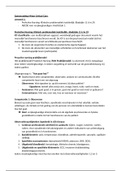
Topic 1 - lifestyle and disease
The heart and circulatory system Animals have a mass transport system to
➔ Transport sufficient quantities of move substances efficiently over long
essential substances around the body distances by mass flow
Unicellular organisms - large SA:V ratio so can rely Features of a mass transport system
on direct diffusion ● Network to move through (vessels)
Multicellular organism - smaller SA:V ratio, higher ● Transport medium for movement
metabolism, longer diffusion distance (blood)
● Controlled direction - (blood moved
Open circulatory system - heart pumps blood along pressure gradient created by the
heart and direction controlled by valves
into cavities surrounding organs and
● Speed maintenance - heart contraction
substances diffuse between blood and cells and elastic recoil of arteries maintain
pressure gradient
Closed circulatory system - blood enclosed in
network of tubes. Generates higher pressure as Single circulatory systems - animals with closed
blood is forced along narrow channels. Blood circulatory can have single or double
travels faster so more efficient ➔ One loop that includes the lungs and
body
● Blood leaves heart under high pressure Double circulatory systems - right ventricle pumps
and flows along arteries and arterioles deoxygenated blood to lungs to receive oxygen
(small arteries) to capillaries which returns to be pumped to rest of the body.
● Pass along capillaries which are in Allows faster transport
close contact with cells for exchange ➔ Blood travels faster at high pressure to the
● Then blood returns to heart by venules body to maintain metabolic rate
(small veins) and veins ➔ Blood travels slower at low pressure to the
lungs to reduce damage
,Transport medium - BLOOD
● plasma fluid is mainly water and contains dissolved substances e.g. food, oxygen, carbon
dioxide. Transports proteins, amino acids, salt, enzymes, hormones, urea
● Also carries red blood cells, white blood cells and platelets
● Blood also helps to regulate body temperature and transfers energy around the body to
distribute heat
Hydrogen bonding - holds the molecules of water together as
Water as a transport medium
positive end attracts to negative ends
A polar molecule with a dipole nature - has
unevenly distributed electrical charge Solvent properties
● Hydrogen end slightly positive ● Can dissolve other polar molecules (hydrophilic) by
● Oxygen end slightly negative interacting with charged regions and can dissolve
ionic by clustering round ions and separating them.
Non polar (hydrophobic) do not dissolve e.g. lipids
● Allows chemical reactions to occur in cells
Thermal properties
● Specific heat capacity of water (amount of energy
to raise 1 cm of water by 1c) is very high - large
amount of energy needed to break strong
hydrogen bonds.
● Water warms and cools slowly to maintain steady
temperature and avoid rapid fluctuations.
Liquid at room temperature - cohesion and adhesion from
hydrogen bonds. Water can flow easily and transport
substances
● Cohesion - attraction of water molecules to each
other
● Adhesion - water can bond to other molecules
, The heart and blood vessels
The walls of arteries and veins contain
● collagen - tough fibrous protein that
makes them strong and durable
● Elastic fibres - allows stretch and recoil
● Smooth muscle cells in endothelium -
allow constriction and dilation and also
Capillaries join arterioles and venules and are
very narrow - one cell thick permeable walls to
allow rapid and efficient exchange between
blood and tissues
The heart and circulatory system Animals have a mass transport system to
➔ Transport sufficient quantities of move substances efficiently over long
essential substances around the body distances by mass flow
Unicellular organisms - large SA:V ratio so can rely Features of a mass transport system
on direct diffusion ● Network to move through (vessels)
Multicellular organism - smaller SA:V ratio, higher ● Transport medium for movement
metabolism, longer diffusion distance (blood)
● Controlled direction - (blood moved
Open circulatory system - heart pumps blood along pressure gradient created by the
heart and direction controlled by valves
into cavities surrounding organs and
● Speed maintenance - heart contraction
substances diffuse between blood and cells and elastic recoil of arteries maintain
pressure gradient
Closed circulatory system - blood enclosed in
network of tubes. Generates higher pressure as Single circulatory systems - animals with closed
blood is forced along narrow channels. Blood circulatory can have single or double
travels faster so more efficient ➔ One loop that includes the lungs and
body
● Blood leaves heart under high pressure Double circulatory systems - right ventricle pumps
and flows along arteries and arterioles deoxygenated blood to lungs to receive oxygen
(small arteries) to capillaries which returns to be pumped to rest of the body.
● Pass along capillaries which are in Allows faster transport
close contact with cells for exchange ➔ Blood travels faster at high pressure to the
● Then blood returns to heart by venules body to maintain metabolic rate
(small veins) and veins ➔ Blood travels slower at low pressure to the
lungs to reduce damage
,Transport medium - BLOOD
● plasma fluid is mainly water and contains dissolved substances e.g. food, oxygen, carbon
dioxide. Transports proteins, amino acids, salt, enzymes, hormones, urea
● Also carries red blood cells, white blood cells and platelets
● Blood also helps to regulate body temperature and transfers energy around the body to
distribute heat
Hydrogen bonding - holds the molecules of water together as
Water as a transport medium
positive end attracts to negative ends
A polar molecule with a dipole nature - has
unevenly distributed electrical charge Solvent properties
● Hydrogen end slightly positive ● Can dissolve other polar molecules (hydrophilic) by
● Oxygen end slightly negative interacting with charged regions and can dissolve
ionic by clustering round ions and separating them.
Non polar (hydrophobic) do not dissolve e.g. lipids
● Allows chemical reactions to occur in cells
Thermal properties
● Specific heat capacity of water (amount of energy
to raise 1 cm of water by 1c) is very high - large
amount of energy needed to break strong
hydrogen bonds.
● Water warms and cools slowly to maintain steady
temperature and avoid rapid fluctuations.
Liquid at room temperature - cohesion and adhesion from
hydrogen bonds. Water can flow easily and transport
substances
● Cohesion - attraction of water molecules to each
other
● Adhesion - water can bond to other molecules
, The heart and blood vessels
The walls of arteries and veins contain
● collagen - tough fibrous protein that
makes them strong and durable
● Elastic fibres - allows stretch and recoil
● Smooth muscle cells in endothelium -
allow constriction and dilation and also
Capillaries join arterioles and venules and are
very narrow - one cell thick permeable walls to
allow rapid and efficient exchange between
blood and tissues