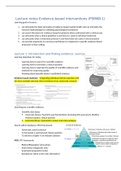
Lecture notes Evidence-based interventions (PSMKB-1)
Learning goals of course;
1. can articulate the basic principles of evidence based mental health and can articulate the
research methodology for validating psychological treatments
2. can search literature for evidence-based-treatments when confronted with a clinical case
3. can articulate what a clinical guideline is and how it is used in individual treatment
4. can articulate what a treatment protocol is and how these are used in clinical practice
5. can provide arguments to convince practitioners to implement a specific evidence-based
treatment in their setting
Lecture 1: Introduction and finding evidence: sources
Learning objectives for today;
- Learning how to search for scientific evidence
- Learning how to formulate a clinical question
- Learning how to appraise the quality of scientific evidence and
methods for improving quality
- Knowing about possible biases in published evidence
Evidence based medicine: “integrating individual clinical expertise with
the best available external clinical evidence from systematic research.”
Searching for scientific evidence;
- Scientific data bases
University library: PsychInfo and PsychArticles (including APA journals) & Medline –
Pubmed (option: clinical queries)
Cochrane library: Systematic reviews and meta-analyses
Search within databases: PICO framework
- Systematic search protocol
- To formulate a well-focused clinical question
- To retrieve a higher % of relevant citations
PICO (TT) framework;
- Patient/Population (who/what)
- Intervention (diagnostic test/
treatment/prognostic factor)
- Comparison (what is the main alternative)
, - Outcome (what are you trying to accomplish/measure/improve/effect)
- (T)ype of question (therapy/diagnosis)
- (T)ype of study (the design that is best for the question)
Example: Does psychodynamic therapy (I) help depressed individuals (P) experience reductions in
depression on the Hamilton depression scale (a clinician-administered measure) (O), that are at least
as strong as those of cognitive behavioral therapy (C)?
Evidence: operationalization
- Summary scores for RCT are helpful, but also ask…
Effect size: moderate = a few patients with large changes? many patients with smaller
changes?
Percent improved: of completers or all who entered?
Percent recovered
Sustained efficacy: what timeline was used
Control groups and what it means to say “treatment ‘x’ works”
- Types of control
No treatment
Wait-list
Treatment as usual (TAU) (=very often
substandard care)
Active control
- No treatment, wait-list, TAU
Control for passage of time
Do NOT control for common factors
(therapeutic alliance)
Do NOT control for expectation/placebo
RCT methods
- Unlike pharmacological RCTs, double-blinding is difficult
Depressed patient enrolled in a study is likely to know whether s/he is receiving the real
treatment (expectancy, placebo, hope)
Active control: expectancy very rarely assessed
Intervention provider is likely to know whether s/he is providing the real treatment
Confirmation bias= tendency to favor information that confirms our theory (beliefs, hypotheses).
Researcher allegiance= the researcher’s ‘belief in the superiority of a treatment and in the superior
validity of the theory of change that is associated with the treatment’.
Lecture 2: Synthesizing evidence: meta-analysis
Today’s topics:
1. Methods and importance of systematic reviews and meta-analyses
2. Publication bias
Systematic review and meta-analyses;
, - Collate all evidence that fits pre-specified eligibility criteria in order to answer research
question
- Minimize bias using explicit, systematic methods
- Meta-analysis= use of statistical methods to summarize the results
- Different from a traditional narrative review;
No systematically collected evidence
(possibly) not objective
No statistical summary of association
Systematic reviews are less biased than a normal review.
A disadvantage of a systematic review is that it takes a lot of time.
Two systematic reviews can have the same subject but very different conclusions due to;
- Other search terms
- Different inclusion and exclusion criteria
Why systematic reviews;
- Many studies, different results
- Overview
- Small effects
- Subgroup
- Reporting bias
Users of systematic reviews;
- Researchers
- Policy advisors guidelines
- Clinicians
Guidelines systematic reviews:
- Cochrane/Campbell
- PRISMA
Steps;
- Step 1: Research questions (PICO)
- Step 2-4: Searching (come up with search terms, searching for research)
- Step 5: Selecting studies
- Step 6: Collecting data
- Step 7: Assessing risk of bias
- Step 8: Analyzing data and meta-analysis
- Step 9: Reporting bias
Quality assessment (risk of bias); look at the individual studies included to assess the quality of the
studies.
Define research question with PICO
- Population
- Intervention/influence
- Control group/comparison
Learning goals of course;
1. can articulate the basic principles of evidence based mental health and can articulate the
research methodology for validating psychological treatments
2. can search literature for evidence-based-treatments when confronted with a clinical case
3. can articulate what a clinical guideline is and how it is used in individual treatment
4. can articulate what a treatment protocol is and how these are used in clinical practice
5. can provide arguments to convince practitioners to implement a specific evidence-based
treatment in their setting
Lecture 1: Introduction and finding evidence: sources
Learning objectives for today;
- Learning how to search for scientific evidence
- Learning how to formulate a clinical question
- Learning how to appraise the quality of scientific evidence and
methods for improving quality
- Knowing about possible biases in published evidence
Evidence based medicine: “integrating individual clinical expertise with
the best available external clinical evidence from systematic research.”
Searching for scientific evidence;
- Scientific data bases
University library: PsychInfo and PsychArticles (including APA journals) & Medline –
Pubmed (option: clinical queries)
Cochrane library: Systematic reviews and meta-analyses
Search within databases: PICO framework
- Systematic search protocol
- To formulate a well-focused clinical question
- To retrieve a higher % of relevant citations
PICO (TT) framework;
- Patient/Population (who/what)
- Intervention (diagnostic test/
treatment/prognostic factor)
- Comparison (what is the main alternative)
, - Outcome (what are you trying to accomplish/measure/improve/effect)
- (T)ype of question (therapy/diagnosis)
- (T)ype of study (the design that is best for the question)
Example: Does psychodynamic therapy (I) help depressed individuals (P) experience reductions in
depression on the Hamilton depression scale (a clinician-administered measure) (O), that are at least
as strong as those of cognitive behavioral therapy (C)?
Evidence: operationalization
- Summary scores for RCT are helpful, but also ask…
Effect size: moderate = a few patients with large changes? many patients with smaller
changes?
Percent improved: of completers or all who entered?
Percent recovered
Sustained efficacy: what timeline was used
Control groups and what it means to say “treatment ‘x’ works”
- Types of control
No treatment
Wait-list
Treatment as usual (TAU) (=very often
substandard care)
Active control
- No treatment, wait-list, TAU
Control for passage of time
Do NOT control for common factors
(therapeutic alliance)
Do NOT control for expectation/placebo
RCT methods
- Unlike pharmacological RCTs, double-blinding is difficult
Depressed patient enrolled in a study is likely to know whether s/he is receiving the real
treatment (expectancy, placebo, hope)
Active control: expectancy very rarely assessed
Intervention provider is likely to know whether s/he is providing the real treatment
Confirmation bias= tendency to favor information that confirms our theory (beliefs, hypotheses).
Researcher allegiance= the researcher’s ‘belief in the superiority of a treatment and in the superior
validity of the theory of change that is associated with the treatment’.
Lecture 2: Synthesizing evidence: meta-analysis
Today’s topics:
1. Methods and importance of systematic reviews and meta-analyses
2. Publication bias
Systematic review and meta-analyses;
, - Collate all evidence that fits pre-specified eligibility criteria in order to answer research
question
- Minimize bias using explicit, systematic methods
- Meta-analysis= use of statistical methods to summarize the results
- Different from a traditional narrative review;
No systematically collected evidence
(possibly) not objective
No statistical summary of association
Systematic reviews are less biased than a normal review.
A disadvantage of a systematic review is that it takes a lot of time.
Two systematic reviews can have the same subject but very different conclusions due to;
- Other search terms
- Different inclusion and exclusion criteria
Why systematic reviews;
- Many studies, different results
- Overview
- Small effects
- Subgroup
- Reporting bias
Users of systematic reviews;
- Researchers
- Policy advisors guidelines
- Clinicians
Guidelines systematic reviews:
- Cochrane/Campbell
- PRISMA
Steps;
- Step 1: Research questions (PICO)
- Step 2-4: Searching (come up with search terms, searching for research)
- Step 5: Selecting studies
- Step 6: Collecting data
- Step 7: Assessing risk of bias
- Step 8: Analyzing data and meta-analysis
- Step 9: Reporting bias
Quality assessment (risk of bias); look at the individual studies included to assess the quality of the
studies.
Define research question with PICO
- Population
- Intervention/influence
- Control group/comparison