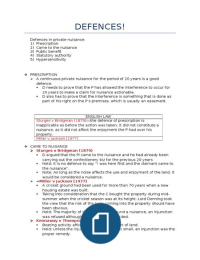
DEFENCES!
Defences in private nuisance:
1) Prescription
2) Came to the nuisance
3) Public benefit
4) Statutory authority
5) Hypersensitivity
PRESCRIPTION
A continuous private nuisance for the period of 20 years is a good
defence.
D needs to prove that the P has allowed the interference to occur for
20 years to make a claim for nuisance actionable.
D also has to prove that the interference is something that is done as
part of his right on the P’s premises, which is usually an easement.
ENGLISH LAW
Sturges v Bridgman (1879)—the defence of prescription is
inapplicable as before the action was taken, it did not constitute a
nuisance, as it did not affect the enjoyment the P had over his
property.
Miller v Jackson [1977]
CAME TO NUISANCE
Sturges v Bridgman (1879)
D argued that the Pl came to the nuisance and he had already been
carrying out the confectionery biz for the previous 20 years
Held: It is no defence to say “I was here first and the claimant came to
the nuisance”.
Note: As long as the noise affects the use and enjoyment of the land, it
would be considered a nuisance.
∞Miller v Jackson [1977]
A cricket ground had been used for more than 70 years when a new
housing estate was built.
Taking into consideration that the C bought the property during mid-
summer when the cricket season was at its height, Lord Denning took
the view that the risk of the balls coming into the property should have
been obvious.
Held: The majority of the court having found a nuisance, an injunction
was refused although damages were awarded.
Kennaway v Thompson (1980)
Boating activity affecting the Pls enjoyment of land.
Held: Unless the injury to the claimant was small, an injunction was the
proper remedy.
, PUBLIC BENEFIT
If the conduct benefits the society generally, it is more likely that the
conduct will not be deemed unreasonable. Unless, there is damage to
property or substantial interference to the plaintiff’s enjoyment of land.
English Law
Adams v Ursell (1913)—dry fish business. D argued public
benefit of community. Held that it was not a defence. The claim
for injunction is actionable by the plaintiff.
Kennaway v Thompson [1981]—even if the defendant’s
activity gives public benefit, it does not justify substantial
interference to the plaintiff. If the plaintiff suffers any physical
damage, then the plaintiff’s right to comfort and enjoyment of
land overrides any public benefit.
Dennis v Ministry of Defence (2003)—Noise interference by
RAF jets which regularly over flew the neighbouring estate
creating nuisance.
Mr. Justice Buckley held :
“that public interest clearly demands that RAF Wittering should
continue to train its pilots”. No remedy of injunction was thus
available using the common law.
Article 1 First Protocol-peaceful enjoyment of property
Noise interference by aircraft a breach of Article 8 and loss of
value of home a breach of First Protocol.
Compensation payable.
STATUTORY AUTHORITY
The D will usually escape liability notwithstanding that the activity gives
rise to interference.
However, the D has to prove that he has taken reasonably precautionary
measures to avoid the interference.( Goh Chat Ngee & 3 Ors v Toh Yan &
Anor [1991])
Defences in private nuisance:
1) Prescription
2) Came to the nuisance
3) Public benefit
4) Statutory authority
5) Hypersensitivity
PRESCRIPTION
A continuous private nuisance for the period of 20 years is a good
defence.
D needs to prove that the P has allowed the interference to occur for
20 years to make a claim for nuisance actionable.
D also has to prove that the interference is something that is done as
part of his right on the P’s premises, which is usually an easement.
ENGLISH LAW
Sturges v Bridgman (1879)—the defence of prescription is
inapplicable as before the action was taken, it did not constitute a
nuisance, as it did not affect the enjoyment the P had over his
property.
Miller v Jackson [1977]
CAME TO NUISANCE
Sturges v Bridgman (1879)
D argued that the Pl came to the nuisance and he had already been
carrying out the confectionery biz for the previous 20 years
Held: It is no defence to say “I was here first and the claimant came to
the nuisance”.
Note: As long as the noise affects the use and enjoyment of the land, it
would be considered a nuisance.
∞Miller v Jackson [1977]
A cricket ground had been used for more than 70 years when a new
housing estate was built.
Taking into consideration that the C bought the property during mid-
summer when the cricket season was at its height, Lord Denning took
the view that the risk of the balls coming into the property should have
been obvious.
Held: The majority of the court having found a nuisance, an injunction
was refused although damages were awarded.
Kennaway v Thompson (1980)
Boating activity affecting the Pls enjoyment of land.
Held: Unless the injury to the claimant was small, an injunction was the
proper remedy.
, PUBLIC BENEFIT
If the conduct benefits the society generally, it is more likely that the
conduct will not be deemed unreasonable. Unless, there is damage to
property or substantial interference to the plaintiff’s enjoyment of land.
English Law
Adams v Ursell (1913)—dry fish business. D argued public
benefit of community. Held that it was not a defence. The claim
for injunction is actionable by the plaintiff.
Kennaway v Thompson [1981]—even if the defendant’s
activity gives public benefit, it does not justify substantial
interference to the plaintiff. If the plaintiff suffers any physical
damage, then the plaintiff’s right to comfort and enjoyment of
land overrides any public benefit.
Dennis v Ministry of Defence (2003)—Noise interference by
RAF jets which regularly over flew the neighbouring estate
creating nuisance.
Mr. Justice Buckley held :
“that public interest clearly demands that RAF Wittering should
continue to train its pilots”. No remedy of injunction was thus
available using the common law.
Article 1 First Protocol-peaceful enjoyment of property
Noise interference by aircraft a breach of Article 8 and loss of
value of home a breach of First Protocol.
Compensation payable.
STATUTORY AUTHORITY
The D will usually escape liability notwithstanding that the activity gives
rise to interference.
However, the D has to prove that he has taken reasonably precautionary
measures to avoid the interference.( Goh Chat Ngee & 3 Ors v Toh Yan &
Anor [1991])