Color changes lecture (1)
● Examples of color changes:
○ Stewing of pears → caused by change in pH.
○ Maillard reaction → caused by a reaction between reducing sugars and
amino acids. Occurs at increased temperatures.
○ Heating of lobster and shrimps.
■ A lobster turns red due to a reaction between carotenoids and
proteins.
○ Meat can change from red to brown→ caused by complex formation of
hemoglobin and iron.
○ Browning of fruit → caused by the oxidation of polyphenols by the enzyme
PPO.
○ Burning of food results in a black color → caused by an extended Maillard
reaction.
○ Caramelisation → caused by sugars with a reducing end.
○ Heating of egg whithe → due to denaturation of proteins, the egg white
changes from transparent to white.
- Visible light: in between
wavelengths of 400-700nm
absorbance.
● The color that an object has, is
opposite of the color that the
material absorbs.
- White color: no absorption,
everything is reflected.
- Black color: no reflection,
everything is absorbed.
- Complementary colors: when
combined, more or less neutral
colors (white, grey, black) are
obtained.
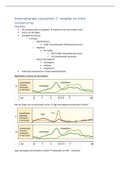
● What color in the graphs?
○ First one: a blue color is absorbed,
so the object has an orange color.
Carotenes (455 nm).
○ Second one: the object has a green
color. Chlorophyll (670 nm).
- Conjugated system: a system in which
double bonds are alternated by single
bonds.
● A small change in conjugated systems can
already make a significant change in color
perception.
,Caramelization:
● Crème brûlée. In this product, sugar is caramelized in a grill or with a torch forming a
brown top layer.
○ In ready-to-go variants, caramelized sugar is supplied in a separate sachet.
● Cotton candy.
● In the caramelization reaction there is the formation of products from reducing
sugars (upon melting of the sugar or the heating of sugar syrup) in the presence of
acidic or alkaline catalysts, low water activity and a high temperature.
○ It leads to brown-colored substances and aroma compounds.
● Caramelization is a form of non-enzymatic browning, which is extensively used in
cooking.
● Caramelization is a set of different reactions, including:
○ Enolizations (acidic pH).
○ Dehydrations (acidic pH).
○ Oxidation (basic pH).
○ Fission (basic pH).
○ Aldol condensation (basic pH).
- Reducing sugar: sugar that has an aldehyde or ketone group. Ketose → C=O group
at C2. Aldehyde → C=O group at C1.
● The C=O bond breaks open and turns into a COH group. Both β and α variants exist.
○ There are less α variants, since these molecules allow for more steric
hindrance.
● There are differences in caramelization temperatures for different monosaccharides.
○ Fructose forms a C5 ring (furanose) → it has more resistance in its structure
→ easier to break → less energy needed to break → lower temperature
required.
● Maltose and sucrose are both disaccharides.Glycosidic bonds in disaccharides seem
to slow down the reaction.
, ○ The caramelization temperature of maltose is higher than for sucrose, since
sucrose contains a C5 ring (furanose).
1. Enolization:
● This is the first reaction of
caramelization.
● Occurs at both a low pH
and high pH, but occurs
way faster at a basic pH.
● There is a shift of the
double bond to form an
enediol. This reaction can
proceed continuously.
● Re-arrangements increase the molecular diversity.
● At a low pH, the dehydration reaction (second step) occurs very fast. Therefore,
enolization will not be so elaborate. The enolization reaction will not be complete.
Only the 1,2-enediol will be formed.
2. Dehydration:
● There is the removal of water molecules, which occurs in an acidic media.
● The 1,2-enediol is dehydrated (2 molecules of water) → a structure is formed with a
dicarbonyl group.
○ Dicarbonyl groups are very reactive!
● The dicarbonyl group will react to form a cyclic product that continues to lose water
(HMF).
● The same reaction is also possible starting with a 2,3-enediol (instead of
1,2-enediol). Again there is the removal of 2 water molecules. A dicarbonyl
compound is formed → cyclation → removal of water → 2-hydroxyacetyl furan.
● Alternatively, starting with 2,3-enediol, a reversed dehydration reaction is possible.
You then end up with maltol.
● Examples of color changes:
○ Stewing of pears → caused by change in pH.
○ Maillard reaction → caused by a reaction between reducing sugars and
amino acids. Occurs at increased temperatures.
○ Heating of lobster and shrimps.
■ A lobster turns red due to a reaction between carotenoids and
proteins.
○ Meat can change from red to brown→ caused by complex formation of
hemoglobin and iron.
○ Browning of fruit → caused by the oxidation of polyphenols by the enzyme
PPO.
○ Burning of food results in a black color → caused by an extended Maillard
reaction.
○ Caramelisation → caused by sugars with a reducing end.
○ Heating of egg whithe → due to denaturation of proteins, the egg white
changes from transparent to white.
- Visible light: in between
wavelengths of 400-700nm
absorbance.
● The color that an object has, is
opposite of the color that the
material absorbs.
- White color: no absorption,
everything is reflected.
- Black color: no reflection,
everything is absorbed.
- Complementary colors: when
combined, more or less neutral
colors (white, grey, black) are
obtained.
● What color in the graphs?
○ First one: a blue color is absorbed,
so the object has an orange color.
Carotenes (455 nm).
○ Second one: the object has a green
color. Chlorophyll (670 nm).
- Conjugated system: a system in which
double bonds are alternated by single
bonds.
● A small change in conjugated systems can
already make a significant change in color
perception.
,Caramelization:
● Crème brûlée. In this product, sugar is caramelized in a grill or with a torch forming a
brown top layer.
○ In ready-to-go variants, caramelized sugar is supplied in a separate sachet.
● Cotton candy.
● In the caramelization reaction there is the formation of products from reducing
sugars (upon melting of the sugar or the heating of sugar syrup) in the presence of
acidic or alkaline catalysts, low water activity and a high temperature.
○ It leads to brown-colored substances and aroma compounds.
● Caramelization is a form of non-enzymatic browning, which is extensively used in
cooking.
● Caramelization is a set of different reactions, including:
○ Enolizations (acidic pH).
○ Dehydrations (acidic pH).
○ Oxidation (basic pH).
○ Fission (basic pH).
○ Aldol condensation (basic pH).
- Reducing sugar: sugar that has an aldehyde or ketone group. Ketose → C=O group
at C2. Aldehyde → C=O group at C1.
● The C=O bond breaks open and turns into a COH group. Both β and α variants exist.
○ There are less α variants, since these molecules allow for more steric
hindrance.
● There are differences in caramelization temperatures for different monosaccharides.
○ Fructose forms a C5 ring (furanose) → it has more resistance in its structure
→ easier to break → less energy needed to break → lower temperature
required.
● Maltose and sucrose are both disaccharides.Glycosidic bonds in disaccharides seem
to slow down the reaction.
, ○ The caramelization temperature of maltose is higher than for sucrose, since
sucrose contains a C5 ring (furanose).
1. Enolization:
● This is the first reaction of
caramelization.
● Occurs at both a low pH
and high pH, but occurs
way faster at a basic pH.
● There is a shift of the
double bond to form an
enediol. This reaction can
proceed continuously.
● Re-arrangements increase the molecular diversity.
● At a low pH, the dehydration reaction (second step) occurs very fast. Therefore,
enolization will not be so elaborate. The enolization reaction will not be complete.
Only the 1,2-enediol will be formed.
2. Dehydration:
● There is the removal of water molecules, which occurs in an acidic media.
● The 1,2-enediol is dehydrated (2 molecules of water) → a structure is formed with a
dicarbonyl group.
○ Dicarbonyl groups are very reactive!
● The dicarbonyl group will react to form a cyclic product that continues to lose water
(HMF).
● The same reaction is also possible starting with a 2,3-enediol (instead of
1,2-enediol). Again there is the removal of 2 water molecules. A dicarbonyl
compound is formed → cyclation → removal of water → 2-hydroxyacetyl furan.
● Alternatively, starting with 2,3-enediol, a reversed dehydration reaction is possible.
You then end up with maltol.