Summary Vaccine
1. Introduction
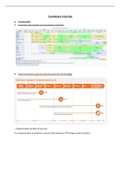
A. Currently used vaccines and vaccination schedules:
B. Vaccine discovery: general overview and some terminology:
= Target product profiles of vaccines
If a company want to produce a vaccine they develop a TPP (target product profile).
,C. Novel technologies:
The structure of covid
was already know
because of the first SARS
virus outbreak in the
early 2000. That is why
the vaccine of COVID-19
was produced very fast.
Internet-based vaccinology: you can put the sequence of an organism online and order vaccines. Viral
vector gene is that you use a virus as a vector, you get rid of everything you don’t need and put in the
thing that needs to be expressed.
Other novel technologies:
- PLLAV technology
- mRNA technology
- Targeted attenuation
o Based on virus biology
o Codon de-optimization
2
,D. A short history of vaccination
1) Vaccines are a ‘recent invention’
Compared the thousands of years that humans have suffered major epidemics. Vaccination only
started to be effectively used in the 20th century in a structured manner:
o Several vaccines developed
o Routine vaccinations introduced
o Large populations vaccinated
With the exception of safe water, no other intervention, not
even antibiotics, has had such a major effect on mortality
reduction and population growth.
2) Epidemics – Pandemics
These are the plagues that shaped the industry/world. The
first plagues started due to the increase in travel and that is
also know the reason that a plague starts.
3
, 3) Vaccines are a recent invention: Before vaccines…
The practice of quarantine began during the 14th century, to protect coastal cities from plague
epidemics. Port authorities required ships arriving in Venice from infected ports to sit at anchor for 40
days before landing. The origin of the word quarantine from the Italian “quaranta giorni”, or 40 days.
One of the first instances of relying on geography and statistical analysis was in mid-19th century
London, during a cholera outbreak. In 1854, Dr. John Snow came to the conclusion that cholera was
spreading via tainted water and decided to display neighborhood mortality data directly on a map. This
method revealed a cluster of cases around a specific water pump.
4
1. Introduction
A. Currently used vaccines and vaccination schedules:
B. Vaccine discovery: general overview and some terminology:
= Target product profiles of vaccines
If a company want to produce a vaccine they develop a TPP (target product profile).
,C. Novel technologies:
The structure of covid
was already know
because of the first SARS
virus outbreak in the
early 2000. That is why
the vaccine of COVID-19
was produced very fast.
Internet-based vaccinology: you can put the sequence of an organism online and order vaccines. Viral
vector gene is that you use a virus as a vector, you get rid of everything you don’t need and put in the
thing that needs to be expressed.
Other novel technologies:
- PLLAV technology
- mRNA technology
- Targeted attenuation
o Based on virus biology
o Codon de-optimization
2
,D. A short history of vaccination
1) Vaccines are a ‘recent invention’
Compared the thousands of years that humans have suffered major epidemics. Vaccination only
started to be effectively used in the 20th century in a structured manner:
o Several vaccines developed
o Routine vaccinations introduced
o Large populations vaccinated
With the exception of safe water, no other intervention, not
even antibiotics, has had such a major effect on mortality
reduction and population growth.
2) Epidemics – Pandemics
These are the plagues that shaped the industry/world. The
first plagues started due to the increase in travel and that is
also know the reason that a plague starts.
3
, 3) Vaccines are a recent invention: Before vaccines…
The practice of quarantine began during the 14th century, to protect coastal cities from plague
epidemics. Port authorities required ships arriving in Venice from infected ports to sit at anchor for 40
days before landing. The origin of the word quarantine from the Italian “quaranta giorni”, or 40 days.
One of the first instances of relying on geography and statistical analysis was in mid-19th century
London, during a cholera outbreak. In 1854, Dr. John Snow came to the conclusion that cholera was
spreading via tainted water and decided to display neighborhood mortality data directly on a map. This
method revealed a cluster of cases around a specific water pump.
4